NorrChemica™
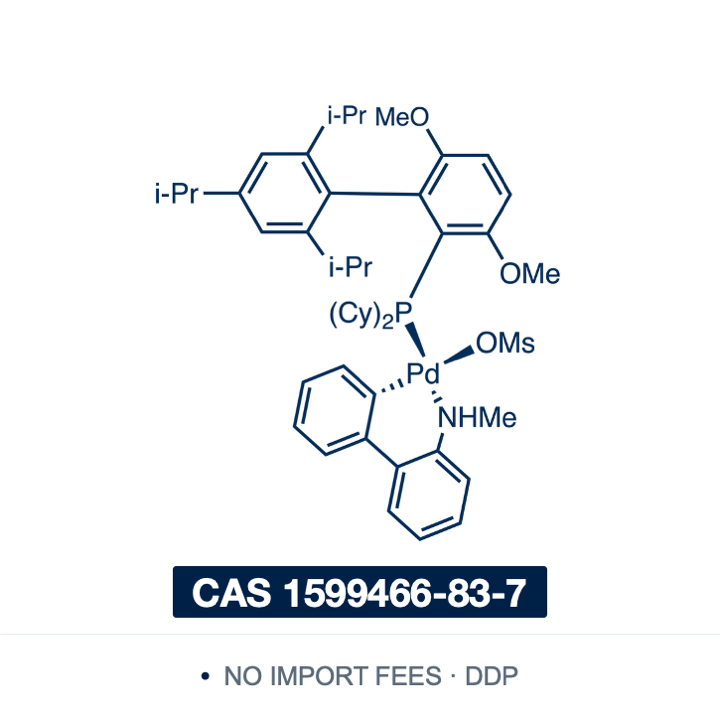
BrettPhos Pd G4
BrettPhos Pd G4 | CAS 1599466-83-7 | ≥98%
Couldn't load pickup availability
Technical Specifications
| CAS Number | 1599466-83-7 |
| EC / EINECS Number | 813-487-7 |
| MDL Number | MFCD29917502 |
| SMILES | CC(C)C1=CC(=C(C(=C1)C(C)C)C2=C(C=CC(=C2P(C3CCCCC3)C4CCCCC4)OC)OC)C(C)C.CNC1=CC=CC=C1C2=CC=CC=[C-]2.CS(=O)(=O)O.[Pd] |
| InChI | InChI=1S/C35H53O2P.C13H12N.CH4O3S.Pd/c1-23(2)26-21-29(24(3)4)33(30(22-26)25(5)6)34-31(36-7)19-20-32(37-8)35(34)38(27-15-11-9-12-16-27)28-17-13-10-14-18-28;1-14-13-10-6-5-9-12(13)11-7-3-2-4-8-11;1-5(2,3)4;/h19-25,27-28H,9-18H2,1-8H3;2-7,9-10,14H,1H3;1H3,(H,2,3,4);/q;-1;; |
| InChIKey | YGIUDYZKEHOKOY-UHFFFAOYSA-N |
| PubChem CID | 124203001 |
| Molecular Formula | C₄₉H₆₉NO₅PPdS⁻ |
| Molecular Weight | 921.5 g/mol |
| Melting Point | 146–151 °C (dec.) |
| Solubility | Soluble in polar organic solvents including methanol and dimethyl sulfoxide |
| Purity | ≥98% |
| Physical Form | White to off-white solid powder |
| HS Code | 2843.90 |
| Shelf Life | Retest period: 36 months from date of manufacture |
| Storage Conditions | Relatively stable in air for weighing and handling. Store refrigerated (2–8 °C) in a tightly closed container, protected from light and under inert gas (N₂ or Ar). |
| SDS / CoA | Download PDF |
Product Description & Scientific Applications
BrettPhos Pd G4 is CAS 1599466-83-7, C₄₉H₆₉NO₅PPdS⁻ at 921.5 g/mol, its formula carrying one phosphorus and one palladium. The free ligand alone is 536.8 g/mol against 921.5 for this complex. On activation it releases N-methylcarbazole, eliminating termination by free carbazole.
Applications and Reactions
- Buchwald-Hartwig amination. The dominant documented use, in pharmaceutical process routes. Aminopyrimidine and aminopyridine nucleophiles have been coupled to chloropyridine and aryl bromide electrophiles. Caesium carbonate, potassium carbonate and potassium tert-butoxide have all served as base, in dioxane, in dioxane with tert-butanol, or in toluene.
- Chemoselective amidation of dihaloarenes. A primary amide has been coupled to a bromochloroarene with complete chemoselectivity, using aqueous tripotassium phosphate with dioxane.
- Continuous flow. Its improved solubility in organic solvents suits a flow process, where it was the best of the catalysts screened.
Why the scaffold changed. Sterically demanding ligands including this one do not react with the chloride-bridged second-generation dimer. The mesylate-bridged dimer is cleaved by this ligand in high yield.
What the generation changes. The carbazole released on third-generation activation can act as a competitive substrate, leaving trace impurities. In some cases that carbazole formation inhibits catalyst performance. A precatalyst releasing an N-substituted carbazole would address both concerns. The N-methyl and N-phenyl analogues of the third-generation complex give the later species.
Activation. The third-generation form of this ligand generates its zerovalent palladium complex and free carbazole.
Further reading: Choosing a phosphine ligand for cross-coupling, a practical guide
Shipping Destinations
- EU & UK: Priority delivery, 2–5 business days.
- United States (DDP): 3–7 business days, duties and taxes prepaid.
- EFTA Countries (DDP): 3–7 business days, duties and taxes prepaid.
- Worldwide: 7–14 business days, selected locations.
Safety Information
| GHS Pictograms |

|
| Signal Word | Warning |
| Hazard Class | Not regulated for transport |
| Transport Category | Not classified as dangerous goods for transport (ADR/IATA/IMDG) |
| H-Statements | H315 - H319 - H335 |
| P-Statements | P273 - P302+P352 - P305+P351+P338 |
Documentation
| Safety Data Sheet | Download PDF |