NorrChemica™
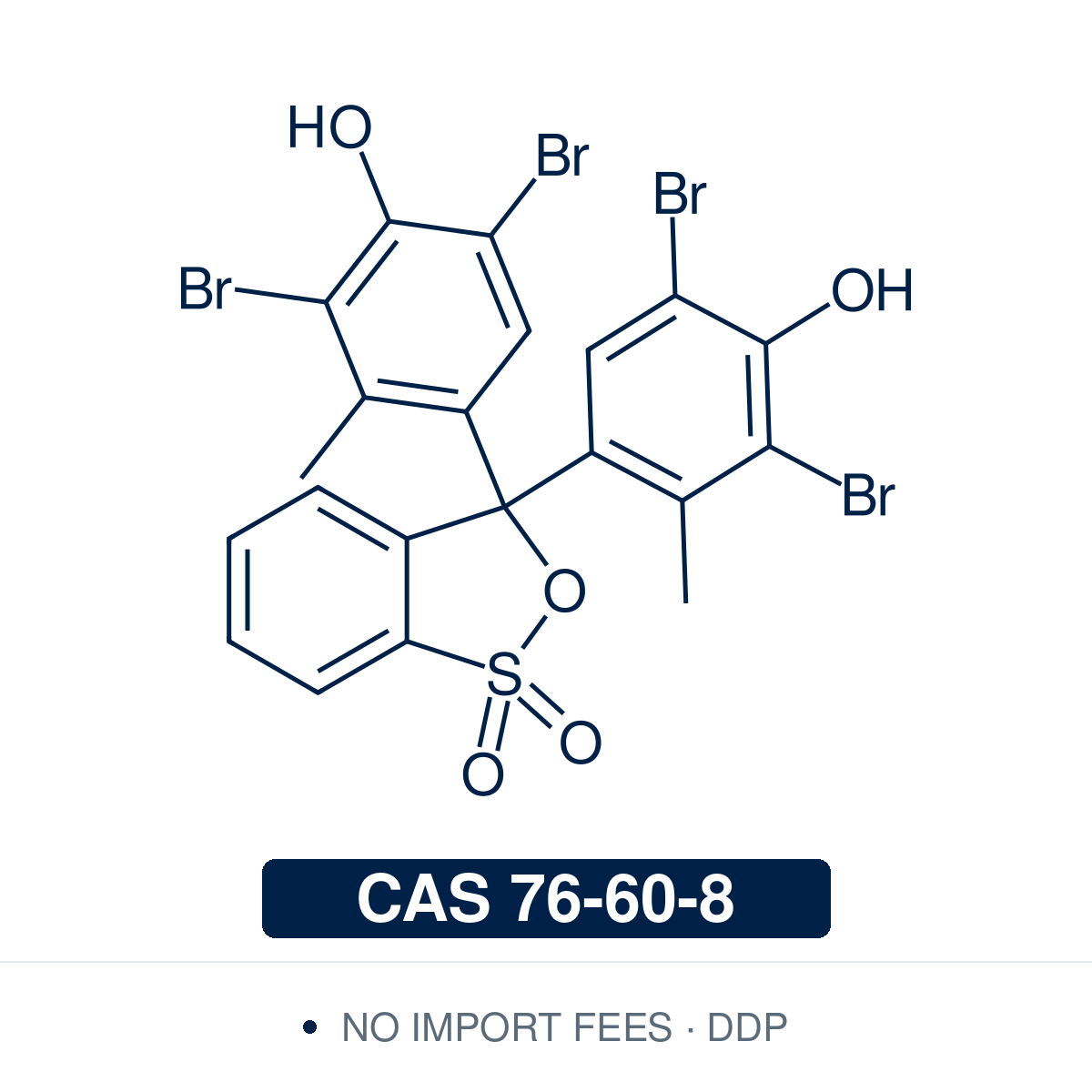
Bromocresol Green
Bromocresol Green | CAS 76-60-8 | Indicator Grade
Pack sizes & prices
| Pack size | Excl. VAT | Incl. VAT | Add to cart |
|---|---|---|---|
| 5.0 g | €39,20 | ||
| 10 g | €54,20 | ||
| 25 g | €74,20 | ||
| 50 g | €109,20 | ||
| 100 g | €149,20 | ||
| 500 g | €589,20 |
Taxes and fees, e.g. VAT, included in the price. Shipping calculated at checkout.Free shipping on EU, UK and EFTA orders above €250, and above €400 to the rest of the world.
Technical Specifications
| CAS Number | 76-60-8 |
| EC / EINECS Number | 200-972-8 |
| MDL Number | MFCD00005874 |
| SMILES | CC1=C(C(=C(C=C1C2(C3=CC=CC=C3S(=O)(=O)O2)C4=CC(=C(C(=C4C)Br)O)Br)Br)O)Br |
| InChI | InChI=1S/C21H14Br4O5S/c1-9-12(7-14(22)19(26)17(9)24)21(13-8-15(23)20(27)18(25)10(13)2)11-5-3-4-6-16(11)31(28,29)30-21/h3-8,26-27H,1-2H3 |
| InChIKey | FRPHFZCDPYBUAU-UHFFFAOYSA-N |
| PubChem CID | 6451 |
| Molecular Formula | C₂₁H₁₄Br₄O₅S |
| Molecular Weight | 698.01 g/mol |
| Melting Point | 225 °C (dec.) |
| Transition Range | pH 3.8 (yellow) to pH 5.4 (blue) |
| Solubility | Soluble in ethanol, diethyl ether and ethyl acetate. Poorly soluble in water. |
| Purity | Indicator Grade |
| Physical Form | Yellow to light brown powder |
| HS Code | 2934.99 |
| Shelf Life | Retest period: 36 months from date of manufacture |
| Storage Conditions | Store in a cool, dry place in a tightly sealed container. |
Product Description & Scientific Applications
Bromocresol green (tetrabromo-m-cresolsulfonphthalein, BCG) is a sulfonphthalein pH indicator. Its colour changes from yellow at pH 3.8 to blue at pH 5.4, and it is green at about pH 4.5. Its pKa is about 4.8.
How the colour changes. In the yellow form, the sulfonate group is ionised but the phenol is not. When the phenol also loses its proton, the dianion is blue. The two forms absorb at clearly different wavelengths, so the colour can also be measured by absorbance.
The yellow monoanion loses the phenolic proton to give the blue dianion.
Acid–base titrations. Bromocresol green is used as a visual indicator in acid–base titrations. For example, the ISO standard method for the total acidity of industrial hydrochloric acid titrates the acid with sodium hydroxide in its presence.
Serum albumin. In the bromocresol green method, albumin binds the dye in an acidic buffer, and the absorbance of the bound dye gives the albumin concentration. The method is simple and fast. It reads albumin higher than electrophoresis and immunoassay do, because the dye also binds some globulins, including acute-phase proteins. For this reason some laboratories use bromocresol purple instead.
Ion-pair methods for basic drugs. In an acidic buffer, protonated basic drugs form yellow ion pairs with the dye anion. The ion pair is extracted into chloroform or dichloromethane and measured by absorbance. This gives simple assays for drugs in tablets and capsules.
A protonated amine drug (R₃NH⁺) pairs with the yellow dye anion, and the ion pair passes into the organic layer.
Shipping Destinations
- EU & UK: Priority delivery, 2–5 business days.
- United States (DDP): 3–7 business days, duties and taxes prepaid.
- EFTA Countries (DDP): 3–7 business days, duties and taxes prepaid.
- Worldwide: 7–14 business days, selected locations.
Safety Information
| Hazard Class | Not classified as dangerous goods |
| Transport Category | Not dangerous goods (ADR/IATA/IMDG) |
Documentation
| Safety Data Sheet | Download PDF |
Share