NorrChemica™
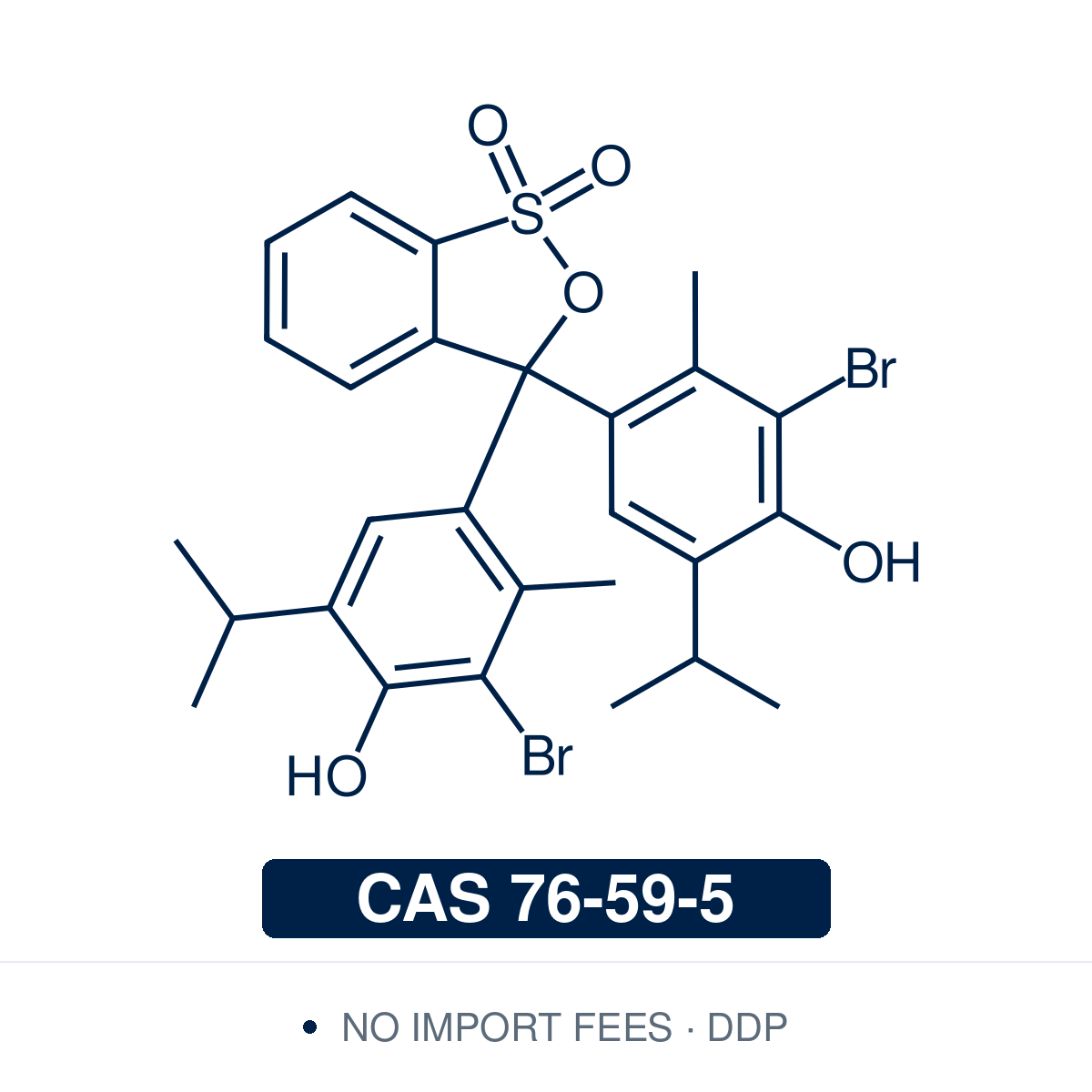
Bromothymol Blue
Bromothymol Blue | CAS 76-59-5 | ≥99%
Couldn't load pickup availability
Technical Specifications
| CAS Number | 76-59-5 |
| EC / EINECS Number | 200-971-2 |
| MDL Number | MFCD00005872 |
| RTECS Number | SJ7450000 |
| SMILES | CC1=C(C=C(C(=C1Br)O)C(C)C)C2(C3=CC=CC=C3S(=O)(=O)O2)C4=C(C(=C(C(=C4)C(C)C)O)Br)C |
| InChI | InChI=1S/C27H28Br2O5S/c1-13(2)17-11-20(15(5)23(28)25(17)30)27(19-9-7-8-10-22(19)35(32,33)34-27)21-12-18(14(3)4)26(31)24(29)16(21)6/h7-14,30-31H,1-6H3 |
| InChIKey | NUHCTOLBWMJMLX-UHFFFAOYSA-N |
| PubChem CID | 6450 |
| Molecular Formula | C₂₇H₂₈Br₂O₅S |
| Molecular Weight | 624.38 g/mol |
| Melting Point | 202 °C |
| Solubility | Sparingly soluble in water; soluble in ethanol, ether, and aqueous alkali solutions; insoluble in petroleum ether. |
| Purity | ≥99% |
| Physical Form | Red to purple powder |
| HS Code | 2934.99 |
| Shelf Life | Retest period: 36 months from date of manufacture. |
| Storage Conditions | Store in a cool, dry place in a tightly sealed container, protected from light and moisture. |
Product Description & Scientific Applications
Bromothymol Blue is a sulfonephthalein dye and a pH indicator. Its colour comes from a central lactoid ring that opens to a quinoid tautomer while the sulfonic acid group stays dissociated; the two tautomers sit in equilibrium, with the quinoid form predominating. As an indicator the dye behaves as a weak acid with a single ionization, so one pKₐ governs its colour change. A spectrophotometric determination places that pKₐ at 7.52, near neutral pH. As pH rises the dye deprotonates and its colour passes from yellow through green to blue, with visible absorption maxima at 433 nm and 617 nm. It is also used as a biological stain.
Optical pH sensing. The dye is read both in solution and immobilised on solid supports. It has been built into an integrated opto-microfluidic device that monitors the pH of a liquid flowing through a microchannel in real time, and anchored onto cellulose fibres carrying grafted quaternary-ammonium groups to give a non-leaching material that changes colour across pH 4–8 for indicating pH changes in food.
Gas sensing. Entrapped on washable threads alongside other colorimetric dyes, it features in a smartphone-read system that senses ammonia and hydrogen chloride vapours from 50 to 1000 ppm, as well as dissolved ammonia, in a format aimed at smart textiles.
Phospholipase A₂ assay. Because its colour tracks pH, Bromothymol Blue also follows reactions that change the pH of their medium. One method uses it to assay phospholipase A₂, an enzyme that hydrolyses the sn-2 ester bond of phospholipids held in liposomes or in mixed micelles with Triton X-100. The dye reports the resulting pH change, which yields the kinetic parameters of the IB and IIA isozymes and screens inhibitors by UV-visible spectrophotometry under near-physiological conditions.
Extractive spectrophotometry. As an anionic dye, Bromothymol Blue pairs with protonated, nitrogen-containing compounds to form 1:1 ion-pair complexes. These complexes extract into chloroform and absorb near 410–415 nm, the basis of extractive spectrophotometric methods that determine basic analytes, including pharmaceuticals, in pure form and in formulations.
Shipping Destinations
- EU & UK: Priority delivery, 2–5 business days.
- United States (DDP): 3–7 business days, duties and taxes prepaid.
- EFTA Countries (DDP): 3–7 business days, duties and taxes prepaid.
- Worldwide: 7–14 business days, selected locations.
Safety Information
| Hazard Class | None — not subject to transport regulations |
| Transport Category | Not classified as dangerous goods for transport (ADR/IATA/IMDG) |
Documentation
| Safety Data Sheet | Download PDF |
Share