NorrChemica™
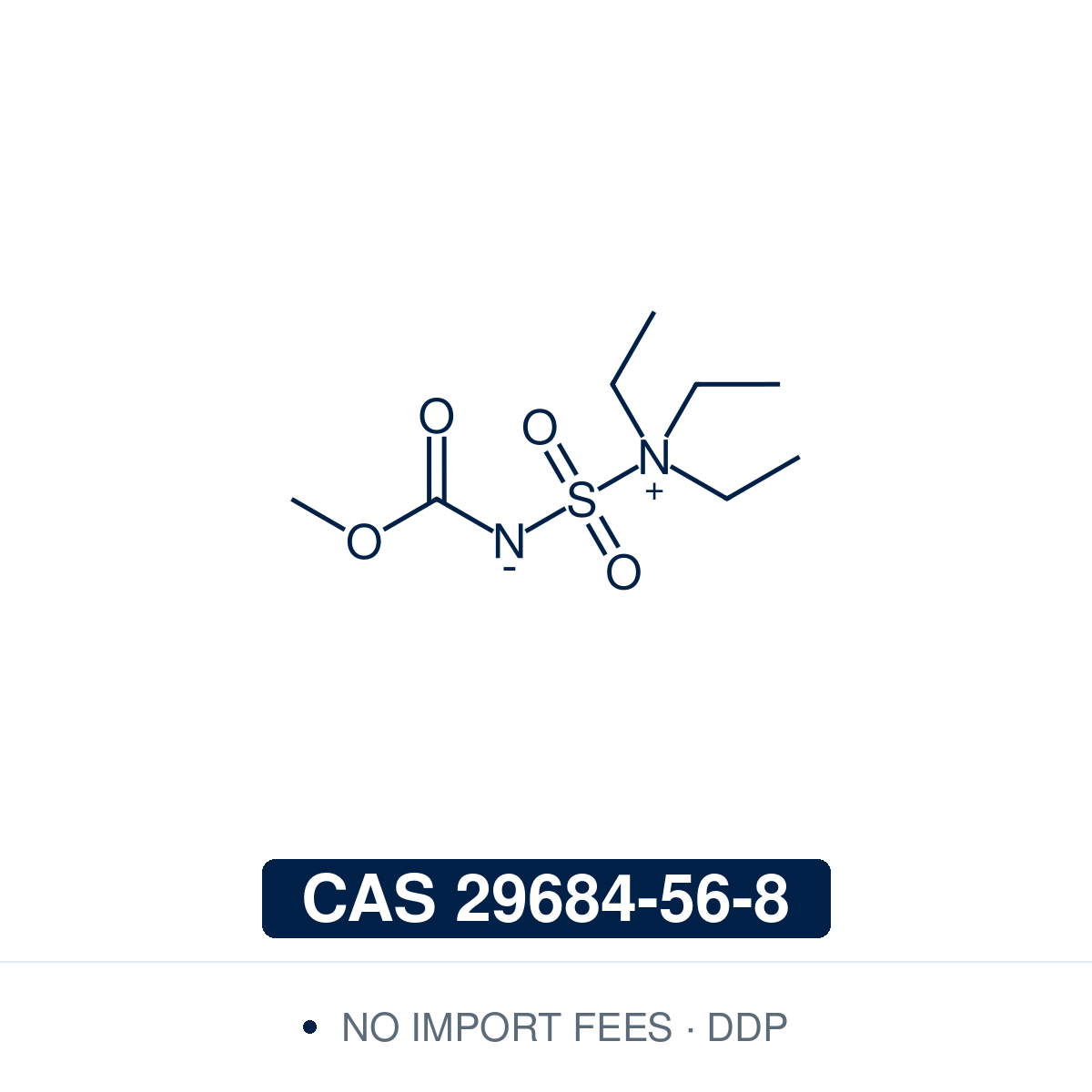
Burgess reagent
CAS 29684-56-8
≥95%
Burgess reagent | CAS 29684-56-8 | ≥95%
Regular price
€34,20 EUR (incl. VAT)
Regular price
Sale price
€34,20 EUR
Taxes included.
Shipping calculated at checkout.
Quantity
Couldn't load pickup availability
Technical Specifications
| CAS Number | 29684-56-8 |
| EC / EINECS Number | 629-648-8 |
| MDL Number | MFCD00077815 |
| SMILES | CC[N+](CC)(CC)S(=O)(=O)/N=C(\[O-])/OC |
| InChI | InChI=1S/C8H18N2O4S/c1-5-10(6-2,7-3)15(12,13)9-8(11)14-4/h5-7H2,1-4H3 |
| InChIKey | YSHOWEKUVWPFNR-UHFFFAOYSA-N |
| PubChem CID | 9566069 |
| Molecular Formula | C₈H₁₈N₂O₄S |
| Molecular Weight | 238.31 g/mol |
| Melting Point | 76-79 °C (lit.) |
| Solubility | Soluble in organic solvents such as tetrahydrofuran; moisture-sensitive, reacts with water. |
| Purity | ≥95% |
| Physical Form | White to light yellow crystalline powder |
| HS Code | 2935.90 |
| Shelf Life | Retest period: 36 months from date of manufacture |
| Storage Conditions | Store tightly closed. Recommended storage temperature -20 °C |
Product Description & Scientific Applications
The Burgess reagent, [methoxycarbonylsulfamoyl]triethylammonium hydroxide inner salt, is a mild dehydrating agent that removes water under mild, near-neutral conditions tolerant of acid-sensitive functionality. That mildness, and the absence of carbocation character in its key step, define its use.
Applications
- Alcohol-to-alkene dehydration (the defining use) — secondary and tertiary alcohols are dehydrated to alkenes: the alcohol is first converted to an alkyl N-carbomethoxysulfamate ester, which undergoes a first-order thermolytic Ei decomposition — a cis-stereospecific (syn) elimination. Because the transition state imposes a cis-β-hydrogen geometrical constraint and lacks α-carbon carbonium-ion character, the elimination is free of skeletal rearrangements and therefore predictable, a strategically useful step in directed synthesis. Primary alcohols give carbamates (urethanes) instead.
- Oxazoline formation (cyclodehydration) — β-hydroxy amides close to oxazolines, the ring-forming step toward the oxazole- and thiazole-containing cyclic peptides dendroamide A and balgacyclamide A. The oxazole itself is completed by a subsequent DBU-assisted oxidation that aromatises the oxazoline; cyclodehydration alone gives the oxazoline, not the oxazole.
- N-Bridged bicyclic pyridines — the same dehydrative cyclisation assembles N-bridged 5,6-bicyclic pyridines (pyrrolo-, imidazo- and triazolopyridines) under mild and neutral conditions that tolerate acid-sensitive groups.
- Oxabicyclic scaffolds — under acidic conditions, the reagent converts δ-diols to oxabicyclo[3.2.1]octan-3-ol scaffolds by dehydrative cyclisation.
- Amide-to-nitrile dehydration — dehydration of a primary amide to the corresponding nitrile, applied on manufacturing scale in the original route to the antiviral nirmatrelvir, where the reagent effects the amide-to-nitrile dehydration in dichloromethane.
- Alcohol oxidation (with DMSO) — beyond dehydration, in the presence of dimethyl sulfoxide the reagent oxidises a broad range of primary and secondary alcohols to the corresponding aldehydes and ketones by a mechanism related to the Pfitzner-Moffatt and Swern oxidations.
Shipping Destinations
- EU & UK: Priority delivery, 2–5 business days.
- United States (DDP): 3–7 business days, duties and taxes prepaid.
- EFTA Countries (DDP): 3–7 business days, duties and taxes prepaid.
- Worldwide: 7–14 business days, selected locations.
Safety Information
| GHS Pictograms |

|
| Signal Word | Warning |
| Hazard Class | Not regulated for transport |
| Transport Category | Not classified as dangerous goods for transport (ADR/IATA/IMDG) |
| H-Statements | H315 - H319 - H335 |
| P-Statements | P261 - P264 - P271 - P280 - P302+P352 - P304+P340 - P305+P351+P338 - P312 - P321 - P332+P313 - P337+P313 - P362+P364 - P403+P233 - P405 - P501 |
Documentation
| Safety Data Sheet | Download PDF |