NorrChemica™
Calcein
Calcein | CAS 1461-15-0 | Indicator Grade
Pack sizes & prices
| Pack size | Excl. VAT | Incl. VAT | Add to cart |
|---|---|---|---|
| 5.0 g | €29,20 | ||
| 10 g | €49,20 | ||
| 25 g | €74,20 | ||
| 50 g | €139,20 | ||
| 100 g | €229,00 |
Taxes and fees, e.g. VAT, included in the price. Shipping calculated at checkout.Free shipping on EU, UK and EFTA orders above €250, and above €400 to the rest of the world.
Technical Specifications
| CAS Number | 1461-15-0 |
| EC / EINECS Number | 215-957-1 |
| MDL Number | MFCD00005049 |
| SMILES | C1=CC=C2C(=C1)C(=O)OC23C4=C(C=C(C(=C4)CN(CC(=O)O)CC(=O)O)O)OC5=C3C=C(C(=C5)O)CN(CC(=O)O)CC(=O)O |
| InChI | InChI=1S/C30H26N2O13/c33-21-7-23-19(5-15(21)9-31(11-25(35)36)12-26(37)38)30(18-4-2-1-3-17(18)29(43)45-30)20-6-16(22(34)8-24(20)44-23)10-32(13-27(39)40)14-28(41)42/h1-8,33-34H,9-14H2,(H,35,36)(H,37,38)(H,39,40)(H,41,42) |
| InChIKey | DEGAKNSWVGKMLS-UHFFFAOYSA-N |
| PubChem CID | 65079 |
| Molecular Formula | C₃₀H₂₆N₂O₁₃ |
| Molecular Weight | 622.5 g/mol |
| Solubility | Soluble in aqueous alkali (e.g. 1 M KOH or NaOH); sparingly soluble in neutral aqueous buffer; poorly soluble in water at low pH, solubility increasing with pH. |
| Purity | Indicator Grade |
| Physical Form | Yellow to brown powder |
| HS Code | 2932.20 |
| Shelf Life | Retest period: 36 months from date of manufacture |
| Storage Conditions | Store in a cool, dry place in a tightly sealed container, protected from light. |
| SDS / CoA | Download PDF |
Product Description & Scientific Applications
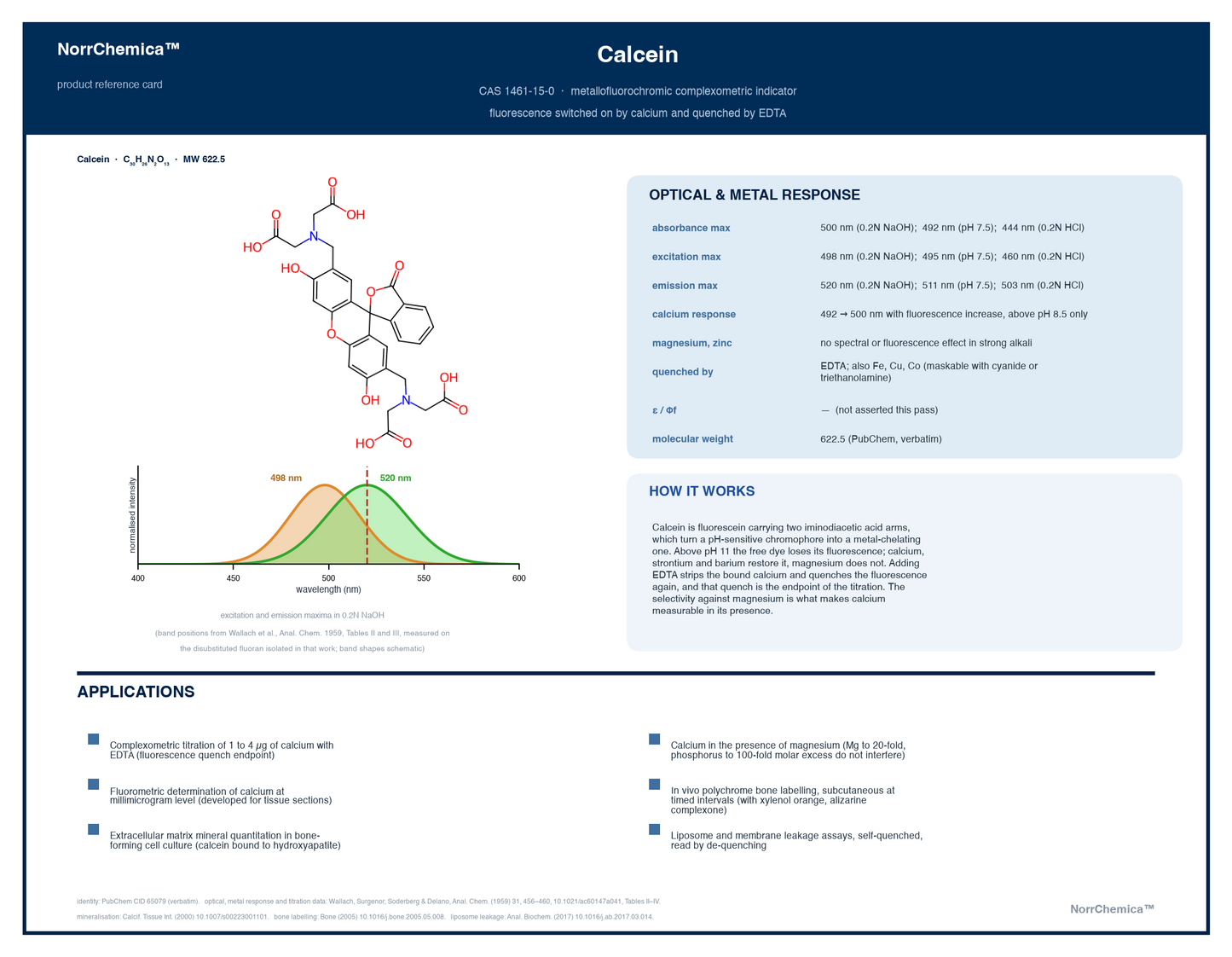
Calcein is 3,6-dihydroxy-2,4-bis-[N,N'-di-(carboxymethyl)-aminomethyl]fluoran, obtained by condensing fluorescein with formaldehyde and iminodiacetic acid. The two iminodiacetic acid groups turn the pH-sensitive fluorescein chromophore into a metal-chelating one, and binding of alkaline earth metals produces marked increases in fluorescence. Above pH 11 the fluorescence is lost; calcium, strontium and barium restore it, magnesium does not, and the metal-sensitive fluorescence is quenched by EDTA.
Optical properties. The absorbance maximum is 444 nm in 0.2N HCl, 492 nm at pH 7.5 and 500 nm in 0.2N NaOH. Activation and emission track the same protonation changes: 460 and 503 nm in acid, 495 and 511 nm at pH 7.5, and 498 and 520 nm in alkali, the emission moving from 503 to 511 nm as the 3-hydroxyl dissociates and from 511 to 520 nm as the 6-hydroxyl follows. Calcium is bound even at neutral pH, but the shift of the 492 nm band to 500 nm and the accompanying rise in fluorescence appear only above pH 8.5, with the emission maximum unchanged. Magnesium and zinc give no spectral or fluorescence effect in strong alkali.
Applications
- Fluorescent indicator for the complexometric titration of 1 to 4 µg of calcium, the EDTA-induced fluorescence quench serving as the endpoint.
- Fluorometric determination of calcium in millimicrogram quantities, developed for calcium in microscopic sections of normal and malignant tissue.
- Calcium in the presence of magnesium: magnesium up to 20-fold molar excess and phosphorus up to 100-fold molar excess do not interfere, nor do sodium and potassium, nor zinc at elevated pH. Barium and strontium titrate with calcium.
- Iron, copper and cobalt quench the fluorescence but can be masked with cyanide or triethanolamine.
- Direct quantitation of extracellular matrix mineral content in cultures of bone-forming cells, by fluorescence of calcein bound to calcium phosphate as hydroxyapatite.
- Fluorescent reporter in liposome and membrane leakage assays read by fluorescence de-quenching, for example cytochrome c and hydrogen-peroxide-induced membrane permeabilisation.
- Sequential in vivo polychrome labelling of bone formation and remodelling, administered subcutaneously at timed intervals alongside xylenol orange and alizarine complexone.
- Dissolution for use is in dilute alkali, with potassium hydroxide preferred for its low alkaline earth content.
Shipping Destinations
- EU & UK: Priority delivery, 2–5 business days.
- United States (DDP): 3–7 business days, duties and taxes prepaid.
- EFTA Countries (DDP): 3–7 business days, duties and taxes prepaid.
- Worldwide: 7–14 business days, selected locations.
Safety Information
| Hazard Class | Not regulated for transport |
| Transport Category | Not classified as dangerous goods for transport (ADR/IATA/IMDG) |
Documentation
| Safety Data Sheet | Download PDF |
Share