1
/
of
1
NorrChemica™
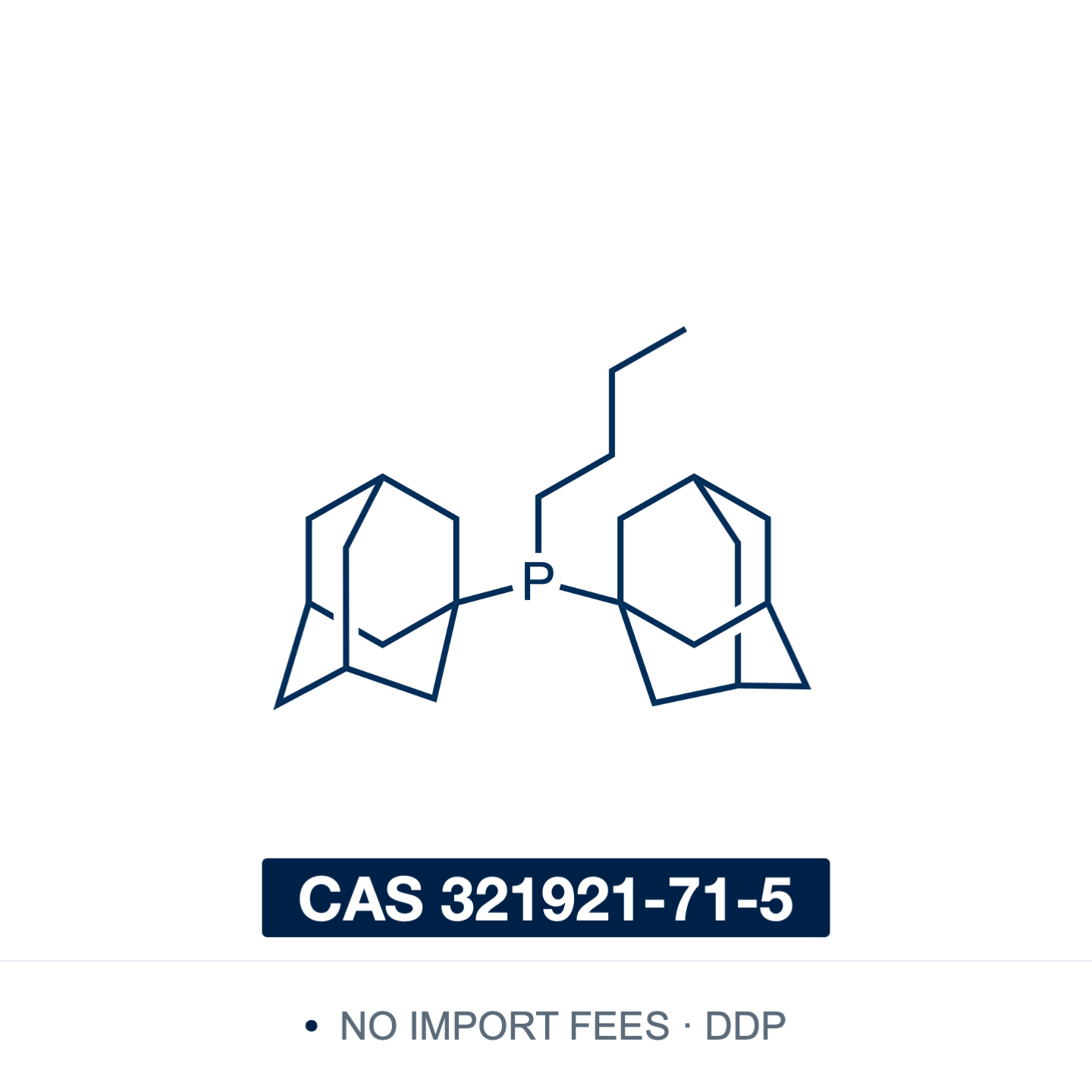
cataCXium A
CAS 321921-71-5
≥97%
cataCXium A | CAS 321921-71-5 | ≥97%
Regular price
€94,20 EUR (incl. VAT)
Regular price
Sale price
€94,20 EUR
Taxes included.
Shipping calculated at checkout.
Quantity
Couldn't load pickup availability
Technical Specifications
| CAS Number | 321921-71-5 |
| EC / EINECS Number | 691-708-4 |
| MDL Number | MFCD05861606 |
| SMILES | CCCCP(C12CC3CC(C1)CC(C3)C2)C45CC6CC(C4)CC(C6)C5 |
| InChI | InChI=1S/C24H39P/c1-2-3-4-25(23-11-17-5-18(12-23)7-19(6-17)13-23)24-14-20-8-21(15-24)10-22(9-20)16-24/h17-22H,2-16H2,1H3 |
| InChIKey | HTJWUNNIRKDDIV-UHFFFAOYSA-N |
| PubChem CID | 11371790 |
| Molecular Formula | C₂₄H₃₉P |
| Molecular Weight | 358.5 g/mol |
| Melting Point | 100–110 °C |
| Solubility | Insoluble in water, soluble in common organic solvents |
| Purity | ≥97% |
| Physical Form | White to yellow solid |
| HS Code | 2931.49 |
| Shelf Life | Retest period: 36 months from date of manufacture |
| Storage Conditions | Store under inert gas (N₂ or Ar) in a tightly sealed container |
Product Description & Scientific Applications
cataCXium A (di(1-adamantyl)-n-butylphosphine) is a bulky, electron-rich trialkylphosphine: the two adamantyl cages supply both the steric bulk and the electron density at phosphorus that let palladium turn over unactivated aryl chlorides.
The free ligand oxidises slowly in air and is handled and stored under inert gas — nothing shields the lone pair the way the second ring does in a biaryl phosphine. The hydriodide salt and the palladium precatalysts derived from it exist for that reason.
Applications and Reactions
- Cross-coupling of non-activated and deactivated aryl chlorides: the founding application and still the defining one. Palladium with this ligand couples aryl chloride substrates across the Suzuki–Miyaura, Heck and Sonogashira manifolds, in Buchwald–Hartwig amination, and in α-arylation of ketones.
- Formylation and carbonylation: palladium acetate with this ligand and TMEDA is the benchmark system for formylation of aryl and heteroaryl bromides with synthesis gas, run on multi-tonne scale for pharmaceutical aldehyde intermediates. The same ligand carries the wider carbonylation family — aminocarbonylation of aryl and heteroaryl halides, alkoxycarbonylation of aryl bromides with phenols to aryl esters at 1–2 bar CO, carbonylative Suzuki coupling to diaryl ketones, and synthesis of aromatic nitriles.
- Alkyl coupling partners: potassium alkyltrifluoroborates couple with aryl and heteroaryl chlorides under palladium with this ligand, giving access to secondary alkyl–aryl bonds.
Further Reading
Practical guidance on choosing a phosphine ligand for palladium- and nickel-catalysed cross-coupling in NorrChemica's Lab Journal: Phosphine Ligands for Cross-Coupling.
Shipping Destinations
- EU & UK: Priority delivery, 2–5 business days.
- United States (DDP): 3–7 business days, duties and taxes prepaid.
- EFTA Countries (DDP): 3–7 business days, duties and taxes prepaid.
- Worldwide: 7–14 business days, selected locations.
Safety Information
| Hazard Class | Not regulated for transport |
| Transport Category | Not classified as dangerous goods for transport (ADR/IATA/IMDG) |
Documentation
| Safety Data Sheet | Download PDF |
Share