NorrChemica™
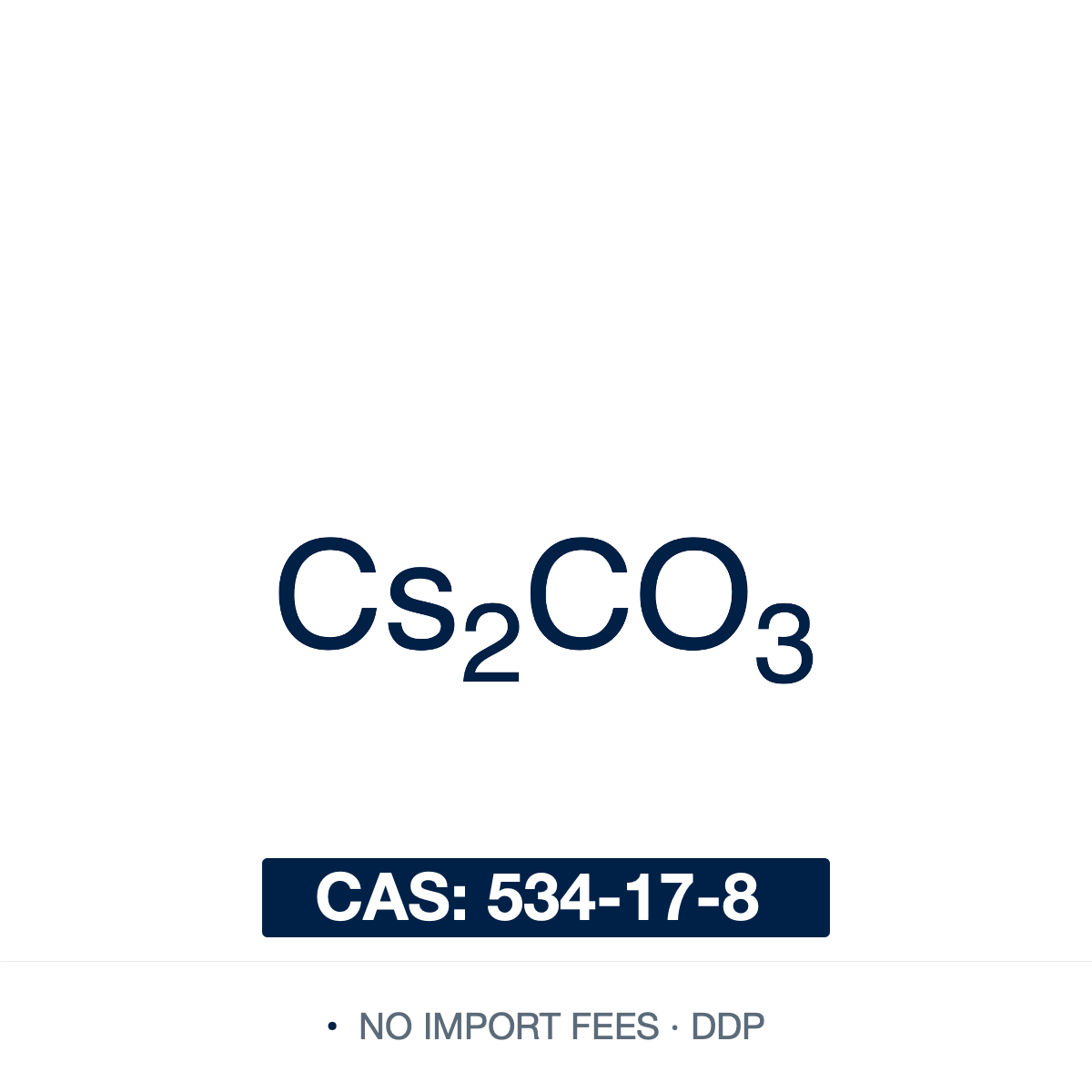
Cesium Carbonate
Cesium Carbonate | CAS 534-17-8 | ≥99%
Couldn't load pickup availability
Technical Specifications
| CAS Number | 534-17-8 |
| EC / EINECS Number | 208-591-9 |
| MDL Number | MFCD00010957 |
| RTECS Number | FK9400000 |
| SMILES | C(=O)([O-])[O-].[Cs+].[Cs+] |
| InChI | InChI=1S/CH2O3.2Cs/c2-1(3)4;;/h(H2,2,3,4);;/q;2*+1/p-2 |
| InChIKey | FJDQFPXHSGXQBY-UHFFFAOYSA-L |
| PubChem CID | 10796 |
| Molecular Formula | Cs₂CO₃ |
| Molecular Weight | 325.82 g/mol |
| Melting Point | 610 °C (dec.) |
| Solubility | Very soluble in water (~2605 g/L at 15 °C); soluble in DMF, DMSO, NMP; slightly soluble in ethanol; insoluble in non-polar organic solvents |
| Purity | ≥99% |
| Physical Form | White crystalline powder |
| HS Code | 2836.99 |
| Shelf Life | Retest period: 36 months from date of manufacture |
| Storage Conditions | Store at room temperature in a tightly sealed container under inert atmosphere, protected from moisture |
Product Description & Scientific Applications
Cesium Carbonate (Cs₂CO₃) is an inorganic carbonate base. The carbonate is a mild base (pKa ≈ 10.3) that deprotonates O–H, N–H, S–H, and acidic C–H bonds without the harshness of alkoxide, amide or hydride bases, while the large, polarisable Cs⁺ cation improves reactivity through weaker ion pairing and better substrate-salt solubility in polar aprotic media (DMF, DMSO, NMP, acetonitrile). This "cesium effect" underpins its use across O-, N-, S-, and C-functionalisation.
O-alkylation ("cesium effect"). For Williamson-type O-alkylation of alcohols and phenols, the loose Cs⁺ ion pair makes the alkoxide or phenoxide reactive, with O/C selectivity and elimination substrate-dependent; TBAI is added when halide reactivity is limiting. Gives unsymmetric aryl alkyl ethers, dialkyl ethers, and cyclic ethers milder than NaH.
Palladium cross-coupling base. A common screening base for Suzuki–Miyaura, Buchwald–Hartwig amination, and selected Sonogashira and Hiyama systems, supporting deprotonation or transmetalation without strongly basic or nucleophilic conditions, limiting boronic-acid decomposition, α-epimerisation, and functional-group degradation.
N-alkylation. For primary amines it can give high mono-N-alkylation selectivity (substrate- and electrophile-dependent), and it deprotonates acidic N–H heterocycles — indoles, pyrazoles, imidazoles, triazoles, tetrazoles — for N-substitution with alkyl halides or sulfonates, milder than NaH or KOtBu. Regioselectivity on tautomerisable rings is substrate-dependent.
Carboxylate ester synthesis. It forms cesium carboxylates in situ — weakly ion-paired nucleophiles that alkylate with primary, benzylic, allylic, or secondary halides or sulfonates to esters, useful for acids sensitive to Fischer or acid-chloride conditions (peptides, glycosides, acid-labile protecting groups). High dilution favours macrocyclisation of seco-acids over polymerisation.
Nucleophilic aromatic substitution. With electron-deficient aryl halides, chloropyridines, and fluoropyrimidines it deprotonates the nucleophile while sparing sensitive groups, giving diaryl ethers, aryl amines, and aryl thioethers; non-activated substrates need a copper or palladium catalyst.
S-alkylation. Thiols and thiophenols are S-alkylated to thioethers under mild carbonate conditions where alkoxide or hydride bases would compromise sensitive substrates.
C-alkylation. Activated C–H substrates — malonates, β-ketoesters, and 1,3-dicarbonyls — are α-alkylated where carbonate basicity suffices and stronger bases are not required.
CO₂ utilisation and C1 transfer. It acts as base, promoter, or carbonate/C1 partner for carbonate, carbamate, urethane, cyclic-carbamate, and oxazolidinone formation.
Shipping Destinations
- EU & UK: Priority delivery, 2–5 business days.
- United States (DDP): 3–7 business days, duties and taxes prepaid.
- EFTA Countries (DDP): 3–7 business days, duties and taxes prepaid.
- Worldwide: 7–14 business days, selected locations.
Safety Information
| GHS Pictograms |


|
| Signal Word | Warning |
| Hazard Class | Not classified for transport (no transport classification required) |
| Transport Category | Non-hazardous for transport |
| H-Statements | H315 - H319 - H335 - H341 |
| P-Statements | P201 - P202 - P261 - P264 - P271 - P280 - P302+P352 - P304+P340 - P305+P351+P338 - P308+P313 - P332+P313 - P337+P313 - P362+P364 - P405 - P501 |
Documentation
| Safety Data Sheet | Download PDF |