NorrChemica™
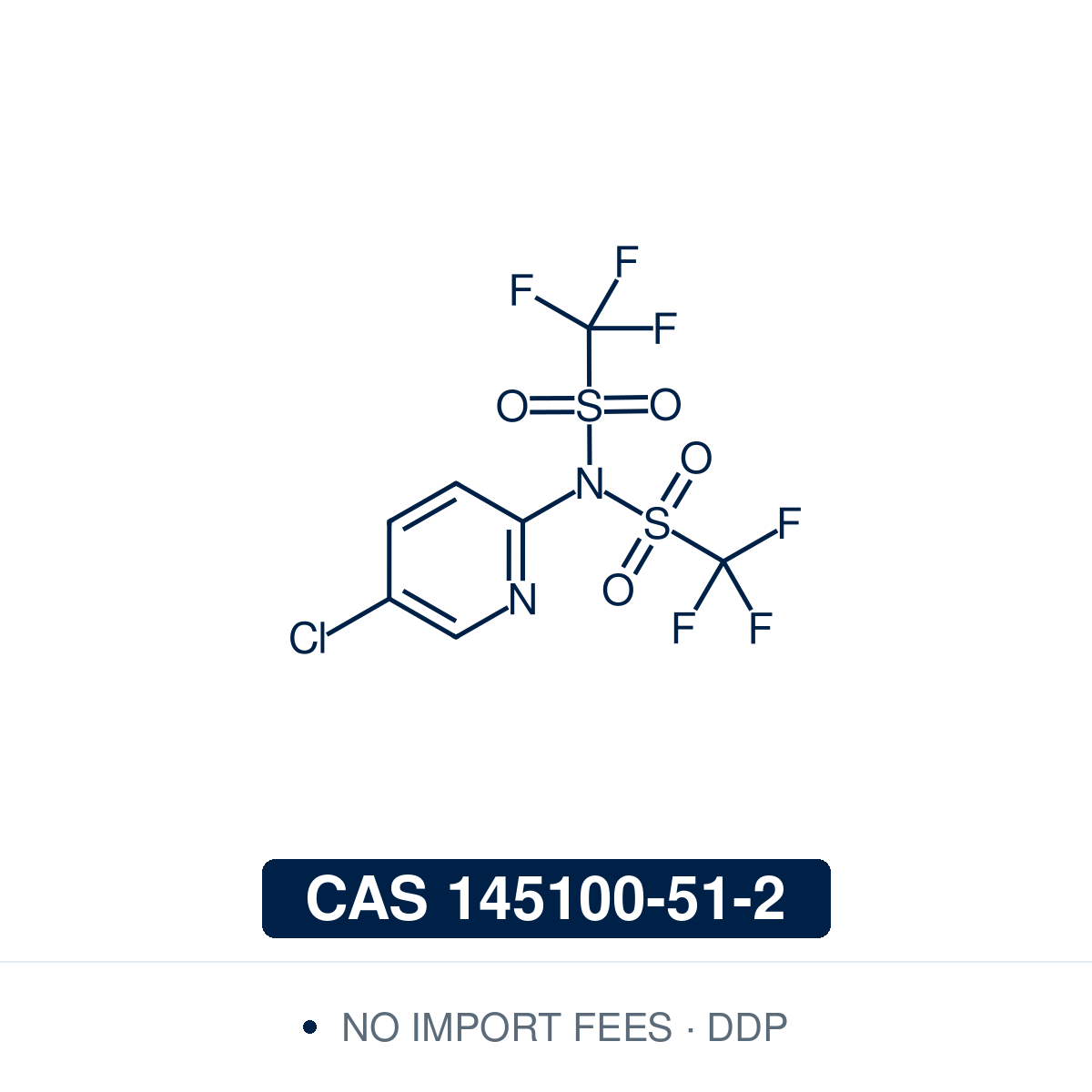
Comins' Reagent
Comins' Reagent | CAS 145100-51-2 | ≥98%
Couldn't load pickup availability
Technical Specifications
| CAS Number | 145100-51-2 |
| EC / EINECS Number | 629-110-2 |
| MDL Number | MFCD00191833 |
| SMILES | C1=CC(=NC=C1Cl)N(S(=O)(=O)C(F)(F)F)S(=O)(=O)C(F)(F)F |
| InChI | InChI=1S/C7H3ClF6N2O4S2/c8-4-1-2-5(15-3-4)16(21(17,18)6(9,10)11)22(19,20)7(12,13)14/h1-3H |
| InChIKey | TUFGVZMNGTYAQD-UHFFFAOYSA-N |
| PubChem CID | 388544 |
| Molecular Formula | C₇H₃ClF₆N₂O₄S₂ |
| Molecular Weight | 392.7 g/mol |
| Melting Point | 45-47 °C (lit.) |
| Solubility | Soluble in most organic solvents. |
| Purity | ≥98% |
| Physical Form | White to Light yellow powder |
| HS Code | 2933.39 |
| Shelf Life | Retest period: 36 months from date of manufacture |
| Storage Conditions | Store under inert gas at room temperature in a tightly closed container. Moisture sensitive. |
Product Description & Scientific Applications
Comins' Reagent is a pyridine-based triflimide that transfers a triflyl group to an enolate or an alkoxide. Ketones cannot undergo cross-coupling without serious selectivity problems. The usual solution is a palladium catalyst, and palladium requires a carbon–halide or carbon–triflate bond to insert into. This reagent installs that triflate on the enol carbon. The white solid dissolves in most organic solvents and may darken on prolonged storage without loss of activity.
Enol triflates from carbonyl compounds. A strong base — LDA or a hexamethyldisilazide — removes a proton adjacent to the carbonyl to generate the enolate. The reagent traps that enolate before it can equilibrate, so the base determines the product. A kinetic base affords the less substituted alkene, a thermodynamic base the more substituted. Double-bond geometry is established in the same step. Glyoxylates, lactones and aldehydes enolise and triflate by the same route.
Lactams and azaheterocycles. Lactams triflate with potassium hexamethyldisilazide. The resulting enecarbamate triflates are synthons for substituted tetrahydropyridines and for pipecolic acid.
Phenols, alcohols and aryne precursors. Phenols and alcohols triflate directly. A silyl-protected phenol is deprotected and triflated in one operation with caesium fluoride and caesium carbonate. Triflation of a lithiated o-silylphenol builds the silyl triflate aryne precursor. That precursor stores in air at room temperature for six months.
Comparison with N-phenyltriflimide. N-Phenyltriflimide is the common alternative. This reagent is more reactive, so triflation proceeds at lower temperature and in less time. It also triflates hindered enolates, the ones that give tetrasubstituted alkenes.
Coupling the triflate. The triflate accepts the same partners an aryl halide does: boronic acids under Suzuki–Miyaura, stannanes under Stille, terminal alkynes under Sonogashira, organozincs under Negishi. Inserting carbon monoxide first gives an α,β-unsaturated ester with methanol, or a dienone with a boronic acid.
Shipping Destinations
- EU & UK: Priority delivery, 2–5 business days.
- United States (DDP): 3–7 business days, duties and taxes prepaid.
- EFTA Countries (DDP): 3–7 business days, duties and taxes prepaid.
- Worldwide: 7–14 business days, selected locations.
Safety Information
| GHS Pictograms |

|
| Signal Word | Warning |
| Hazard Class | Not regulated for transport |
| Transport Category | Not classified as dangerous goods for transport (ADR/IATA/IMDG) |
| H-Statements | H315 - H319 - H335 |
| P-Statements | P264 - P280 - P301+P312 - P302+P352 - P305+P351+P338 - P332+P313 |
Documentation
| Safety Data Sheet | Download PDF |