NorrChemica™
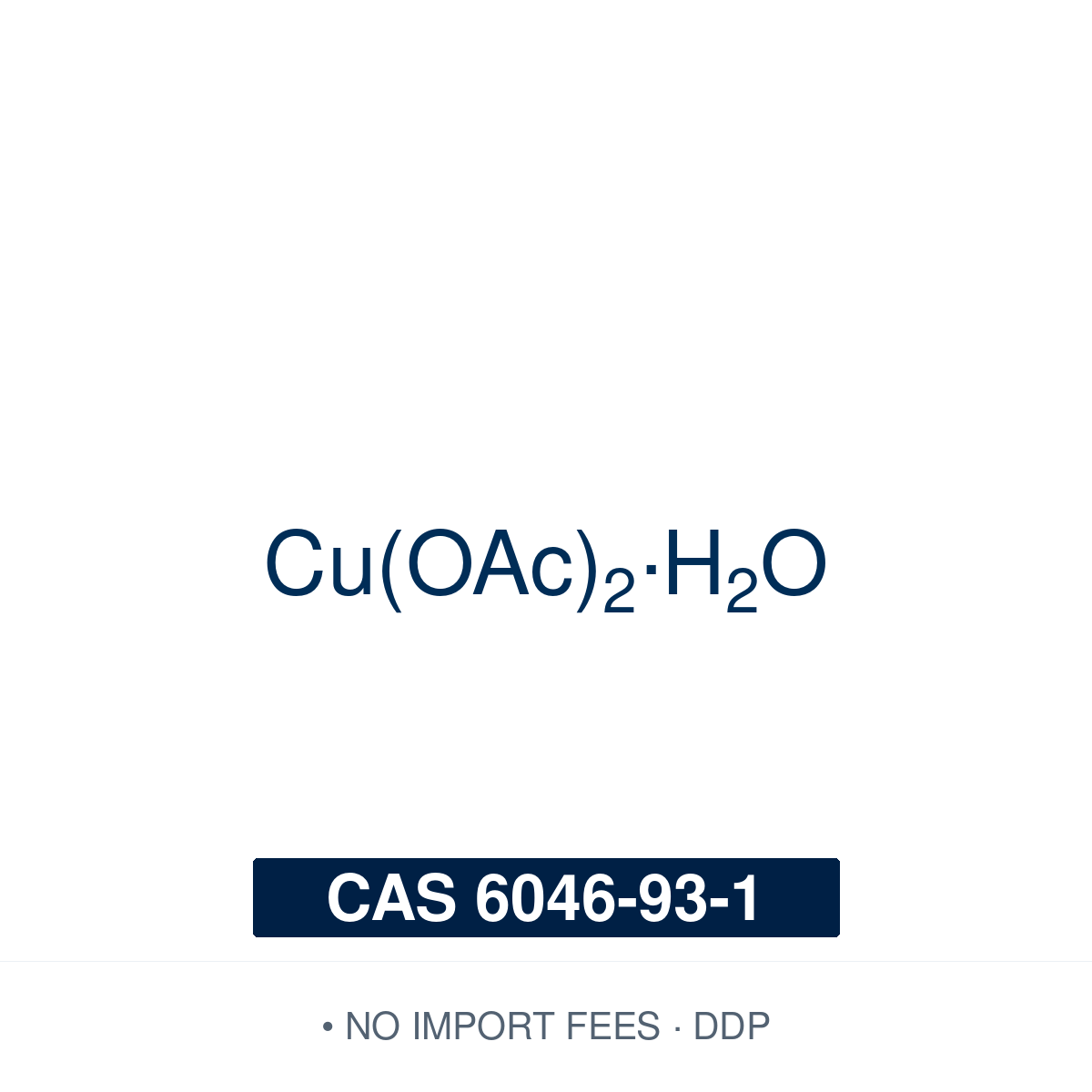
Copper(II) Acetate Monohydrate (Cu(OAc)2·H2O)
Copper(II) Acetate Monohydrate (Cu(OAc)2·H2O) | CAS 6046-93-1 | ≥98%
Couldn't load pickup availability
Technical Specifications
| CAS Number | 6046-93-1 |
| EC / EINECS Number | 611-978-9 |
| MDL Number | MFCD00149570 |
| RTECS Number | AG3480000 |
| SMILES | CC(=O)[O-].CC(=O)[O-].O.[Cu+2] |
| InChI | InChI=1S/2C2H4O2.Cu.H2O/c2*1-2(3)4;;/h2*1H3,(H,3,4);;1H2/q;;+2;/p-2 |
| InChIKey | NWFNSTOSIVLCJA-UHFFFAOYSA-L |
| PubChem CID | 165397 |
| Molecular Formula | Cu(OAc)₂·H₂O |
| Molecular Weight | 199.65 g/mol |
| Melting Point | 115 °C |
| Solubility | Soluble in water (72 g/L, pH 5.2–5.5 at 20 °C); soluble in alcohol and acetonitrile; slightly soluble in diethyl ether and glycerol |
| Purity | ≥98% |
| Physical Form | Dark green to blue-green crystalline powder |
| HS Code | 2915.29 |
| Shelf Life | Retest period: 36 months from date of manufacture |
| Storage Conditions | Store in a cool, dry place in a tightly sealed container |
Product Description & Scientific Applications
Copper(II) Acetate Monohydrate is a paddlewheel dimer rather than a simple salt: two copper(II) centres bridged by four acetates with an axial water on each, antiferromagnetically coupled. That structure survives dissolution — in solution the acetate-bridged paddlewheel is the dominant species — and it accounts for most of what the reagent does.
Chan–Lam coupling. Catalysis begins by displacing the axial water: a chelating aromatic secondary amine replaces it on the dimer, and the acetate counterions then act as an internal base to deprotonate the coordinated amine. Aerobic oxidative coupling with phenylboronic acid runs in dichloromethane, in air, at room temperature, on one equivalent of the salt.
C–H amidation. It catalyses intramolecular C(sp³)–H amidation to indolines with silver carbonate as the terminal oxidant. Solvent choice is decisive: dimethyl sulfoxide gave only a trace of product, acetonitrile, dimethylformamide and dioxane none at all, while non-polar aromatics worked well.
Stoichiometric oxidant. Rhodium-catalysed oxidative indazole synthesis uses it at 2.1 equivalents with a pivalic acid additive.
Azide–alkyne cycloaddition. The acetate-bridged copper(II) dimer oxidises the terminal alkyne to the diyne, and that step yields both the copper(I) acetate dimer which catalyses the cycloaddition and the acetic acid which releases the triazole.
Framework synthesis. Growth of the copper trimesate framework requires formation of carboxylate-bridged paddlewheel copper dimers, so the reagent supplies the secondary building unit directly.
Handling. Solubility in methanol rises significantly on adding a few volume per cent of water. The monohydrate dehydrates between 125 and 225 °C, so an anhydrous-only protocol has to allow for that step — and since these couplings run at or above one equivalent, the 10% mass difference between hydrate and anhydrous salt is a real weighing error rather than a rounding one.
Shipping Destinations
- EU, UK & Switzerland only: Priority delivery, 2–5 business days. UK and Switzerland (DDP): duties and taxes prepaid. Classified as dangerous goods — shipping restrictions apply outside the EU, UK and Switzerland.
Safety Information
| GHS Pictograms |


|
| Signal Word | Danger |
| Hazard Class | UN 1759 — Corrosive solid, n.o.s. (copper di(acetate)) (Class 8, PG II) |
| Transport Category | Class 8, PG II (ADR/IATA/IMDG) |
| H-Statements | H302 - H314 - H411 |
| P-Statements | P260 - P273 - P280 - P301+P312 - P303+P361+P353 - P305+P351+P338 - P310 - P391 - P501 |
Documentation
| Safety Data Sheet | Download PDF |