NorrChemica™
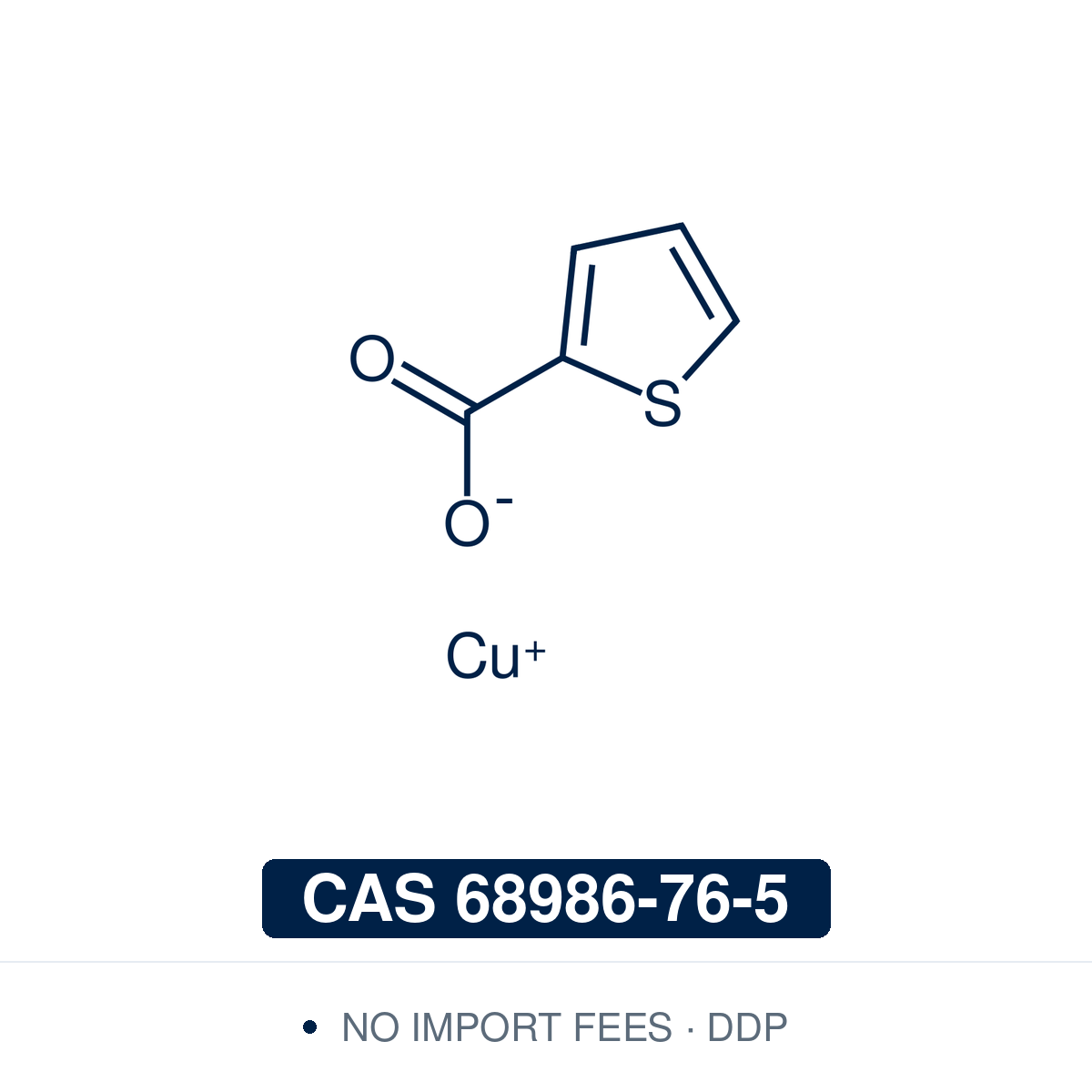
Copper(I) Thiophene-2-carboxylate (CuTC)
Copper(I) Thiophene-2-carboxylate (CuTC) | CAS 68986-76-5 | ≥98%
| Pack size | Excl. VAT | Incl. VAT | Add to cart |
|---|---|---|---|
| 5.0 g | €74,20 | ||
| 10 g | €98,20 | ||
| 25 g | €129,20 | ||
| 100 g | €298,80 | ||
| 500 g | €1.195,00 |
Taxes and fees, e.g. VAT, included in the price. Shipping calculated at checkout.Free shipping on EU, UK and EFTA orders above €250, and above €400 to the rest of the world.
Technical Specifications
| CAS Number | 68986-76-5 |
| EC / EINECS Number | 633-277-7 |
| MDL Number | MFCD02183524 |
| SMILES | C1=CSC(=C1)C(=O)[O-].[Cu+] |
| InChI | InChI=1S/C5H4O2S.Cu/c6-5(7)4-2-1-3-8-4;/h1-3H,(H,6,7);/q;+1/p-1 |
| InChIKey | SFJMFSWCBVEHBA-UHFFFAOYSA-M |
| PubChem CID | 11194830 |
| Molecular Formula | C₅H₃CuO₂S |
| Molecular Weight | 190.69 g/mol |
| Purity | ≥98% |
| Physical Form | Orange to brown to dark red powder or crystals |
| HS Code | 2934.99 |
| Shelf Life | Retest period: 36 months from date of manufacture |
| Storage Conditions | Keep container tightly closed in a dry, cool and well-ventilated place. Store under an inert atmosphere. Protect from light. |
Product Description & Scientific Applications
Copper(I) thiophene-2-carboxylate (CuTC) is a copper(I) carboxylate: the copper(I) salt of thiophene-2-carboxylic acid. It is also known as Liebeskind's reagent. It is used both as a copper(I) mediator in palladium-catalysed cross-couplings and as a copper catalyst in its own right.
Liebeskind–Srogl coupling. In the Liebeskind–Srogl reaction, thioesters couple with boronic acids to give ketones under neutral conditions. A review describes this desulfitative coupling as catalytic in palladium(0) and stoichiometric in copper(I), and as applicable to a range of organosulfur compounds and organometallic nucleophiles. A 2023 study of the reaction describes the role of the copper(I) cofactor as twofold: it activates the C(O)–S bond towards oxidative addition, and it facilitates transmetallation from boron to palladium. Another study demonstrated that the Liebeskind–Srogl protocol is orthogonal in selectivity to Suzuki–Miyaura and Stille couplings, in a modular synthesis of functionalised pyrimidinones.
With CuTC as the mediator, π-deficient heteroaromatic thioethers undergo palladium-catalysed cross-coupling with boronic acids. In one study, thioalkynes coupled with boronic acids under palladium catalysis in the presence of CuTC or copper(I) 3-methylsalicylate, under mild, non-basic conditions, giving functionalised alkynes; the authors present the reaction as complementary to the Sonogashira protocol. Another study made nitriles from boronic acids and benzyl thiocyanate under palladium catalysis with CuTC. The authors present this reaction as a cyanide-free alternative to the classic cyanation of aryl halides with cyanide sources. A bis(arylthio)cyclobutenedione coupled with both organostannanes and (hetero)arylboronic acids using catalytic palladium and stoichiometric CuTC, giving symmetrically disubstituted cyclobutenediones.
Cyanation of arylboronic acids with benzyl thiocyanate under palladium catalysis with CuTC, as reported in one study. The position of R is drawn for illustration only; other reagents and conditions are not shown.
Coupling of thioalkynes with boronic acids under palladium catalysis with CuTC and without base, as reported in one study. An arylboronic acid is drawn for illustration; conditions are not shown.
Base-free coupling of iodides with boronic acids. CuTC also mediates a palladium-catalysed coupling of aryl and alkenyl iodides with boronic acids that runs without a base. The authors present it as an alternative to the Suzuki coupling and expect it to be particularly useful for substrates with base-sensitive or thermally sensitive groups.
Base-free coupling of aryl iodides with arylboronic acids under palladium catalysis with CuTC, as reported in one study; alkenyl iodides also reacted. The positions of R¹ and R² are drawn for illustration only; conditions are not shown.
Couplings with organostannanes. In one Stille–Migita protocol, catalytic Pd(PPh₃)₄ combined with CuTC and tetrabutylammonium diphenylphosphinate allowed a series of demanding couplings; because the protocol is fluoride-free, O-silyl and C-silyl groups remained intact. Thiocarbamoyl-protected α-hydroxystannanes, racemic or enantioenriched, cross-coupled with alkenyl, aryl and heteroaryl iodides using CuTC, with retention of configuration at the stereocentres. A pH-neutral, CuTC-catalysed cross-coupling of amino acid thiol esters with chiral α-alkoxyalkylstannanes gave α-amino-α′-alkoxy ketones with complete retention of configuration at both stereocentres.
1-Sulfonyl-1,2,3-triazoles. In one study, CuTC catalysed the formation of 1-sulfonyl-1,2,3-triazoles from sulfonyl azides and copper(I) acetylides generated in situ, both under non-basic anhydrous conditions and in water. The authors found CuTC by screening sulfur ligands and sulfur-containing copper(I) complexes for selective formation of the triazole over an N-acyl sulfonamide by-product. They propose that CuTC stabilises the triazolyl–copper intermediate and so disfavours loss of nitrogen to a ketenimine. They also suggest that, in toluene, the carboxylate may deprotonate the alkyne; if the thiophene-2-carboxylic acid formed stays bound to copper, the final protonolysis would be intramolecular. Internal alkynes did not react, which the authors take as strong support for copper(I) acetylide intermediates. In another study, a 1-sulfonyl triazole made with CuTC from tosyl azide and phenylacetylene was converted, without isolation, into a 1-sulfonyl imidazole by rhodium(II)-catalysed reaction with benzonitrile. CuTC also catalysed the reaction of sulfamoyl azides with alkynes to 1-sulfamoyl-1,2,3-triazoles, which the authors describe as shelf-stable precursors of rhodium azavinyl carbenes.
CuTC-catalysed synthesis of 1-sulfonyl-1,2,3-triazoles from sulfonyl azides and terminal alkynes, as reported in one study, with toluene or water as the solvent. Quantities and conditions are not shown.
Other uses in copper chemistry. One study coupled aryl iodides, mostly piperazine-substituted pyrimidines, pyridines and benzenes, with aryl thiols to diaryl sulfides using CuTC, which the authors describe as a soluble, non-basic catalyst; ortho-substituted and heteroaryl partners also coupled. In another, catalytic CuTC converted propargylic halides and (trifluoromethyl)trimethylsilane into trifluoromethylated products with high selectivity. In a copper-catalysed trifluoromethylation of unactivated alkenes, CuTC was chosen for an epoxide-containing substrate as a catalyst of lower Lewis acidity, to avoid ring-opening of the epoxide by methanol.
In one study, CuTC catalysed the enantioselective SN2′ allylic alkylation of difunctionalised allylic halides, such as 1,4-dihalo-2-butenes, with Grignard reagents; more substituted alkenes gave all-carbon quaternary stereocentres. With DMEDA as the ligand, CuTC served as the copper source for the N-allenylation of allylic sulfonamides with bromoallenes. Combined with FeCl₃, CuTC formed a bimetallic system that coupled aryl Grignard reagents with 1-arylvinyl halides to 1,1-diarylethylenes, and the system outperformed either metal used alone. An air-stable N-heterocyclic carbene–copper thiophene-2-carboxylate complex catalysed the stereoselective hydroboration of terminal alkynes with pinacolborane or HBdan, and hydroboranes activated it directly, without a base co-catalyst.
Shipping Destinations
- EU & UK: Priority delivery, 2–5 business days.
- United States (DDP): 3–7 business days, duties and taxes prepaid.
- EFTA Countries (DDP): 3–7 business days, duties and taxes prepaid.
- Worldwide: 7–14 business days, selected locations.
Safety Information
| GHS Pictograms |

|
| Signal Word | Warning |
| Hazard Class | Not regulated for transport |
| Transport Category | Not classified as dangerous goods for transport (ADR/IATA/IMDG) |
| H-Statements | H315 - H319 - H335 |
| P-Statements | P261 - P280 - P304+P340 - P305+P351+P338 - P337+P313 - P501 |
Documentation
| Safety Data Sheet | Download PDF |