NorrChemica™
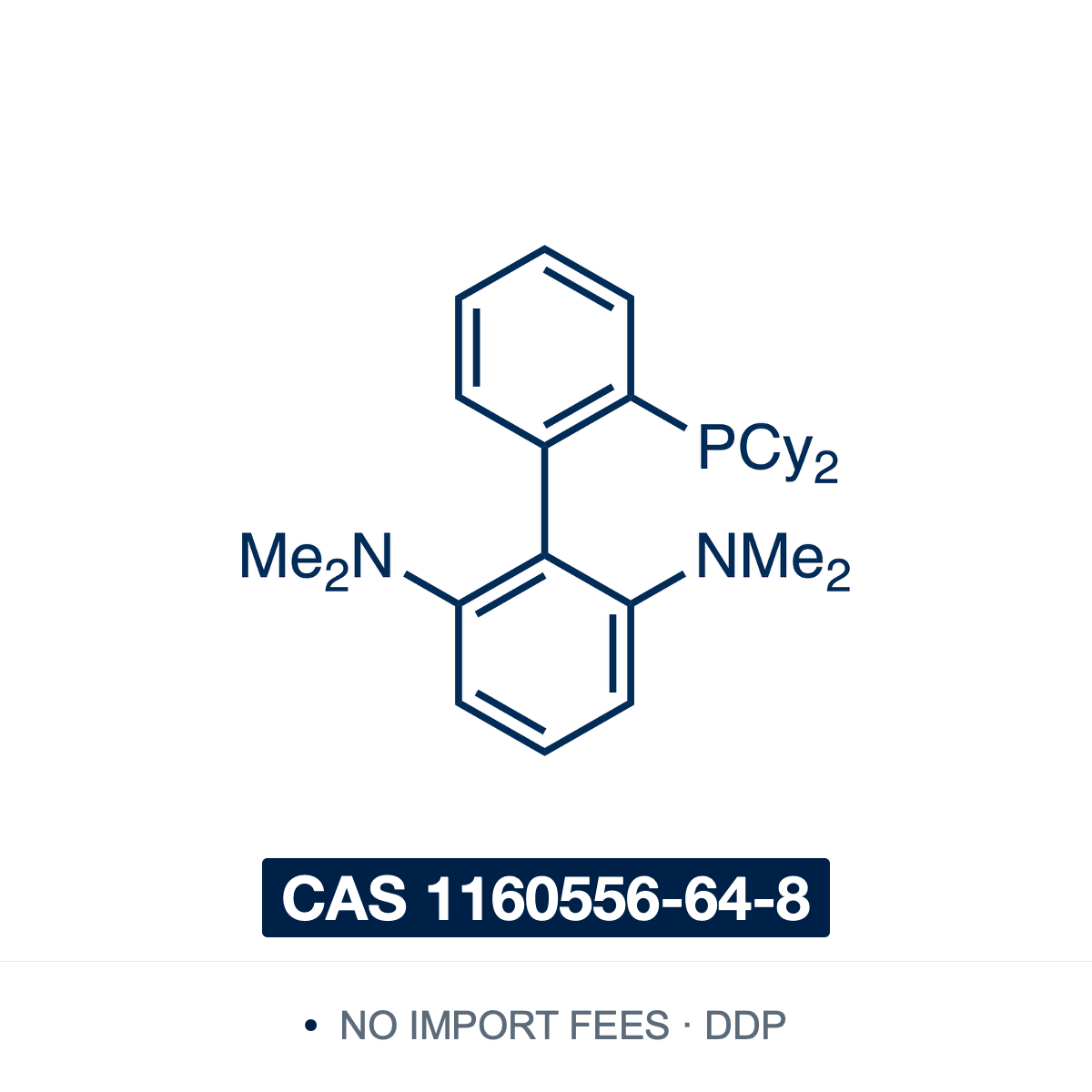
CPhos
CPhos | CAS 1160556-64-8 | ≥98%
Couldn't load pickup availability
Technical Specifications
| CAS Number | 1160556-64-8 |
| MDL Number | MFCD27978504 |
| SMILES | CN(C)C1=C(C(=CC=C1)N(C)C)C2=CC=CC=C2P(C3CCCCC3)C4CCCCC4 |
| InChI | InChI=1S/C28H41N2P/c1-29(2)25-19-13-20-26(30(3)4)28(25)24-18-11-12-21-27(24)31(22-14-7-5-8-15-22)23-16-9-6-10-17-23/h11-13,18-23H,5-10,14-17H2,1-4H3 |
| InChIKey | DRNAQRXLOSUHBQ-UHFFFAOYSA-N |
| PubChem CID | 44156169 |
| Molecular Formula | C₂₈H₄₁N₂P |
| Molecular Weight | 436.6 g/mol |
| Melting Point | 108–113 °C |
| Solubility | Soluble in THF, 1,4-dioxane, toluene, dichloromethane and ethyl acetate; practically insoluble in water. Air-sensitive in solution — prepare in degassed solvents under inert atmosphere. |
| Purity | ≥98% |
| Physical Form | White solid |
| HS Code | 2931.90 |
| Shelf Life | Retest period: 36 months from date of manufacture |
| Storage Conditions | Store in a cool, dry place in a tightly sealed container under inert atmosphere |
Product Description & Scientific Applications
CPhos is a dialkylbiaryl phosphine carrying two dimethylamino groups on the lower ring. With SPhos and RuPhos it supports Suzuki and Negishi reactions of aryl chlorides with secondary alkyl nucleophiles.
Suppressing isomerisation. This is the ligand's primary application. When a secondary alkylzinc couples to an aryl electrophile, the palladium–alkyl intermediate can migrate along the chain by β-hydride elimination and re-addition, so a branched nucleophile delivers the linear product instead. CPhos is one of a short list of ligands developed to limit that pathway, alongside dppf, tri-tert-butylphosphine and the N-heterocyclic carbenes. In one comparison under Barbier conditions — the alkyl halide, zinc and electrophile combined in a single pot — only CPhos and dppf converted the aryl triflate at all, and CPhos gave a 77:23 ratio of the direct coupling product to the chain-walked C2 and C1 isomers. Its ortho dimethylamino group has since been borrowed by others: a hybrid ligand pairing that group with the ortho methoxy of SPhos gave cross-coupled product with no isomerised product at all.
Mechanochemical coupling. It was the phosphine chosen for a mechanochemical Negishi coupling of aryl halides with organozinc reagents, and that work calls it the most efficient ligand of those screened.
Alkene carboamination. A palladium acetate system with this ligand, lithium tert-butoxide and benzotrifluoride gave the highest yield of the desired product, with only a small amount of Heck arylation side product.
Limits. In one diastereoselective piperidine arylation, CPhos gave the product in 18% yield at 98:2 dr, where RuPhos on the same palladium source gave 29% at 93:7 — higher diastereocontrol at roughly half the yield.
Further reading: For phosphine-ligand selection, palladium sources and precatalysts, and Suzuki–Miyaura and Buchwald–Hartwig reagent choice, see NorrChemica's Lab Journal guide: Phosphine Ligands for Cross-Coupling.
Shipping Destinations
- EU & UK: Priority delivery, 2–5 business days.
- United States (DDP): 3–7 business days, duties and taxes prepaid.
- EFTA Countries (DDP): 3–7 business days, duties and taxes prepaid.
- Worldwide: 7–14 business days, selected locations.
Safety Information
| GHS Pictograms |

|
| Signal Word | Warning |
| Hazard Class | Not regulated for transport |
| Transport Category | Not classified as dangerous goods for transport (ADR/IATA/IMDG) |
| H-Statements | H315 - H319 - H335 |
| P-Statements | P261 - P264 - P271 - P280 - P302+P352 - P304+P340 - P305+P351+P338 - P332+P313 - P337+P313 - P362+P364 |
Documentation
| Safety Data Sheet | Download PDF |