NorrChemica™
CPM
CPM | CAS 76877-33-3 | ≥98%
Pack sizes & prices
| Pack size | Excl. VAT | Incl. VAT | Add to cart |
|---|---|---|---|
| 5 mg | €229,20 | ||
| 10 mg | €339,20 | ||
| 25 mg | €675,00 |
Taxes and fees, e.g. VAT, included in the price. Shipping calculated at checkout.Free shipping on EU, UK and EFTA orders above €250, and above €400 to the rest of the world.
Technical Specifications
| CAS Number | 76877-33-3 |
| MDL Number | MFCD00077334 |
| SMILES | CCN(CC)C1=CC2=C(C=C1)C(=C(C(=O)O2)C3=CC=C(C=C3)N4C(=O)C=CC4=O)C |
| InChI | InChI=1S/C24H22N2O4/c1-4-25(5-2)18-10-11-19-15(3)23(24(29)30-20(19)14-18)16-6-8-17(9-7-16)26-21(27)12-13-22(26)28/h6-14H,4-5H2,1-3H3 |
| InChIKey | YGIABALXNBVHBX-UHFFFAOYSA-N |
| PubChem CID | 122042 |
| Molecular Formula | C₂₄H₂₂N₂O₄ |
| Molecular Weight | 402.4 g/mol |
| Melting Point | 220-223 °C |
| Solubility | Soluble in anhydrous DMSO; slightly soluble in methanol |
| Log Pow | 3.4 |
| Purity | ≥98% |
| Physical Form | Yellow to dark-orange solid |
| HS Code | 2934.99 |
| Shelf Life | Retest period: 36 months from date of manufacture |
| Storage Conditions | Store at -20 °C in a tightly sealed container, protected from light and moisture |
| SDS / CoA | Download PDF |
Product Description & Scientific Applications
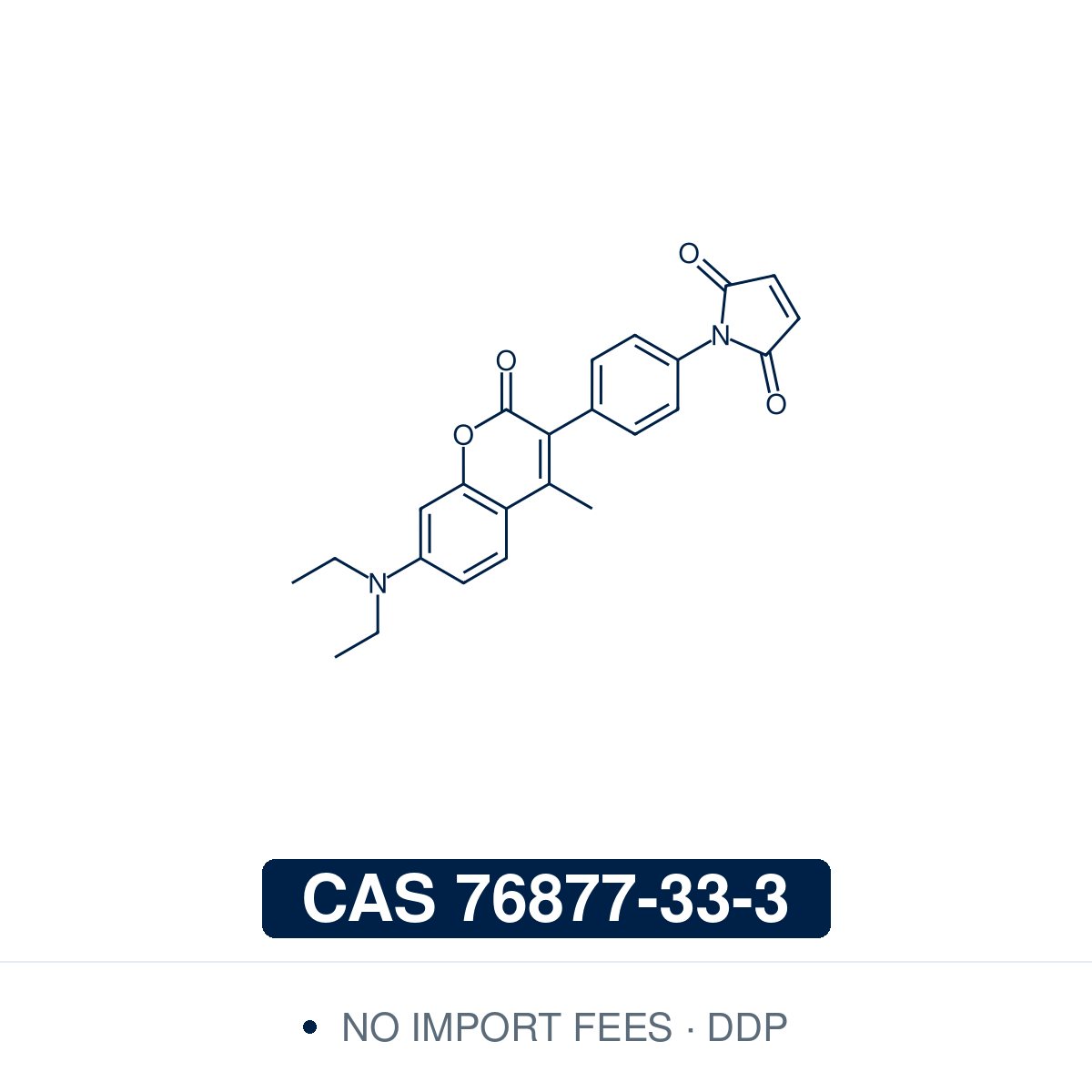
CPM is 7-diethylamino-3-(4'-maleimidylphenyl)-4-methylcoumarin, a profluorescent coumarin bearing a thiol-reactive maleimide, and it becomes fluorescent only on forming a covalent bond. The conjugate is read at 463 nm under 387 nm excitation. It is profluorescent rather than fluorescent: the maleimide on the phenyl ring modulates resonance between the coumarin carbonyl and the 7-amino group, quenching emission until the maleimide has reacted. The maleimide adds across a free thiol to give a covalent fluorescent product.
Its principal use is thermostability profiling of purified membrane proteins, where cysteines buried in the folded state become accessible on thermal unfolding and react to give fluorescent adducts. Tracking that signal against temperature gives an apparent melting temperature for a transporter population. The same readout applies to G protein-coupled receptors, monitored across a temperature ramp. Because reactivity tracks cysteine exposure, a ligand that changes accessibility shifts the measured melting temperature, which is what makes the assay report on binding.
In enzymology it detects the coenzyme A thiol released by acyltransferases, giving a fluorescent adduct that reports turnover. That format has been built into high-throughput fluorometric screening for enzyme inhibitors. In bioconjugation it labels a single free thiol on a purified substrate, giving the monolabelled product after chromatography.
It is not site-selective on a multi-cysteine protein: mapping in a single acyltransferase found adducts at at least 10 of 20 possible cysteines. Endogenous cysteine-rich proteins are a source of nonspecific background in cell-based work. In screening campaigns thiol-trapping compounds are a significant source of assay artefacts.
The assay is run as a thermostability shift to test inhibitor binding to a mitochondrial carrier and its point mutants. It also reports ligand binding to a detergent-solubilised synaptic vesicle protein, run in a real-time PCR cycler. In efflux-pump work it resolves inhibitor titration against wild-type and substitution variants of a multidrug transporter. Its profluorescent character supports a homogeneous binding assay for a transcription-factor pocket, used to find covalent inhibitors. In a chemoselective conjugation protocol the maleimide delivers dual-probe conjugates. It also serves as a direct quantification readout for enzymatic reactions that liberate a thiol.
Shipping Destinations
- EU & UK: Priority delivery, 2–5 business days.
- United States (DDP): 3–7 business days, duties and taxes prepaid.
- EFTA Countries (DDP): 3–7 business days, duties and taxes prepaid.
- Worldwide: 7–14 business days, selected locations.
Safety Information
| Hazard Class | Not regulated for transport |
| Transport Category | Not classified as dangerous goods for transport (ADR/IATA/IMDG) |
Documentation
| Safety Data Sheet | Download PDF |
Share