NorrChemica™
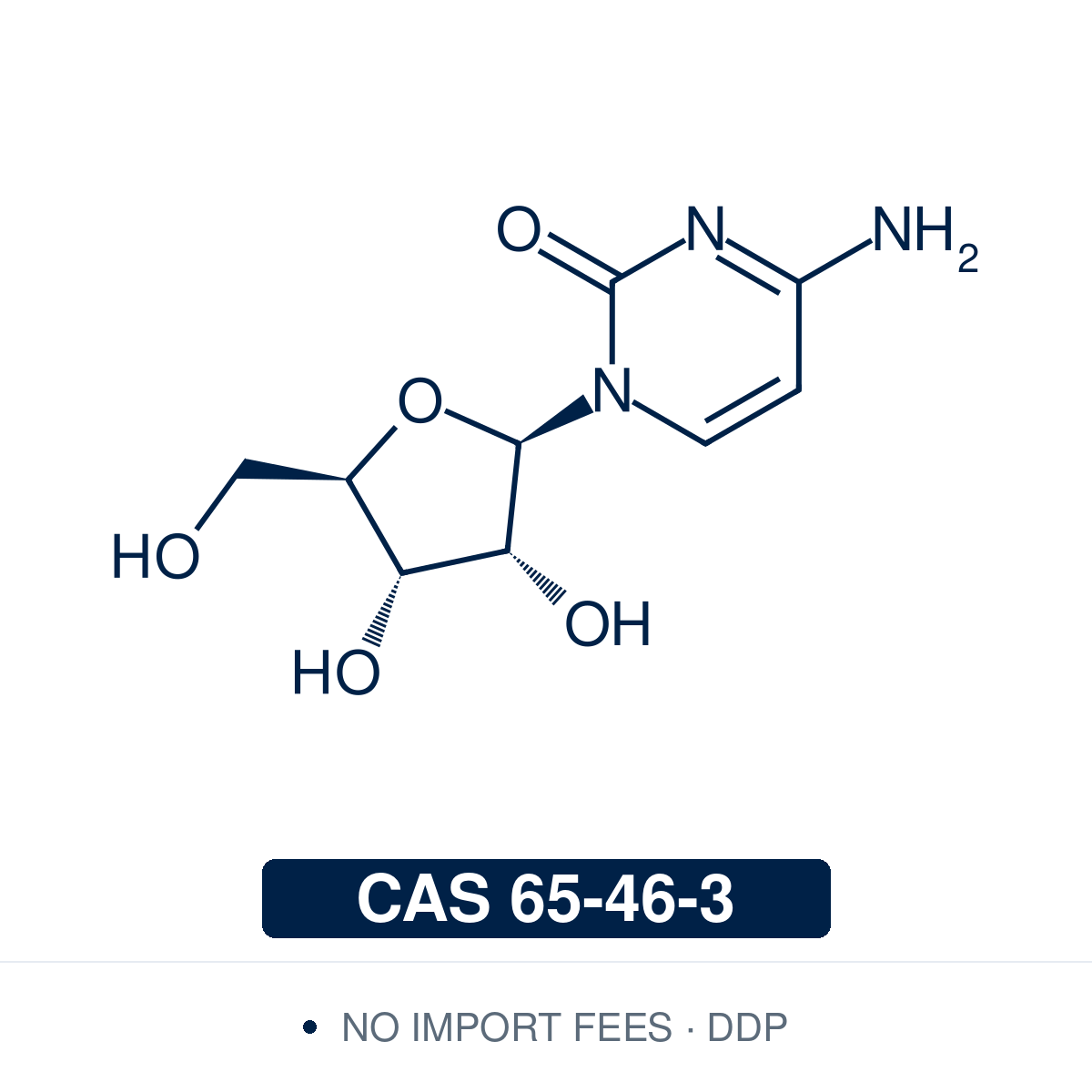
Cytidine
Cytidine | CAS 65-46-3 | ≥98%
Couldn't load pickup availability
Technical Specifications
| CAS Number | 65-46-3 |
| EC / EINECS Number | 200-610-9 |
| MDL Number | MFCD00006545 |
| SMILES | C1=CN(C(=O)N=C1N)[C@H]2[C@@H]([C@@H]([C@H](O2)CO)O)O |
| InChI | InChI=1S/C9H13N3O5/c10-5-1-2-12(9(16)11-5)8-7(15)6(14)4(3-13)17-8/h1-2,4,6-8,13-15H,3H2,(H2,10,11,16)/t4-,6-,7-,8-/m1/s1 |
| InChIKey | UHDGCWIWMRVCDJ-XVFCMESISA-N |
| PubChem CID | 6175 |
| Molecular Formula | C₉H₁₃N₃O₅ |
| Molecular Weight | 243.22 g/mol |
| Melting Point | 210–220 °C (dec.) |
| Solubility | Freely soluble in water (~50 mg/mL); slightly soluble in ethanol |
| Purity | ≥98% |
| Physical Form | White to off-white crystalline powder |
| HS Code | 2934.99 |
| Country of Origin | Finland |
| Shelf Life | Retest period: 36 months from date of manufacture |
| Storage Conditions | Store refrigerated (2–8 °C) in a tightly sealed container |
Product Description & Scientific Applications
Cytidine (β-D-cytidine; Cyd) is a naturally occurring pyrimidine ribonucleoside of cytosine joined to D-ribofuranose through a β-N1-glycosidic bond. One of the four canonical RNA ribonucleosides, it pairs with guanosine and enters the cytidine salvage pathway through phosphorylation by uridine-cytidine kinases UCK1 and UCK2 (EC 2.7.1.48), the rate-limiting step yielding cytidine 5′-monophosphate (CMP); CMP is phosphorylated by CMP kinase to CDP and by nucleoside diphosphate kinase to cytidine 5′-triphosphate (CTP). CTP supports RNA synthesis and supplies the cytidylyl group for CMP-Neu5Ac formation by CMP-sialic acid synthase (CMAS; EC 2.7.7.43), the donor for sialyltransferase-mediated glycoprotein and glycolipid sialylation. Cellular uptake proceeds through equilibrative nucleoside transporters hENT1 and hENT2 (SLC29A1/A2) and concentrative transporters hCNT1 (pyrimidine-preferring) and hCNT3 (broad selectivity).
Phospholipid biosynthesis. In the Kennedy pathway for de novo synthesis of the major membrane phospholipids phosphatidylcholine (PC) and phosphatidylethanolamine (PE), CTP activates phosphocholine and phosphoethanolamine in the cytidylyltransferase reactions catalysed by CCT (PCYT1) and ECT (PCYT2) to give CDP-choline and CDP-ethanolamine; the head groups are then condensed with diacylglycerol by the phosphotransferases CHPT1, CEPT1 and EPT1 at the ER and Golgi to give PC and PE. This supports studies of membrane phospholipid metabolism, neuronal-membrane biochemistry, lipid remodelling and phospholipid-pool regulation.
Cell-culture supplementation. Cytidine is a pyrimidine ribonucleoside supplement for cell-culture and metabolic research requiring salvage-pathway support or defined nucleoside availability, particularly where salvage metabolism must be separated from de novo pyrimidine synthesis. Phosphorylation through UCK1 and/or UCK2 varies with cell type and proliferative state. Uses include defined-media optimisation, salvage-dependent culture of primary and stem cells, and quantitative study of pyrimidine uptake, phosphorylation kinetics and nucleotide-pool regulation by mass spectrometry or radioisotope tracing.
Cytidine deaminase substrate. Cytidine is the physiological substrate of cytidine deaminase (CDA, EC 3.5.4.5), a zinc-dependent homotetrameric hydrolase whose ~15 kDa subunits each carry a catalytic Zn²⁺ coordinated by three cysteines (C65, C99, C102), with Glu67 as the proton shuttle; the Zn²⁺-activated water performs nucleophilic attack at C4 of the cytosine ring. CDA catalyses the irreversible hydrolytic deamination of cytidine and 2′-deoxycytidine to uridine and 2′-deoxyuridine, linking the salvage and degradation arms of pyrimidine metabolism and feeding uridine pools. It is a reference substrate in CDA kinetic and mechanistic assays, transition-state-analogue screens, zinc-coordination studies, and comparative research across the cytidine/deoxycytidine deaminase family.
Oligonucleotide and analogue synthesis. Cytidine is a chiral starting material and reference ribonucleoside in synthetic RNA chemistry. Its N4-amino group, C5 position and 2′-, 3′- and 5′-hydroxyls provide established sites for selective protection (DMTr at 5′-OH; TBDMS or ACE at 2′-OH; benzoyl on N4), activation and base-functionalisation. These support preparation of the standard 5′-O-DMTr-N4-benzoyl, 2′-O-TBDMS-protected cytidine 3′-phosphoramidite monomer of solid-phase RNA oligonucleotide synthesis, and of modified cytidine analogues including 5-methylcytidine, N4-modified cytidines, 2′-O-methylcytidine, 2′-fluoro and LNA cytidines, and click-chemistry handles for modified-RNA structure-function research and RNA-aptamer chemistry.
RNA epigenetics. Cytidine residues in RNA undergo enzymatic post-transcriptional modification to chemically distinct nucleosides, a major branch of the epitranscriptome. 5-Methylcytidine (m5C) is installed by NSUN-family methyltransferases — NSUN2 on cytoplasmic mRNA, NSUN3 on mitochondrial tRNA, NSUN/NOP2-family enzymes on rRNA — and recognised by m5C-binding proteins such as ALYREF and YBX1. The oxidised derivatives 5-hydroxymethylcytidine (hm5C) and 5-formylcytidine (f5C) arise through Fe(II)/α-KG-dependent dioxygenase activity, with ALKBH1 the major RNA hm5C/f5C-forming enzyme; the canonical NSUN3 → ALKBH1 cascade generates f5C at the wobble position of mt-tRNA-Met, with TET-family dioxygenases proposed in additional RNA contexts. N4-acetylcytidine (ac4C) is installed by the acetyltransferase NAT10 on rRNA, tRNA and mRNA, and influences RNA stability, translation efficiency, tRNA integrity and ribosomal RNA biology.
Further applications
- Reference standard for HPLC, UHPLC and LC-MS analysis of nucleosides in nucleic-acid hydrolysates and intracellular nucleoside pools, and for RNA-bisulfite-sequencing and nucleoside-mapping workflows comparing canonical and modified cytidine species
- Substrate in uridine-cytidine kinase (UCK1/UCK2) and nucleoside-transporter (hENT/hCNT) assays
- Standard pyrimidine riboside in NMR and X-ray structural studies of RNA building blocks, including base hydrogen-bonding, glycosyl torsion (anti/syn) and sugar pucker (north/south)
Shipping Destinations
- EU & UK: Priority delivery, 2–5 business days.
- United States (DDP): 3–7 business days, duties and taxes prepaid.
- EFTA Countries (DDP): 3–7 business days, duties and taxes prepaid.
- Worldwide: 7–14 business days, selected locations.
Safety Information
| Hazard Class | None — not subject to transport regulations |
| Transport Category | Not classified as dangerous goods for transport (ADR/IATA/IMDG) |
Documentation
| Safety Data Sheet | Download PDF |
Share