NorrChemica™
D-Alanine
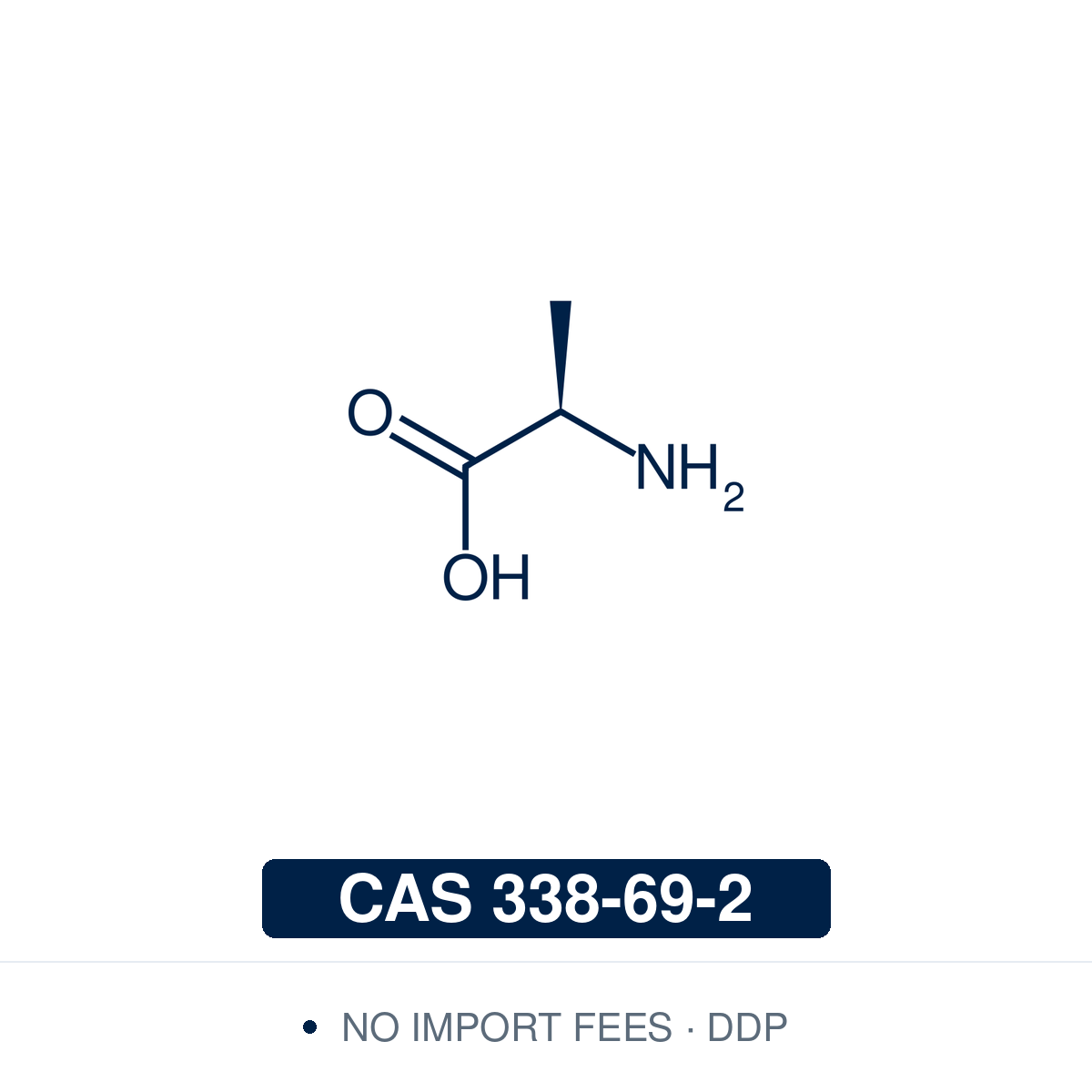
D-Alanine | CAS 338-69-2 | ≥97%
Pack sizes & prices
| Pack size | Excl. VAT | Incl. VAT | Add to cart |
|---|---|---|---|
| 10 g | €39,20 | ||
| 25 g | €49,20 | ||
| 50 g | €64,20 | ||
| 100 g | €79,20 | ||
| 250 g | €109,20 | ||
| 500 g | €189,20 | ||
| 1 kg | €249,20 |
Taxes and fees, e.g. VAT, included in the price. Shipping calculated at checkout.Free shipping on EU, UK and EFTA orders above €250, and above €400 to the rest of the world.
Technical Specifications
| CAS Number | 338-69-2 |
| EC / EINECS Number | 206-418-1 |
| MDL Number | MFCD00008077 |
| SMILES | C[C@H](C(=O)O)N |
| InChI | InChI=1S/C3H7NO2/c1-2(4)3(5)6/h2H,4H2,1H3,(H,5,6)/t2-/m1/s1 |
| InChIKey | QNAYBMKLOCPYGJ-UWTATZPHSA-N |
| PubChem CID | 71080 |
| Molecular Formula | C₃H₇NO₂ |
| Molecular Weight | 89.09 g/mol |
| Melting Point | 291 °C (dec.) |
| Solubility | Soluble in water (165 g/L at 25 °C). Slightly soluble in ethanol and pyridine. Insoluble in diethyl ether and acetone. |
| Purity | ≥97% |
| Physical Form | White powder |
| HS Code | 2922.49 |
| Shelf Life | Retest period: 36 months from date of manufacture |
| Storage Conditions | Store in a cool, dry place in a tightly sealed container. |
Product Description & Scientific Applications
D-Alanine (D-Ala) is the D (R) enantiomer of alanine. It is not one of the amino acids that cells use to make proteins, but in bacteria it is a building block of the cell wall.
Bacterial cell wall. The bacterial cell wall is made of peptidoglycan: sugar chains linked by short peptides that end in D-alanine. During cell wall synthesis, enzymes called transpeptidases remove the last D-alanine of one peptide and join that peptide to a peptide on a neighbouring chain. D-Alanine is therefore used in research on how bacteria build their cell wall.
Substrate of D-amino acid oxidase. D-Amino acid oxidase (DAAO) is an enzyme that oxidises D-amino acids. The products are an α-keto acid, ammonia and hydrogen peroxide; from D-alanine, the α-keto acid is pyruvate. D-Alanine is used as the substrate in assays of DAAO activity. In cells made to express DAAO, adding D-alanine produces hydrogen peroxide inside the cell, so that the place, time and amount of hydrogen peroxide can be controlled.
D-Amino acid oxidase (DAAO) converts D-alanine (left) to pyruvic acid, ammonia and hydrogen peroxide.
Amine donor for transaminases. (R)-Selective ω-transaminases that use alanine as the amine donor require D-alanine. They transfer its amino group to a ketone, which gives an (R)-amine and pyruvate. The reaction is an equilibrium, so the pyruvate is removed, for example with lactate dehydrogenase, to drive the reaction towards the amine.
An (R)-selective ω-transaminase transfers the amino group of D-alanine to a ketone, which gives an (R)-amine and pyruvic acid.
Shipping Destinations
- EU & UK: Priority delivery, 2–5 business days.
- United States (DDP): 3–7 business days, duties and taxes prepaid.
- EFTA Countries (DDP): 3–7 business days, duties and taxes prepaid.
- Worldwide: 7–14 business days, selected locations.
Safety Information
| Hazard Class | Not regulated for transport. |
| Transport Category | Not classified as dangerous goods for transport (ADR/IATA/IMDG) |
Documentation
| Safety Data Sheet | Download PDF |
Share