NorrChemica™
D-Biotin
D-Biotin | CAS 58-85-5 | ≥98%
Couldn't load pickup availability
Technical Specifications
| CAS Number | 58-85-5 |
| EC / EINECS Number | 200-399-3 |
| MDL Number | MFCD00005541 |
| RTECS Number | XJ9088200 |
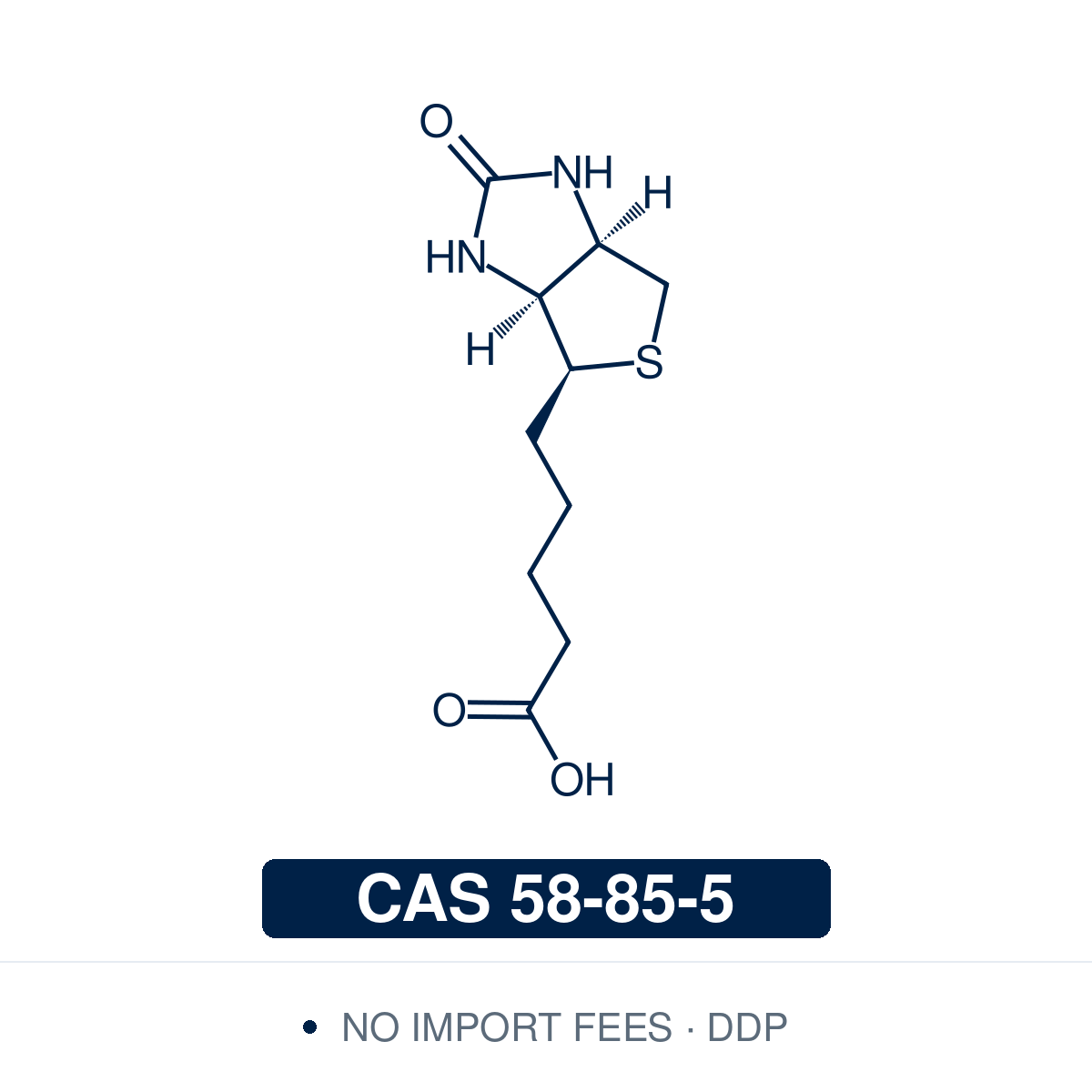
| SMILES | C1[C@H]2[C@@H]([C@@H](S1)CCCCC(=O)O)NC(=O)N2 |
| InChI | InChI=1S/C10H16N2O3S/c13-8(14)4-2-1-3-7-9-6(5-16-7)11-10(15)12-9/h6-7,9H,1-5H2,(H,13,14)(H2,11,12,15)/t6-,7-,9-/m0/s1 |
| InChIKey | YBJHBAHKTGYVGT-ZKWXMUAHSA-N |
| PubChem CID | 171548 |
| Molecular Formula | C₁₀H₁₆N₂O₃S |
| Molecular Weight | 244.31 g/mol |
| Melting Point | 231–233 °C (dec.) |
| Solubility | Slightly soluble in water and ethanol. More soluble in hot water and dilute alkali. Soluble in DMSO. |
| Purity | ≥98% |
| Physical Form | White to off-white crystalline powder |
| HS Code | 2934.99 |
| Shelf Life | Retest period: 36 months from date of manufacture. |
| Storage Conditions | Store in a cool, dry place in a tightly sealed container. |
Product Description & Scientific Applications
D-Biotin (vitamin B7) is a bicyclic compound: a ureido ring cis-fused to a tetrahydrothiophene ring, bearing a valeric acid side chain. It has three contiguous stereocentres, so eight stereoisomers are possible; only the naturally occurring D-(+) form is biologically active. The valerate carboxyl is the site of attachment to other molecules.
(Strept)avidin recognition. Biotin binds the proteins avidin and streptavidin with a dissociation constant on the order of 10⁻¹⁴ M, one of the strongest non-covalent interactions known. Each streptavidin subunit buries the ligand in an eight-stranded antiparallel β-barrel: three tryptophans, together with a fourth contributed by the neighbouring subunit, form a hydrophobic pocket around the tetrahydrothiophene ring and the valerate chain, and hydrogen bonds engage the ureido group. A flexible surface loop then closes over the bound biotin.
Affinity tagging and detection. The valerate carboxyl is the handle for conjugation: coupled to an amine group, biotin is installed as a small tag on antibodies, proteins and nucleic acids. Captured through avidin or streptavidin, this tag underpins enzyme-linked immunosorbent assays, the detection and purification of proteins and nucleic acids, and the immobilization of biomolecules on surfaces. The complex does not dissociate except under conditions harsh enough to denature the protein.
Enzyme cofactor. In biology biotin is the covalently bound prosthetic group of biotin-dependent carboxylases, among them acetyl-CoA carboxylase, pyruvate carboxylase and propionyl-CoA carboxylase, amide-linked through its valerate to a lysine of the carrier protein. It shuttles activated CO₂: at the biotin-carboxylase site the ureido N1′ is carboxylated from bicarbonate in an ATP-dependent step to give carboxybiotin, and at the carboxyltransferase site the carboxyl is transferred to the acceptor substrate.
Shipping Destinations
- EU & UK: Priority delivery, 2–5 business days.
- United States (DDP): 3–7 business days, duties and taxes prepaid.
- EFTA Countries (DDP): 3–7 business days, duties and taxes prepaid.
- Worldwide: 7–14 business days, selected locations.
Safety Information
| Hazard Class | Not regulated for transport |
| Transport Category | Not classified as dangerous goods for transport (ADR/IATA/IMDG) |
Documentation
| Safety Data Sheet | Download PDF |
Share