NorrChemica™
D-Cycloserine
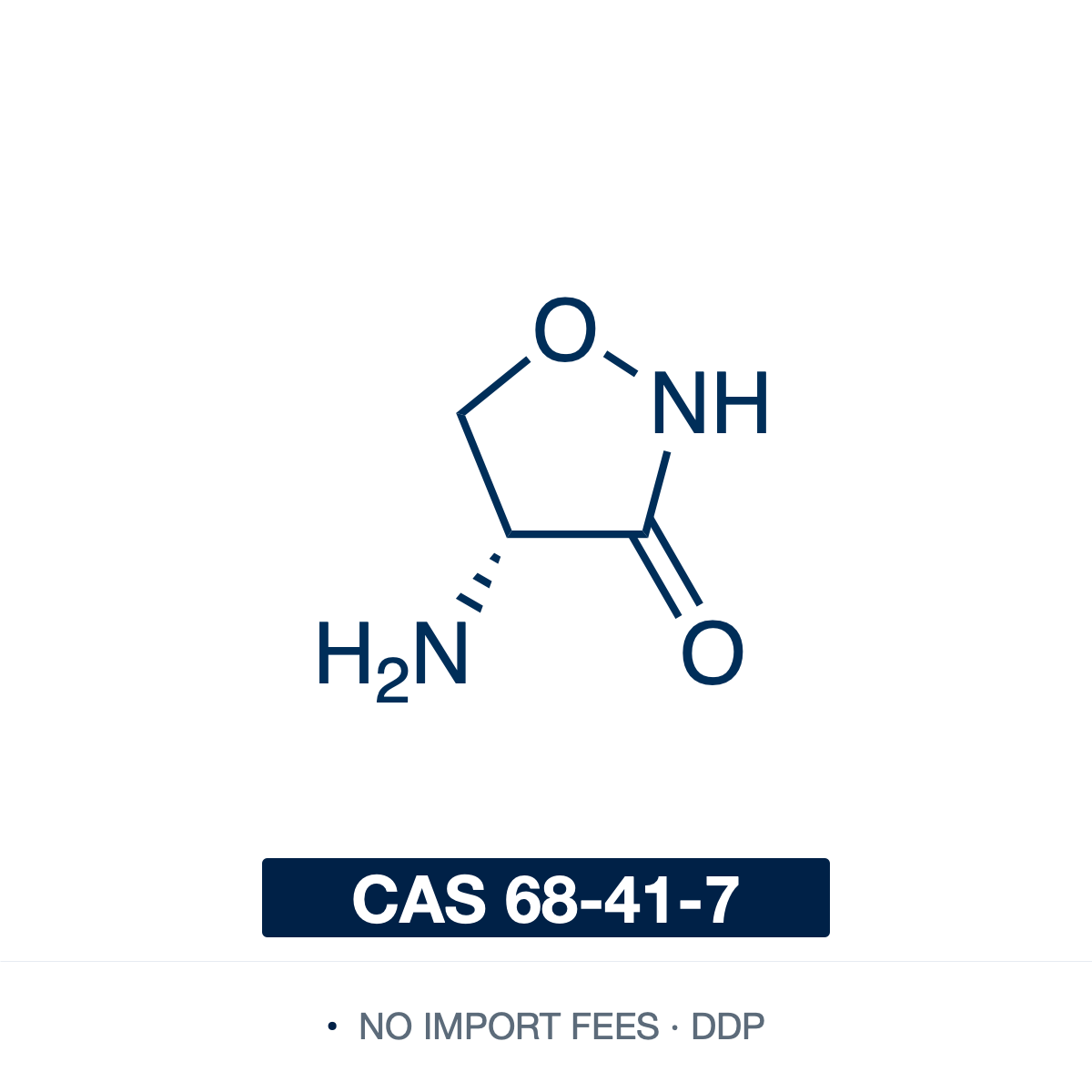
D-Cycloserine | CAS 68-41-7 | ≥98%
Couldn't load pickup availability
Technical Specifications
| CAS Number | 68-41-7 |
| EC / EINECS Number | 200-688-4 |
| MDL Number | MFCD00005353 |
| RTECS Number | NY2975000 |
| SMILES | C1[C@H](C(=O)NO1)N |
| InChI | InChI=1S/C3H6N2O2/c4-2-1-7-5-3(2)6/h2H,1,4H2,(H,5,6)/t2-/m1/s1 |
| InChIKey | DYDCUQKUCUHJBH-UWTATZPHSA-N |
| PubChem CID | 6234 |
| Molecular Formula | C₃H₆N₂O₂ |
| Molecular Weight | 102.09 g/mol |
| Melting Point | 155–156 °C (dec.) |
| Solubility | Soluble in water. Mildly soluble in methanol, ethanol, butanol, isopropanol, propylene glycol, acetone, dioxane. |
| Purity | ≥98% |
| Physical Form | White to pale yellow crystalline powder |
| HS Code | 2941.90 |
| Shelf Life | Retest period: 36 months from date of manufacture |
| Storage Conditions | Keep in a dark place under inert atmosphere; recommended storage in freezer at -20 °C |
Product Description & Scientific Applications
D-Cycloserine ((R)-4-amino-3-isoxazolidinone, D-(+)-cycloserine, oxamycin, orientomycin) is a cyclic structural analogue of D-alanine, produced by Streptomyces orchidaceus, S. garyphalus and S. lavendulae or prepared by stereospecific synthesis. It has two distinct research roles: as a selective antibacterial agent in culture media, and as a partial agonist at the glycine site of the NMDA receptor. It is bacteriostatic against both Gram-negative and Gram-positive bacteria.
As a D-alanine analogue it binds and inactivates two enzymes of peptidoglycan biosynthesis, alanine racemase (Alr) and D-Ala:D-Ala ligase. Inactivation of Alr was long assumed to be irreversible through adduct formation with the pyridoxal-5'-phosphate cofactor. The adduct in fact hydrolyses and rearranges to a stable substituted oxime, so the enzyme reactivates, which explains why racemase activity remains detectable after exposure.
Neutral and acidic aqueous solutions are unstable; prepare fresh for each use. Activity is optimal between pH 6.4 and 7.4. Stock solutions run 10–100 mg/mL in water or 96% ethanol, working concentrations 20–100 µg/mL, stored at −20 °C for up to six months. Sodium carbonate buffered solutions at pH 10 hold activity approximately seven days at +4 °C.
Applications and Reactions
- Selective media for Clostridioides difficile: The defining component, with cefoxitin, of cycloserine–cefoxitin fructose agar (CCFA), described in 1979 and still a reference method for isolating C. difficile. Classical formulations use 500 µg/mL; in environmental sampling, reducing this to 250 µg/mL raised the positive culture rate from 4% to 17%, indicating 500 µg/mL is too inhibitory for moderately sensitive strains.
- Peptidoglycan biosynthesis studies: Reference inhibitor of alanine racemase and D-Ala:D-Ala ligase for work on D-alanine metabolism, cell-wall assembly, and the consequences of racemase inactivation. Which enzyme is the primary lethal target remains contested.
- Antimycobacterial research: A standard tool compound in Mycobacterium tuberculosis work, and a component of regimens studied against multidrug- and extensively drug-resistant disease. Screening of over 1,500 drug-resistant strains identified three alanine racemase mutations under positive selection that likely confer resistance; mutations in alanine dehydrogenase and the permease cycA also contribute.
- NMDA receptor pharmacology: Partial agonist at the D-serine/glycine binding site. At 20 µM in juvenile rat hippocampal slices it augments NMDAR-dependent long-term potentiation and long-term depression without affecting basal synaptic transmission, widening the bidirectional plasticity range.
- Extinction learning: Given before or shortly after cue exposure it facilitates extinction of conditioned fear and attenuates its return following stress. Effects are strongly dose-dependent: in rat cocaine self-administration, 30 mg/kg accelerated extinction from nine days to four, where 15 mg/kg produced no effect. Clinical augmentation data are modest: pooled results from 21 trials and 1047 participants showed improvement at post-treatment but not at follow-up.
- Serine hydroxymethyltransferase inhibition: Used to inhibit SHMT in one-carbon metabolism studies.
- Biosynthesis: The producer carries a 21-kb cluster of ten open reading frames, dcsA to dcsJ, in Streptomyces lavendulae ATCC 11924, with dcsI and dcsJ conferring self-resistance.
Supplied for research use only. Not for diagnostic, therapeutic, or human or veterinary use.
Shipping Destinations
- EU & UK: Priority delivery, 2–5 business days
- EFTA Countries (DDP): 2–5 business days, duties and taxes prepaid.
Safety Information
| Hazard Class | Not regulated for transport |
| Transport Category | Not classified as dangerous goods for transport (ADR/IATA/IMDG) |
Documentation
| Safety Data Sheet | Download PDF |
Share