1
/
of
1
NorrChemica™
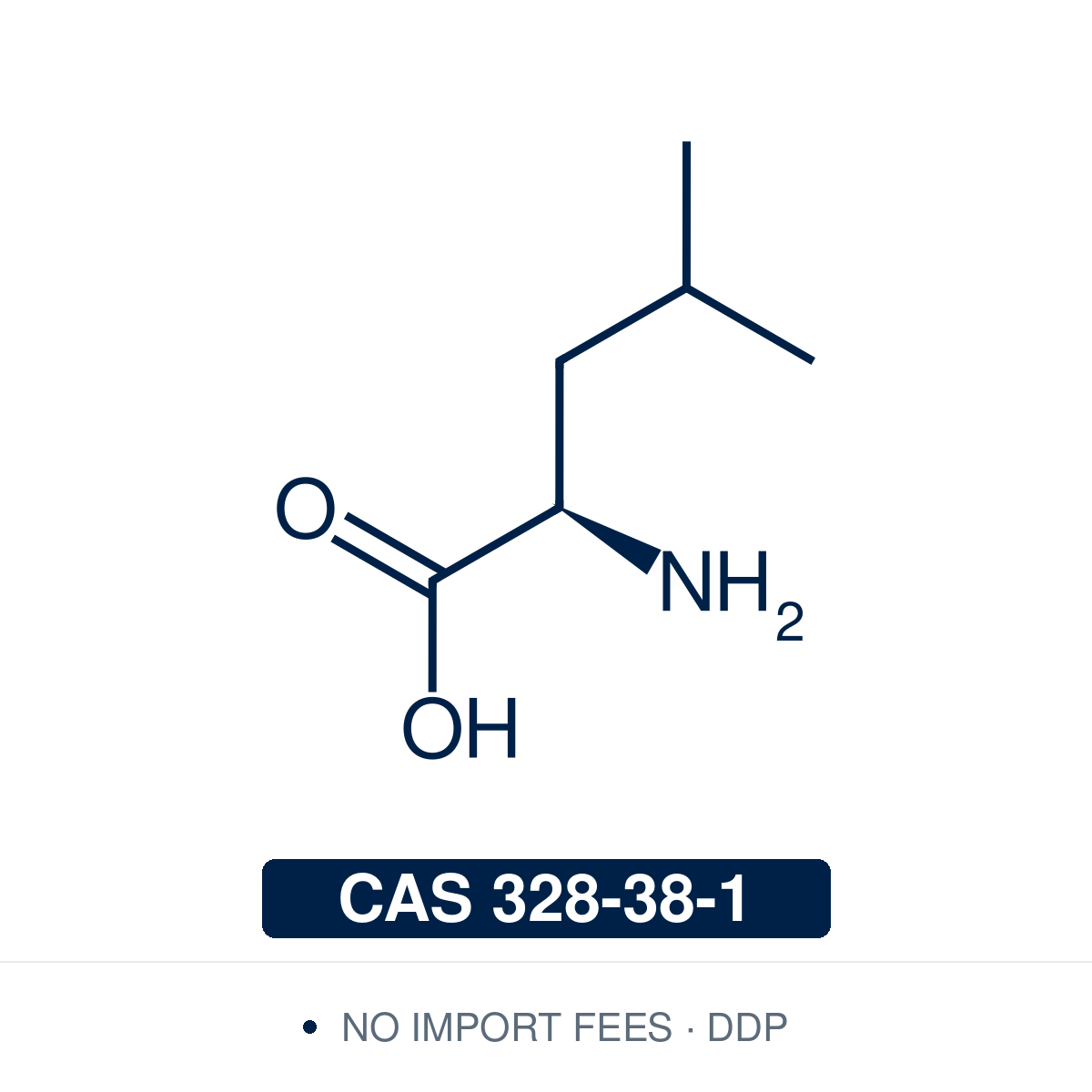
D-Leucine
CAS 328-38-1
≥98%
D-Leucine | CAS 328-38-1 | ≥98%
Regular price
€29,20 EUR (incl. VAT)
Regular price
€34,80 EUR
Sale price
€29,20 EUR
Taxes included.
Shipping calculated at checkout.
Quantity
Couldn't load pickup availability
Technical Specifications
| CAS Number | 328-38-1 |
| EC / EINECS Number | 206-327-7 |
| MDL Number | MFCD00063088 |
| RTECS Number | OH2840000 |
| SMILES | CC(C)C[C@H](C(=O)O)N |
| InChI | InChI=1S/C6H13NO2/c1-4(2)3-5(7)6(8)9/h4-5H,3,7H2,1-2H3,(H,8,9)/t5-/m1/s1 |
| InChIKey | ROHFNLRQFUQHCH-RXMQYKEDSA-N |
| PubChem CID | 439524 |
| Molecular Formula | C6H13NO2 |
| Molecular Weight | 131.17 g/mol |
| Melting Point | >300 °C (dec.) |
| Solubility | Soluble in water; freely soluble in dilute hydrochloric acid |
| Purity | ≥98% |
| Physical Form | White crystalline powder |
| HS Code | 2922.49 |
| Country of Origin | Finland |
| Shelf Life | Retest period: 36 months from date of manufacture |
| Storage Conditions | Store in a cool, dry place in a tightly sealed container |
Product Description & Scientific Applications
D-Leucine (D-α-aminoisocaproic acid) is a branched-chain D-amino acid used as a chiral building block in research peptide synthesis and as a substrate in D-amino-acid metabolism and oxidase-assay studies. The compound is supplied as a white crystalline powder, moderately soluble in water and soluble in dilute acids. Fmoc-, Boc-, Cbz-, and N-acetyl-D-leucine derivatives are widely used when protected D-leucine residues are required for peptide or small-molecule synthesis.
Applications:
- D-peptide synthesis: Incorporated into research peptides as a hydrophobic branched-chain D-residue to increase resistance to proteolysis and alter stereochemical recognition. Useful in mirror-image peptide design, all-D peptide libraries, and proteolytically stable analogues of natural sequences used in receptor-recognition, membrane-interaction, and structure–activity studies.
- D-amino acid oxidase and D-amino-acid metabolism studies: Used as a neutral hydrophobic D-amino-acid substrate in assays of D-amino acid oxidase and related D-amino-acid-metabolising enzymes. DAAO catalyses oxidative deamination of many neutral D-amino acids to the corresponding imino/keto acids with production of ammonia and hydrogen peroxide, making D-leucine useful in substrate-specificity, enzyme-engineering, and analytical oxidase-assay workflows.
- Biofilm and bacterial cell-wall research: Used in microbial-community studies investigating D-amino-acid-triggered biofilm inhibition and disassembly. D-leucine is one of the D-amino acids reported in biofilm-disassembly mixtures that affect bacterial matrix stability and release amyloid fibres linking cells in the biofilm, with documented effects in Bacillus subtilis, Staphylococcus aureus, and Pseudomonas aeruginosa.
- Chiral separation and enantiomeric analysis reference: Employed as a D-amino-acid standard in HPLC, ligand-exchange chromatography, and capillary electrophoresis methods developed for separation, detection, and quantification of D- and L-amino acid enantiomers in biological, food, fermentation, and analytical quality-control samples.
- Chiral-pool and peptidomimetic synthesis: Used as a stereochemically defined branched-chain amino acid for preparing protected D-leucine derivatives, peptidomimetics, and chiral small-molecule intermediates where the D-configuration and hydrophobic isobutyl side chain are used to tune conformation, solubility, and molecular recognition.
Shipping Destinations
- EU & UK: Priority delivery, 2–5 business days.
- United States (DDP): 3–7 business days, duties and taxes prepaid.
- EFTA Countries (DDP): 3–7 business days, duties and taxes prepaid.
- Worldwide: 7–14 business days, selected locations.
Safety Information
| Hazard Class | Not regulated for transport |
| Transport Category | Not classified as dangerous goods for transport (ADR/IATA/IMDG) |
Documentation
| Safety Data Sheet | Download PDF |
Share