1
/
of
1
NorrChemica™
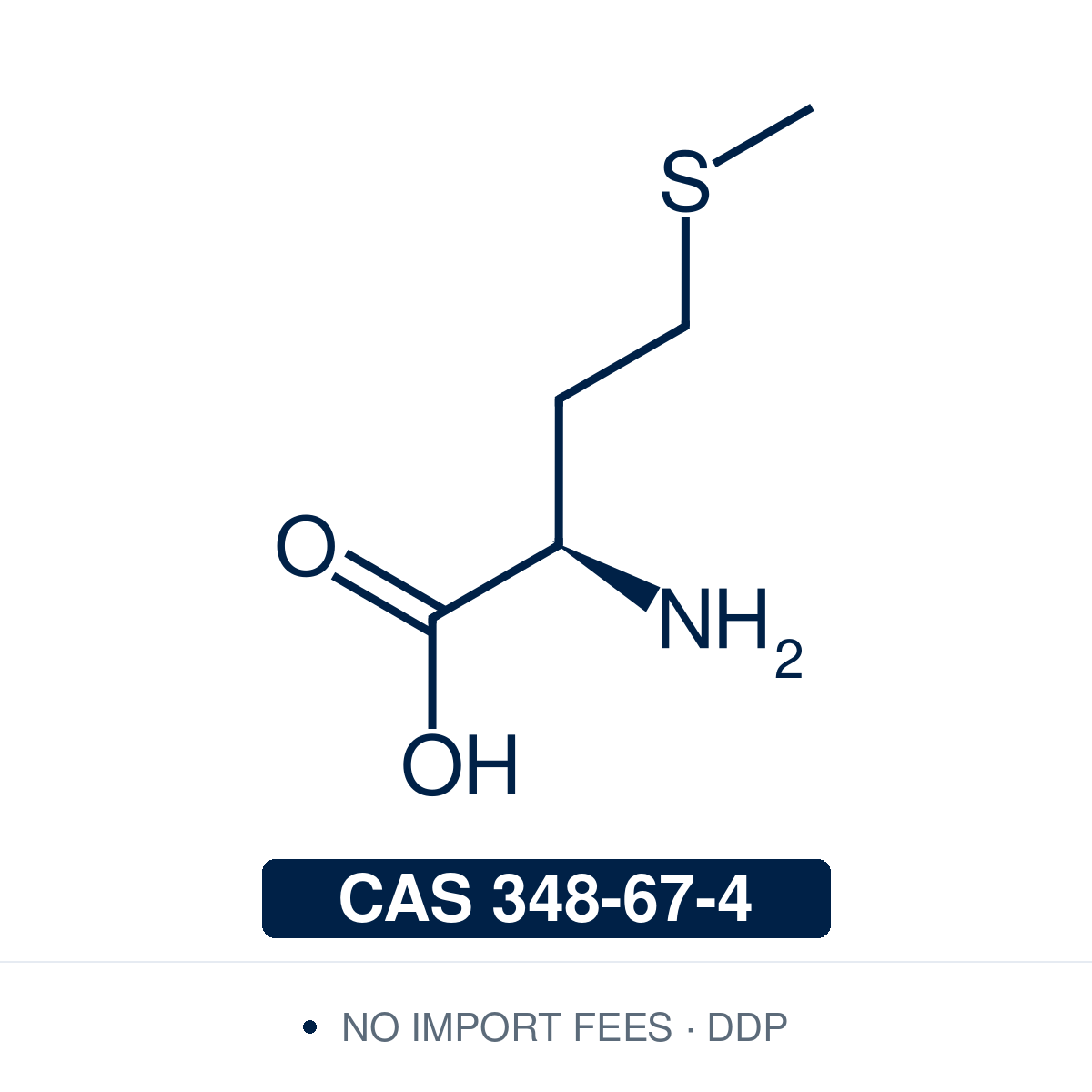
D-Methionine
CAS 348-67-4
≥98%
D-Methionine | CAS 348-67-4 | ≥98%
Regular price
€34,20 EUR (incl. VAT)
Regular price
Sale price
€34,20 EUR
Taxes included.
Shipping calculated at checkout.
Quantity
Couldn't load pickup availability
Technical Specifications
| CAS Number | 348-67-4 |
| EC / EINECS Number | 206-483-6 |
| MDL Number | MFCD00002622 |
| RTECS Number | PD0455000 |
| SMILES | CSCC[C@H](C(=O)O)N |
| InChI | InChI=1S/C5H11NO2S/c1-9-3-2-4(6)5(7)8/h4H,2-3,6H2,1H3,(H,7,8)/t4-/m1/s1 |
| InChIKey | FFEARJCKVFRZRR-SCSAIBSYSA-N |
| PubChem CID | 84815 |
| Molecular Formula | C₅H₁₁NO₂S |
| Molecular Weight | 149.21 g/mol |
| Melting Point | 273 °C (dec.) |
| Solubility | Soluble in water, dilute acids and dilute alkalis; very slightly soluble in ethanol; insoluble in diethyl ether |
| Purity | ≥98% |
| Physical Form | White to off-white fine crystalline powder |
| HS Code | 2930.40 |
| Shelf Life | Retest period: 36 months from date of manufacture |
| Storage Conditions | Store at room temperature in a tightly closed container, protected from light and moisture |
Product Description & Scientific Applications
D-Methionine ((R)-methionine, H-D-Met-OH) is the unnatural enantiomer of methionine. It has the same melting point and solubility as the L form. Enzymes, transporters and cell-wall enzymes tell the two apart, and only L-methionine is used in ribosomal protein synthesis. Enantiomeric identity is checked by specific rotation: −23 to −25° at c = 4 in 1:1 hydrochloric acid.
Applications and Reactions
- Peptidoglycan and cell-wall remodelling: Bacteria incorporate non-canonical D-amino acids, D-methionine among them, into the fifth position of peptidoglycan muropeptides. It probes cell-wall editing and the enzymes that perform it.
- Biofilm research: A 2010 report found D-methionine, with D-leucine, D-tyrosine and D-tryptophan, in a Bacillus subtilis factor that acted against biofilms at nanomolar concentrations. The mechanism is disputed. Later work attributed the effect to interference with protein synthesis rather than to matrix disassembly, and a separate study found no inhibition of Staphylococcus aureus biofilms.
- Spore germination: D-methionine does not trigger germination of Clostridium sporogenes or C. botulinum spores. It blocks the germination that L-methionine induces, and so probes germinant receptor specificity.
- Otoprotection: Studied against cisplatin, aminoglycoside and noise-induced cochlear damage. Cochlear oxidative state is followed through superoxide dismutase, catalase, glutathione peroxidase, glutathione reductase and malondialdehyde. Rescue dosing reduced permanent threshold shift for steady-state noise at every dose, time and frequency tested, but did not reduce temporary threshold shift.
- Radioprotection: It protected non-transformed human cells in culture from radiation-induced death, and protected tumour cells less. That difference is the basis of the mucositis work.
- Tumour imaging: Radiolabelled D-methionine reached roughly three times the tumour radioactivity of the L-isomer in Ehrlich solid tumour. Both labelled isomers serve as positron emission tomography tracers for brain tumours.
- Biocatalysis and transport: A four-enzyme cascade converts D-methionine to L-methionine. The bacterial periplasmic binding protein MetQ binds both isomers, so the pair tests stereospecificity in transport studies.
Shipping Destinations
- EU & UK: Priority delivery, 2–5 business days.
- United States (DDP): 3–7 business days, duties and taxes prepaid.
- EFTA Countries (DDP): 3–7 business days, duties and taxes prepaid.
- Worldwide: 7–14 business days, selected locations.
Safety Information
| Hazard Class | Not regulated for transport |
| Transport Category | Not classified as dangerous goods for transport (ADR/IATA/IMDG) |
Documentation
| Safety Data Sheet | Download PDF |
Share