NorrChemica™
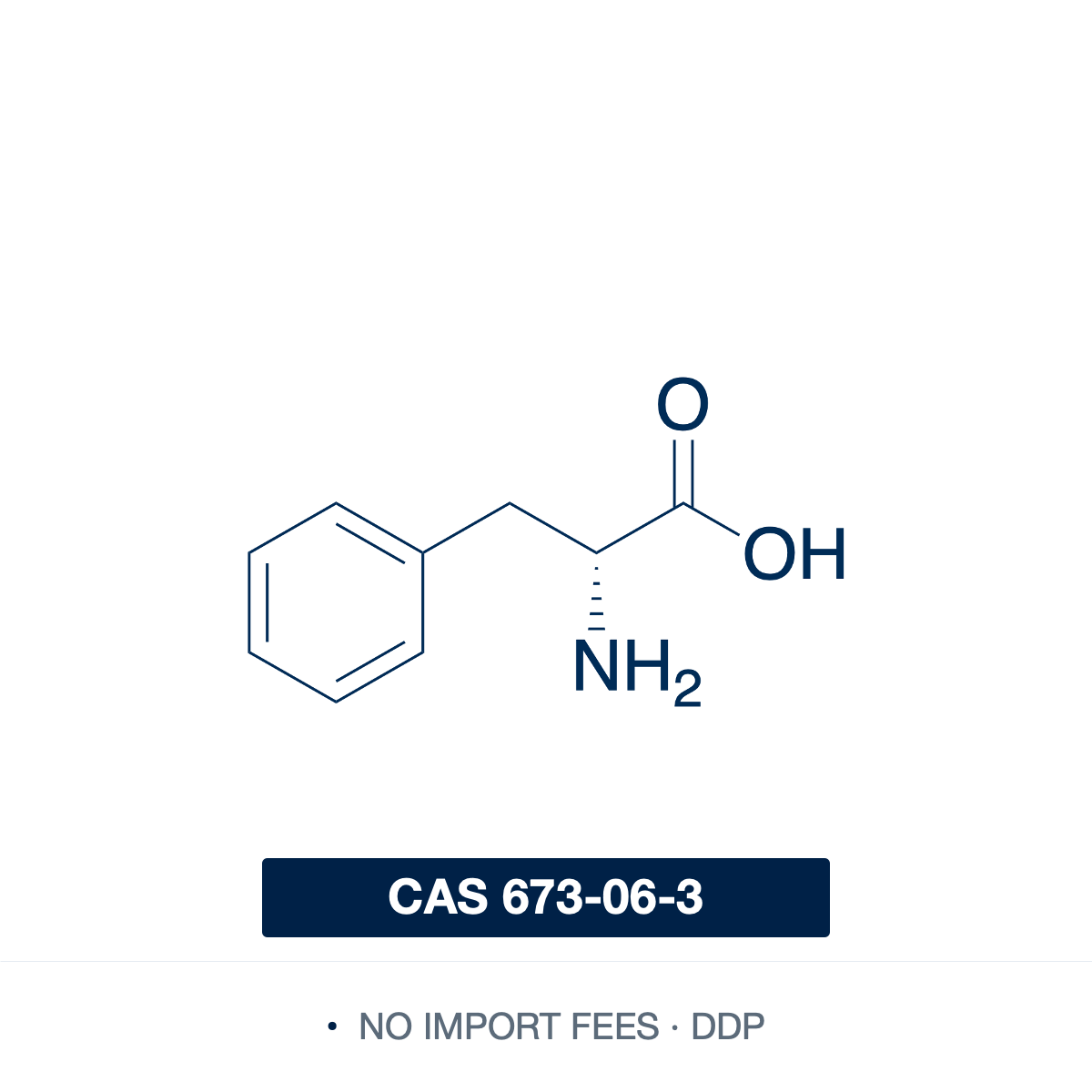
D-Phenylalanine
D-Phenylalanine | CAS 673-06-3 | ≥99%
Couldn't load pickup availability
Technical Specifications
| CAS Number | 673-06-3 |
| EC / EINECS Number | 211-603-5 |
| MDL Number | MFCD00004270 |
| SMILES | C1=CC=C(C=C1)C[C@H](C(=O)O)N |
| InChI | InChI=1S/C9H11NO2/c10-8(9(11)12)6-7-4-2-1-3-5-7/h1-5,8H,6,10H2,(H,11,12)/t8-/m1/s1 |
| InChIKey | COLNVLDHVKWLRT-MRVPVSSYSA-N |
| PubChem CID | 71567 |
| Molecular Formula | C₉H₁₁NO₂ |
| Molecular Weight | 165.19 g/mol |
| Melting Point | 273–276 °C (lit.) |
| Solubility | Soluble in water (30 mg/mL); slightly soluble in methanol, ethanol, and DMSO. |
| Purity | ≥99.0% |
| Physical Form | White crystalline powder |
| HS Code | 2922.49 |
| Country of Origin | Finland |
| Shelf Life | Retest period: 36 months from date of manufacture. |
| Storage Conditions | Store in a cool, dry place in a tightly sealed container. |
Product Description & Scientific Applications
D-Phenylalanine (D-Phe; H-D-Phe-OH) is the non-proteinogenic D-enantiomer of phenylalanine and an aromatic D-amino acid building block for peptide chemistry, asymmetric synthesis, and biocatalysis. Because chymotrypsin and other L-stereoselective proteases process only L-configured residues, placing D-Phe at a cleavage site can raise a peptide's proteolytic resistance while preserving the aromatic side chain that supports hydrophobic binding and conformational bias. Its fixed configuration and UV-detectable aromatic chromophore suit it to D-amino acid scans and to mechanistic studies of D-amino-acid-transforming enzymes.
Protease-resistant residue. Chymotrypsin's hydrophobic S1 pocket favours L-Phe, Tyr, and Trp at P1; inverting the α-carbon to D-Phe disrupts productive substrate alignment without removing the aromatic group. It is used in D-amino acid scans, peptidomimetics, and cyclic protease-resistant scaffolds, where a D-residue paired with proline templates a type II′ β-turn. It occurs in non-ribosomal cyclic decapeptides — gramicidin S, cyclo(Val-Orn-Leu-D-Phe-Pro)₂, whose two D-Phe–Pro turns close the antiparallel β-sheet, and the related tyrocidine D-Phe–Pro motif. In gramicidin S biosynthesis the GrsA module activates L-Phe and epimerises the thioester-bound intermediate before chain transfer.
Chiral building block. The fixed (R)-configuration transfers stereochemistry predictably into downstream intermediates; after N- and C-terminal protection, protected D-Phe derivatives are built into peptide and small-molecule scaffolds, chiral auxiliaries, and resolving agents requiring the non-natural configuration.
Biocatalysis probe. A substrate and mechanistic probe for D-amino acid oxidase (DAAO, FAD-dependent) and PLP-dependent D-amino acid transaminases, used to probe stereoselectivity, substrate scope, kinetic mechanism, and active-site recognition. For human DAAO, bulky hydrophobic D-amino acids — D-Phe, D-DOPA, D-Tyr, D-Trp — are among the most reactive, varying with enzyme source and engineered variant. It is also a DAAO substrate in immobilised-enzyme reactors and in amino-acid deracemisation, which couples stereoselective enzymatic oxidation with non-selective chemical reduction of the imino acid.
Hydroxyl-radical probe. A specific •OH trap in chemical, enzymatic, cellular, and intact-organ systems: aromatic hydroxylation yields the three regioisomers o-, m-, and p-tyrosine, resolved by HPLC with electrochemical or fluorescence detection. Because phenylalanine hydroxylase is L-selective, tyrosines from administered D-Phe report non-enzymatic radical attack rather than enzymatic Phe→Tyr conversion — used in oxidative-stress, ex vivo organ-perfusion and reperfusion, and redox-signalling studies.
Other uses. Reference standard for enantioselective HPLC and capillary-electrophoresis separations; probe for stereoselective recognition by the system-L transporter LAT1; substrate in biocatalytic stereoinversion and deracemisation; certified-reference/calibration standard for chromatographic (LC–CD) quantification of amino acid enantiomers.
Shipping Destinations
- EU & UK: Priority delivery, 2–5 business days.
- United States (DDP): 3–7 business days, duties and taxes prepaid.
- EFTA Countries (DDP): 3–7 business days, duties and taxes prepaid.
- Worldwide: 7–14 business days, selected locations.
Safety Information
| Hazard Class | None — not subject to transport regulations |
| Transport Category | Not classified as dangerous goods for transport (ADR/IATA/IMDG) |
Documentation
| Safety Data Sheet | Download PDF |
Share