1
/
of
1
NorrChemica™
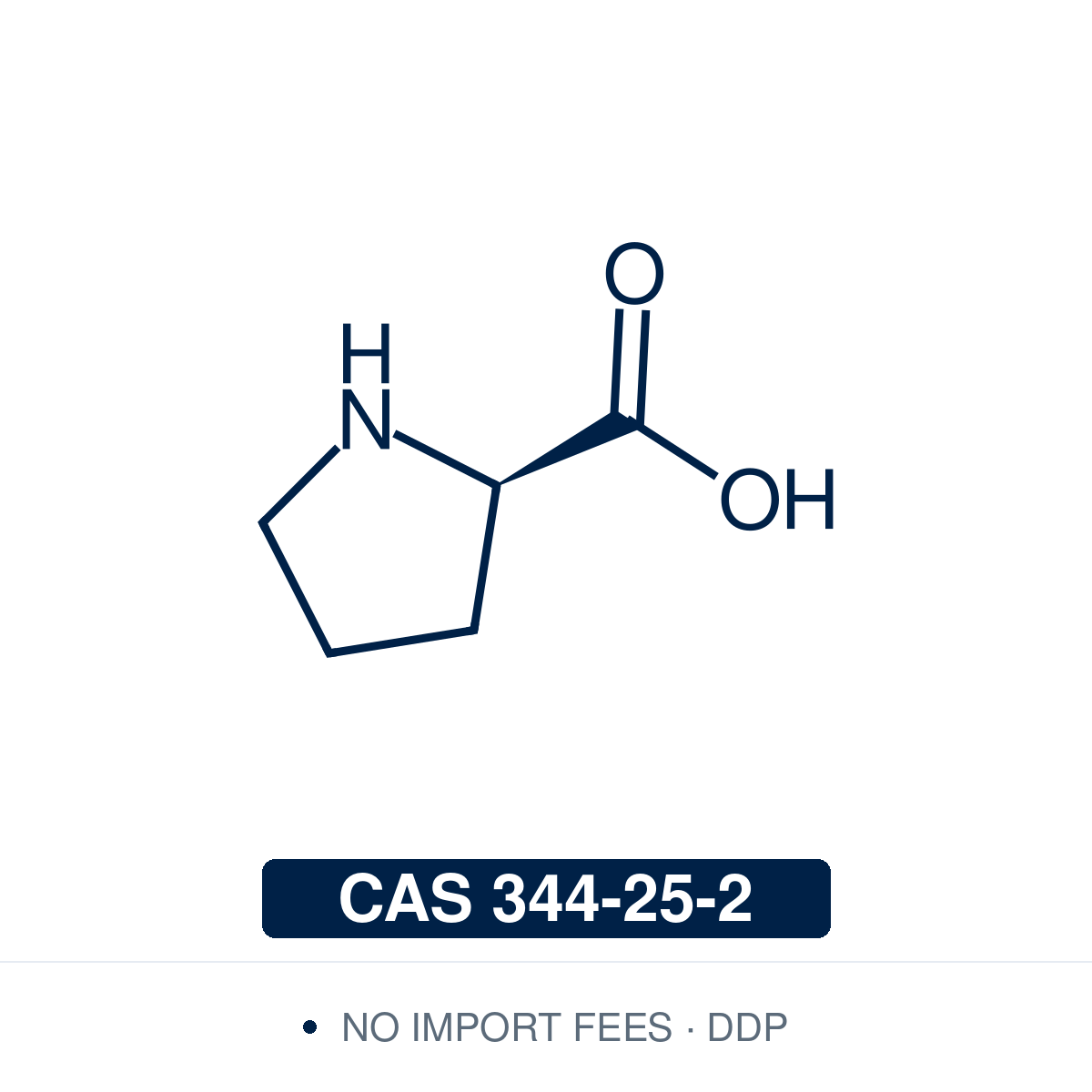
D-Proline
CAS 344-25-2
≥98%
D-Proline | CAS 344-25-2 | ≥98%
Regular price
€29,20 EUR (incl. VAT)
Regular price
Sale price
€29,20 EUR
Taxes included.
Shipping calculated at checkout.
Quantity
Couldn't load pickup availability
Technical Specifications
| CAS Number | 344-25-2 |
| EC / EINECS Number | 206-452-7 |
| MDL Number | MFCD00064317 |
| SMILES | C1C[C@@H](NC1)C(=O)O |
| InChI | InChI=1S/C5H9NO2/c7-5(8)4-2-1-3-6-4/h4,6H,1-3H2,(H,7,8)/t4-/m1/s1 |
| InChIKey | ONIBWKKTOPOVIA-SCSAIBSYSA-N |
| PubChem CID | 8988 |
| Molecular Formula | C₅H₉NO₂ |
| Molecular Weight | 115.13 g/mol |
| Melting Point | 223 °C (dec.) |
| Solubility | Soluble in water. Sparingly soluble in acetone. Insoluble in ethanol. |
| Purity | ≥98% |
| Physical Form | White powder |
| HS Code | 2933.99 |
| Shelf Life | Retest period: 36 months from date of manufacture |
| Storage Conditions | Store at room temperature in a tightly sealed container protected from moisture |
Product Description & Scientific Applications
D-Proline is the (R)-enantiomer of proline, the only natural amino acid whose amine is secondary. Amine and acid act together: the amine condenses with an aldehyde or ketone to a nucleophilic enamine, while the carboxylic acid hydrogen-bonds to the electrophile and activates it. That same hydrogen bond fixes the position of the electrophile, so it reacts at only one prochiral face of the enamine. In this manner, D-proline is able to catalyse a considerable set of asymmetric transformations.
Which face is selected follows from the configuration at the pyrrolidine ring, so D-proline gives the mirror image of the L-series.
Reaction scope
- Aldol and Mannich: Enamine activation of aldehydes and ketones towards carbonyl and imine electrophiles.
- Michael addition: Conjugate addition of aldehydes and ketones to nitroolefins and related acceptors.
- α-Amination: Azodicarboxylate electrophiles, giving α-hydrazino carbonyl compounds.
- α-Aminoxylation: With nitrosobenzene as the oxygen source, choosing L- or D-proline gives either 1,2-diol antipode at 54–86% yield and 94–99% ee.
- Catalyst scaffold: Starting material for D-prolinamide, Pro-Pro dipeptide and diketopiperazine organocatalysts, where the D-residue reverses the sense of induction.
Peptide conformational templating
- β-Hairpin nucleation: The heterochiral D-Pro-L-Pro dipeptide has a marked propensity for the type II′ β-turn and nucleates hairpins; homochiral L-Pro-L-Pro instead induces local helical folding.
- Loop mimetics: A twelve-residue loop from the interferon-γ receptor grafted onto the template gives a cyclic peptide whose flanking residues mimic the receptor’s antiparallel strands; it also promotes backbone cyclisation.
- Downstream use: D-Pro-L-Pro and D-Pro-Gly are the two turn templates now most used, underpinning self-assembling hairpin hydrogels and cyclic peptidomimetic antibiotics.
Shipping Destinations
- EU & UK: Priority delivery, 2–5 business days.
- United States (DDP): 3–7 business days, duties and taxes prepaid.
- EFTA Countries (DDP): 3–7 business days, duties and taxes prepaid.
- Worldwide: 7–14 business days, selected locations.
Safety Information
| Hazard Class | Not regulated for transport |
| Transport Category | Not classified as dangerous goods for transport (ADR/IATA/IMDG) |
Documentation
| Safety Data Sheet | Download PDF |
Share