NorrChemica™
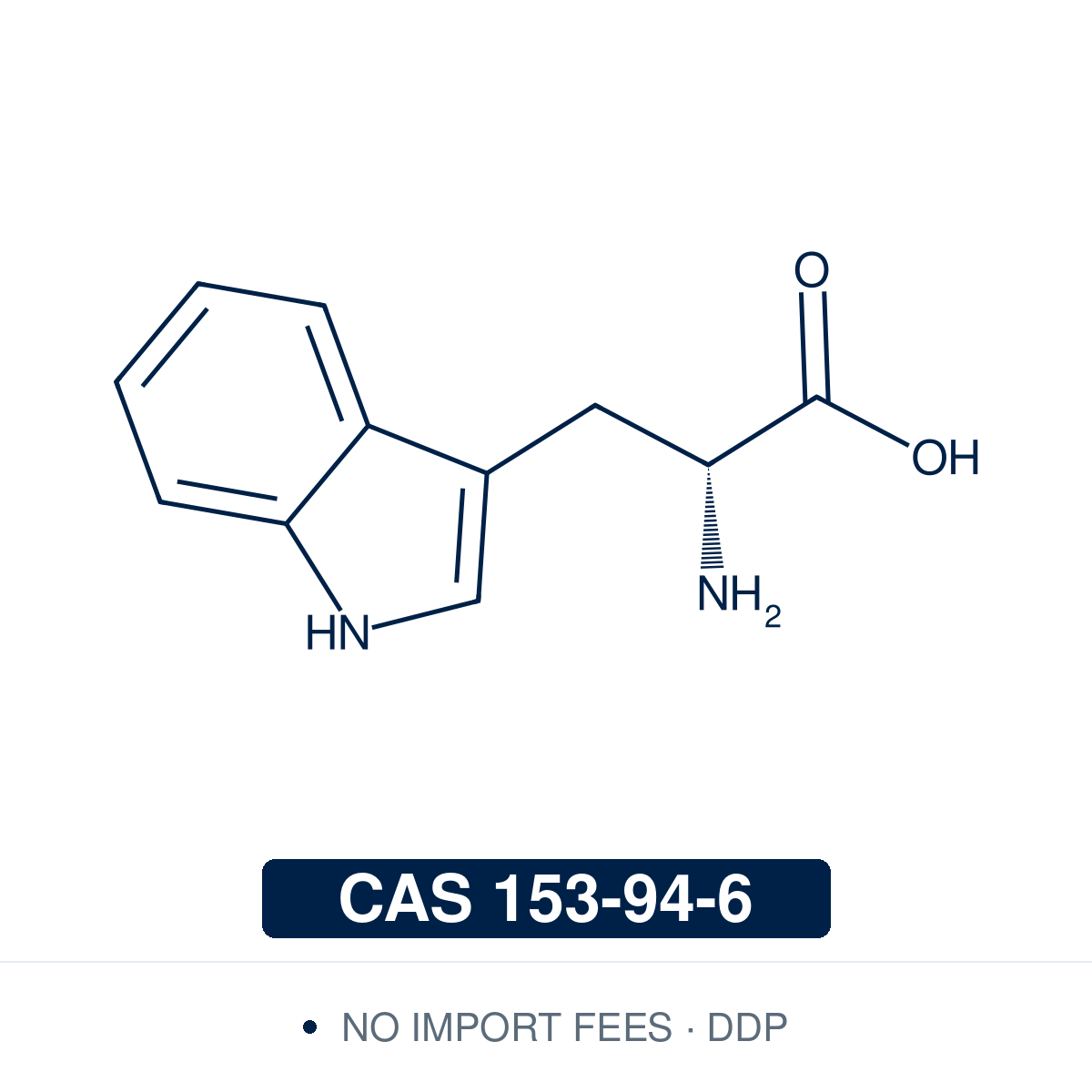
D-Tryptophan
D-Tryptophan | CAS 153-94-6 | ≥98%
Couldn't load pickup availability
Technical Specifications
| CAS Number | 153-94-6 |
| EC / EINECS Number | 205-819-9 |
| MDL Number | MFCD00005647 |
| RTECS Number | YN6129000 |
| SMILES | C1=CC=C2C(=C1)C(=CN2)C[C@H](C(=O)O)N |
| InChI | InChI=1S/C11H12N2O2/c12-9(11(14)15)5-7-6-13-10-4-2-1-3-8(7)10/h1-4,6,9,13H,5,12H2,(H,14,15)/t9-/m1/s1 |
| InChIKey | QIVBCDIJIAJPQS-SECBINFHSA-N |
| PubChem CID | 9060 |
| Molecular Formula | C11H12N2O2 |
| Molecular Weight | 204.23 g/mol |
| Melting Point | 282–285 °C (dec.) |
| Solubility | Moderately soluble in water; sparingly soluble in lower alcohols; essentially insoluble in non-polar organic solvents |
| Log Pow | -1.06 |
| Purity | ≥98% |
| Physical Form | White to pale yellow crystalline powder |
| HS Code | 2933.99 |
| Country of Origin | Finland |
| Shelf Life | Retest period: 36 months from date of manufacture |
| Storage Conditions | Store in a cool, dry place in a tightly sealed container, protected from light |
Product Description & Scientific Applications
D-Tryptophan ((2R)-2-amino-3-(1H-indol-3-yl)propanoic acid, (R)-tryptophan, D-Trp) is the non-proteinogenic D-enantiomer of the aromatic indole amino acid tryptophan. It is supplied as a white to pale yellow crystalline powder with a melting/decomposition range near 282–285 °C and a positive specific rotation around +31° in water, consistent with the D/R configuration. The compound is sparingly soluble in water (~11 g/L at 20 °C), soluble in dilute acid, alkali hydroxide solution, hot alcohol, and DMSO, and essentially insoluble in chloroform. Its indole side chain provides near-UV absorbance around 280 nm and intrinsic fluorescence emission near 350 nm, making D-Tryptophan useful as a chiral indole amino-acid reference, peptide-synthesis building block, and substrate or probe in D-amino-acid metabolism studies.
Applications:
- D-peptide and antimicrobial-peptide synthesis: Incorporated into synthetic research peptides as a hydrophobic aromatic D-residue where the indole side chain is required but proteolytic stability, stereochemical inversion, or altered membrane interaction is desired. D-Trp is useful in mirror-image peptide design, partial D-substituted peptides, cyclic peptide analogues, and Trp-rich antimicrobial or amphipathic peptide scaffolds studied for membrane binding, interfacial anchoring, and structure–activity relationships.
- Spectroscopic and chiral analytical reference: The indole chromophore of D-Tryptophan absorbs near 280 nm and gives environment-sensitive fluorescence around 340–360 nm, supporting use as an enantiomeric reference in fluorescence spectroscopy, circular dichroism, chiral HPLC, and capillary electrophoresis methods that distinguish D- from L-tryptophan and resolve indole-containing amino-acid or peptide mixtures.
- D-amino acid oxidase and kynurenine-pathway metabolism studies: D-Tryptophan is a substrate of D-amino acid oxidase (DAAO), the FAD-dependent flavoenzyme that catalyses stereoselective oxidative deamination of D-amino acids to the corresponding α-keto acids, hydrogen peroxide, and ammonia. In mammalian metabolism studies, D-Tryptophan is converted in brain and peripheral tissues into kynurenine-pathway metabolites including D-kynurenine, L-kynurenine, kynurenic acid, 3-hydroxykynurenine, and quinolinic acid, with DAAO involvement confirmed experimentally. This supports its use in studies of DAAO substrate specificity, D-amino-acid metabolism, and stereoselective indole catabolism.
- Biofilm and microbial-community research: Used in bacterial biofilm studies investigating D-amino-acid-mediated inhibition, dispersal, and cell-wall or matrix regulation. D-Tryptophan is reported both as a component of D-amino-acid mixtures that disperse established biofilms and as an individual D-amino acid affecting attachment and biofilm formation in Pseudomonas and Staphylococcus systems.
Shipping Destinations
- EU & UK: Priority delivery, 2–5 business days.
- United States (DDP): 3–7 business days, duties and taxes prepaid.
- EFTA Countries (DDP): 3–7 business days, duties and taxes prepaid.
- Worldwide: 7–14 business days, selected locations.
Safety Information
| Hazard Class | Not regulated for transport |
| Transport Category | Not classified as dangerous goods for transport (ADR/IATA/IMDG) |
Documentation
| Safety Data Sheet | Download PDF |
Share