NorrChemica™
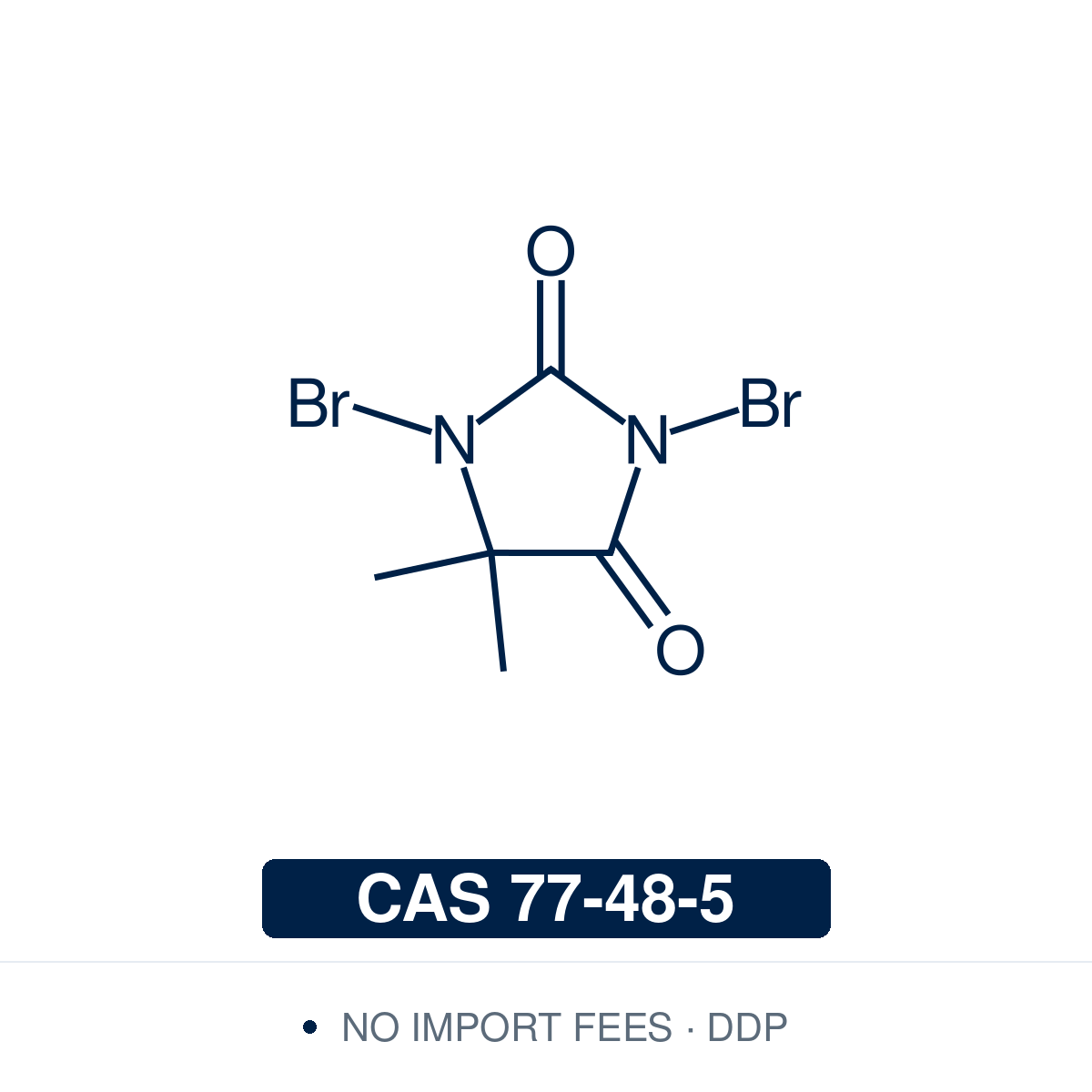
1,3-Dibromo-5,5-dimethylhydantoin
CAS 77-48-5
≥97%
1,3-Dibromo-5,5-dimethylhydantoin | CAS 77-48-5 | ≥97%
| Pack size | Excl. VAT | Incl. VAT | Add to cart |
|---|---|---|---|
| 25 g | €39,20 | ||
| 50 g | €49,20 | ||
| 100 g | €64,20 | ||
| 500 g | €149,20 | ||
| 1 kg | €249,20 |
Taxes and fees, e.g. VAT, included in the price. Shipping calculated at checkout.Free shipping on EU, UK and EFTA orders above €250, and above €400 to the rest of the world.
Technical Specifications
| CAS Number | 77-48-5 |
| EC / EINECS Number | 201-030-9 |
| MDL Number | MFCD00003189 |
| SMILES | CC1(C(=O)N(C(=O)N1Br)Br)C |
| InChI | InChI=1S/C5H6Br2N2O2/c1-5(2)3(10)8(6)4(11)9(5)7/h1-2H3 |
| InChIKey | VRLDVERQJMEPIF-UHFFFAOYSA-N |
| PubChem CID | 6479 |
| Molecular Formula | C₅H₆Br₂N₂O₂ |
| Molecular Weight | 285.92 g/mol |
| Melting Point | 196–198 °C |
| Solubility | Soluble in chloroform, ethanol, acetone and acetonitrile. Slightly soluble in water (2.2 g/L at 20 °C). |
| Purity | ≥97% |
| Physical Form | White to off-white crystalline powder |
| HS Code | 2933.21 |
| Shelf Life | Retest period: 36 months from date of manufacture |
| Storage Conditions | Store at room temperature in a tightly sealed container, protected from moisture |
Product Description & Scientific Applications
1,3-Dibromo-5,5-dimethylhydantoin, also sold as DBDMH or dibromantin (C5H6Br2N2O2, 285.92 g/mol), is the N,N′-dibrominated hydantoin: a bromine on each ring nitrogen, so one molecule carries two.
It is a stronger brominating reagent than N-bromosuccinimide. Head to head as an activator on the same substrate at the same loading, it gave 87% against 65% for NBS and 43% for NCS, and systematic screening of brominating agents has identified it as the optimal reagent.
Applications and Reactions
- Aromatic bromination: delivers the aryl bromide directly at 93% yield, giving a cross-coupling handle in one step.
- Selective heterocycle bromination: on electron-rich heterocycles it gives the monobrominated pyrrole in 81% yield rather than an over-brominated mixture.
- Benzylic bromination: as an alternative bromine source it gave more consistent yields, 57%, than the reagent it replaced.
- Enolate trapping: converts a difluoroenolate quantitatively to a chromatographically stable α-bromide, 79% isolated.
- Polybromination: converts a dibromide to the tribromide in 80% yield.
- Amide N-β-bromination: with a Togni reagent it achieves dehydrogenative N-β-bromination of amides.
- Thioglycoside hydrolysis: in aqueous acetone it hydrolyses thioglycosides, unmasking the anomeric position for donor synthesis.
- Storage: room temperature in a tightly sealed container, protected from moisture.
Shipping Destinations
- EU & UK only: DDP shipping, 3–7 business days. Classified as dangerous goods — shipping restrictions apply.
Safety Information
| GHS Pictograms |


|
| Signal Word | Danger |
| Hazard Class | UN 3087 — Oxidizing solid, toxic, n.o.s. (1,3-dibromo-5,5-dimethylhydantoin) (Class 5.1 (6.1), PG II) |
| Transport Category | Class 5.1 (6.1), PG II (ADR/IATA/IMDG) |
| H-Statements | H272 - H301 - H314 - H410 |
| P-Statements | P210 - P220 - P260 - P273 - P280 - P301+P310+P330 - P303+P361+P353 - P304+P340+P310 - P391 |
Documentation
| Safety Data Sheet | Download PDF |