1
/
of
1
NorrChemica™
VI880
Diazaborine 64
Sodium Salt Reference
VI880 | Diazaborine 64 | Sodium Salt Reference | ≥98%
Regular price
€280,25 EUR (incl. VAT)
Regular price
Sale price
€280,25 EUR
Taxes included.
Shipping calculated at checkout.
Quantity
Couldn't load pickup availability
Technical Specifications
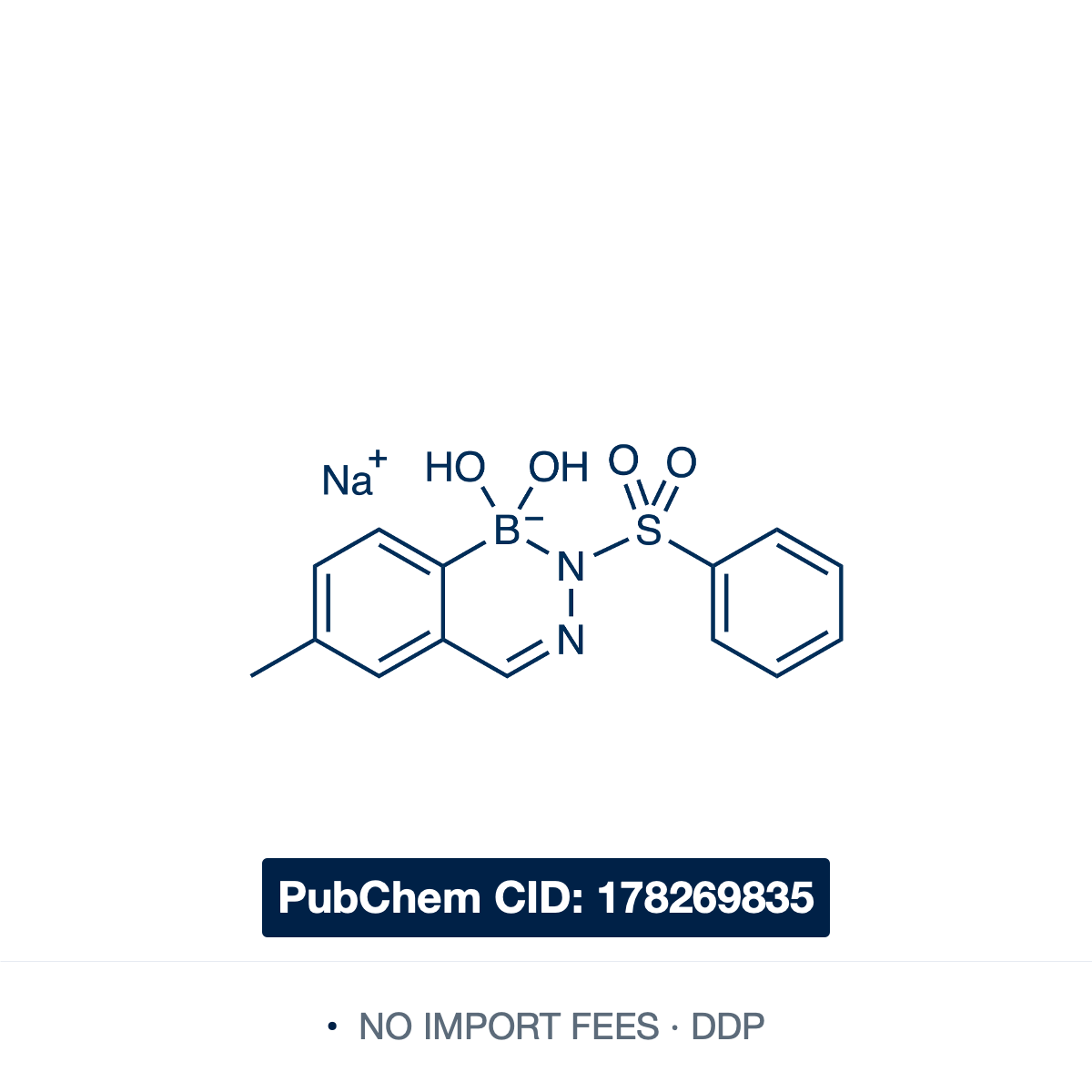
| SMILES | [B-]1(C2=C(C=C(C=C2)C)C=NN1S(=O)(=O)C3=CC=CC=C3)(O)O.[Na+] |
| InChI | InChI=1S/C14H14BN2O4S.Na/c1-11-7-8-14-12(9-11)10-16-17(15(14,18)19)22(20,21)13-5-3-2-4-6-13;/h2-10,18-19H,1H3;/q-1;+1 |
| InChIKey | HABIUIGGZIFDKS-UHFFFAOYSA-N |
| PubChem CID | 178269835 |
| Molecular Formula | C14H14BN2NaO4S |
| Molecular Weight | 340.14 g/mol |
| Solubility | Soluble in water, DMSO |
| Purity | ≥98% |
| Physical Form | White to yellowish solid |
| HS Code | 2934.99 |
| Shelf Life | Retest period: 36 months from date of manufacture |
| Storage Conditions | Store in a cool, dry place in a tightly sealed container |
Product Description & Scientific Applications
- Identity: Sodium 1,1-dihydroxy-6-methyl-2-(phenylsulfonyl)-1,2-dihydrobenzo[d][1,2,3]diazaborin-1-uide. The water-soluble sodium salt of paper compound 13 from Ilina et al., J. Med. Chem. 2026, 69, 3796–3810, designated Diazaborine 64 in the publication. The benzodiazaborine ring system carries a 6-methyl substituent on the benzo ring and an unsubstituted phenylsulfonyl group on N2; the boron centre is anionic with sodium counterion.
- Position in the SAR series — matched-pair reference: VI880 is the matched-pair structural reference to the lead VI706 (Diazaborine 62, Na salt of compound 11). VI880 and VI706 share R¹ = 3-methyl on the benzodiazaborine ring and differ only at R² on the sulfonyl side chain — VI880 has an unsubstituted phenyl, VI706 has a 3-aminophenyl. The pair provides a direct matched-pair comparison for assessing how the 3-amino group affects whole-cell activity, FabI inhibition, cytotoxicity, and aqueous salt behaviour.
- Antibacterial spectrum: Compound 13 shows MIC 6.25 μM against E. coli CB9615, E. coli CFT073, and Salmonella enterica serovar Typhimurium 19585; 12.5 μM against E. coli ATCC 25922, E. coli UMN026 (uropathogenic, multiple antibiotic resistances), Acinetobacter baumannii 19606, and Klebsiella aerogenes 13048. Activity against K. pneumoniae 700603 was substantially lower (>50 μM).
- FabI inhibition data: Compound 13 was reported with a preliminary Kᵢ of 0.34 μM against isolated E. coli FabI in the paper's enzymatic assay — among the most potent compounds tested in that subset, and closely matched to compound 11 (Kᵢ 0.32 μM). Mechanism: covalent adduct formation between the boron atom and the 2′-hydroxyl of the ribose in the enzyme-bound NAD⁺ cofactor (PDB 5CG1, 5CG2; resolution 2.07–2.2 Å).
- Matched-pair SAR insight on the 3-amino group: The paper explicitly notes that compounds 11 and 22 differ from compound 13 by the presence of an amine at the R2 benzenesulfonyl side chain instead of an unsubstituted phenyl, showing that an amine substitution is not required for activity at FabI in E. coli. The matched-pair data therefore show that the 3-amino group is not required for strong isolated FabI inhibition, while its contribution to whole-cell activity and cytotoxicity is strain- and assay-dependent.
- Cytotoxicity profile: HepG2 IC₅₀ = 63 ± 9 μM; Hs27 (noncancerous fibroblast) IC₅₀ = 170 ± 9 μM, corresponding to an approximate HepG2/MIC selectivity index of 5× (calculated against the E. coli ATCC 25922 MIC of 12.5 μM). LDH membrane-integrity assay showed 16% cytotoxicity at 250 μM concentration — the highest among the four diazaborines selected for follow-up studies (cytotoxicity order: 13 > 11 > 41 ≥ 47). Selectivity is therefore reduced compared with VI706; for in vivo work VI706 is the preferred candidate.
- Colistin synergy (FICI 0.25): Checkerboard assay against E. coli ATCC 25922 demonstrates strong synergy with colistin — FICI 0.25 (same as VI706). Compound 13 at 1.25 μM reduces colistin MIC from 1 to 0.25 μg/mL, equivalent to compound 11. The matched-pair pattern therefore preserves polymyxin synergy independent of the 3-amino group, providing a clean reference compound for synergy mechanism studies.
- Aqueous handling and Na-salt usage in the paper: Free-acid parent diazaborines are barely water-soluble; water-soluble sodium salts were used in the paper's water and human-plasma stability experiments to avoid DMSO interference. The paper reports that the biological performance of the salts was identical with the original compounds, with explicit MIC-equivalence demonstration for the salt forms of compound 11. VI880 provides the sodium-salt form of compound 13 for aqueous research workflows without DMSO.
- Plasma stability (¹¹B NMR): The Na salt of compound 13 retained the characteristic ¹¹B NMR single peak at ca. +6.5 ppm after 72 h in human plasma at 37 °C, showing the same qualitative plasma-stability signature reported for the sodium salts of compounds 11 and 41.
- Resistance profile: MPC/MIC = 32, the same ratio reported for compound 11 under the study protocol and similar to fabimycin (approximately 2× ciprofloxacin under the same protocol). In this assay, removal of the 3-amino group did not change the MPC/MIC ratio.
- Research applications: Matched-pair structure–activity relationship studies isolating the contribution of 3-amino substitution to whole-cell potency, FabI binding, and cytotoxicity; control compound for FabI binding studies (since FabI inhibition is preserved without the amino group); colistin-synergy mechanism studies decoupled from the amino contribution; structure-guided optimisation reference using PDB 5CG1, 5CG2; comparative pharmacology against the lead VI706.
- Class context: Mechanistically distinct from cyclic boronate β-lactamase inhibitors approved or in clinical development (vaborbactam, FDA-approved 2017; taniborbactam and xeruborbactam in clinical development). Different target (FabI vs β-lactamases), different binding partner (NAD⁺ ribose vs active-site serine), different ring geometry. The original Sandoz diazaborine programme (Grassberger 1984, J. Med. Chem. 27, 947) was halted on intrinsic-toxicity concerns about boron, a position the modern boron-drug regulatory record reopens.
- Documentation: ≥98% purity by ¹H NMR. CoA and SDS provided with each shipment. DDP shipping to EU, UK, EFTA, and worldwide locations.
- Further reading: Scientific background on diazaborine FabI inhibitors and water-soluble sodium-salt derivatives in NorrChemica's Lab Journal: Water-Soluble Diazaborines: Selective Gram-Negative Antibiotic Candidates for Synergy Studies and R&D.
Shipping Destinations
- EU & UK: Priority delivery, 2–5 business days.
- United States (DDP): 3–7 business days, duties and taxes prepaid.
- EFTA Countries (DDP): 3–7 business days, duties and taxes prepaid.
- Worldwide: 7–14 business days, selected locations.
Safety Information
| Hazard Class | None — not subject to transport regulations |
| Transport Category | Not classified as dangerous goods for transport (ADR/IATA/IMDG) |
Documentation
| Safety Data Sheet | Download PDF |
Share