NorrChemica™
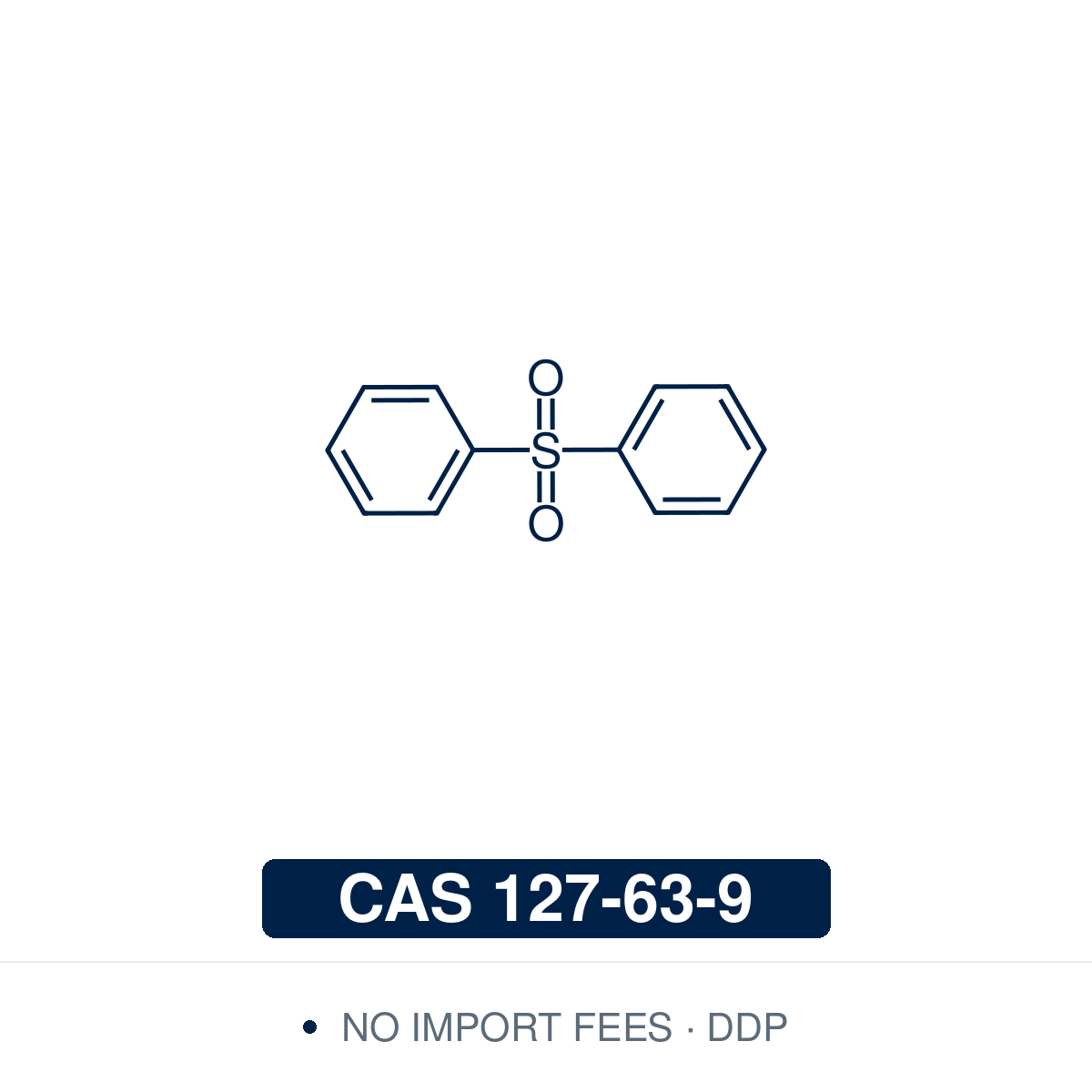
Diphenyl sulfone
Diphenyl sulfone | CAS 127-63-9 | ≥98%
| Pack size | Excl. VAT | Incl. VAT | Add to cart |
|---|---|---|---|
| 100 g | €74,20 | ||
| 500 g | €89,20 | ||
| 1 kg | €109,20 |
Taxes and fees, e.g. VAT, included in the price. Shipping calculated at checkout.Free shipping on EU, UK and EFTA orders above €250, and above €400 to the rest of the world.
Technical Specifications
| CAS Number | 127-63-9 |
| EC / EINECS Number | 204-853-1 |
| MDL Number | MFCD00007548 |
| RTECS Number | SX2400000 |
| SMILES | C1=CC=C(C=C1)S(=O)(=O)C2=CC=CC=C2 |
| InChI | InChI=1S/C12H10O2S/c13-15(14,11-7-3-1-4-8-11)12-9-5-2-6-10-12/h1-10H |
| InChIKey | KZTYYGOKRVBIMI-UHFFFAOYSA-N |
| PubChem CID | 31386 |
| Molecular Formula | C₁₂H₁₀O₂S |
| Molecular Weight | 218.27 g/mol |
| Melting Point | 123-129 °C (lit.) |
| Solubility | Soluble in acetone, methanol and toluene. Insoluble in water. |
| Log Pow | 2.41 |
| Purity | ≥98% |
| Physical Form | White crystalline powder |
| HS Code | 2930.90 |
| Shelf Life | Retest period: 36 months from date of manufacture |
| Storage Conditions | Store at room temperature in a tightly closed container, in a cool, dry and dark place. |
Product Description & Scientific Applications
Diphenyl sulfone is a sulfone compound with two phenyl substituents on the sulfur atom. It boils at 379 °C. It is used as a high-temperature solvent. Solvents of this kind are useful for processing very rigid polymers such as poly(ether ether ketone) (PEEK), which dissolve only in very hot solvents.
Polymerisation solvent. PEEK is made by a polycondensation based on nucleophilic substitution. One of the monomers is a fluorinated aromatic compound, and the solvent is diphenyl sulfone, a polar aprotic solvent. In one study, PEEK copolymers were prepared from 4,4′-difluorobenzophenone, 4,4′-dichlorodiphenyl sulfone and hydroquinone with sodium and potassium carbonates in diphenyl sulfone. After the reaction, the diphenyl sulfone and the inorganic salts were removed by washing with acetone and water. Other PEEK copolymers have also been prepared by solution polymerisation in diphenyl sulfone. Current commercial methods for producing poly(ether ketone ketone) (PEKK) also use high-boiling solvents such as diphenyl sulfone. A wholly aromatic polyketone containing benzimidazolone units has also been made in diphenyl sulfone, by N–C coupling polycondensation. A dicyanate ester has also been polymerised in diphenyl sulfone to prepare a microporous polymer.
Processing of polyaryletherketones. When carbon fibres are impregnated with a polyaryletherketone (PAEK), one traditional way to make this easier is to dissolve the PAEK in a high-boiling solvent such as molten diphenyl sulfone, which temporarily lowers its viscosity.
Porous polymers and membranes. Diphenyl sulfone is one of the solvents used to prepare porous PEEK. Cooling a solution of PEEK in diphenyl sulfone has been shown to make it separate into phases. Depending on the preparation, this has given fibrillar foams or powders. Diphenyl sulfone is also one of the solvents used in a solvent-freezing method that makes polymer membranes with vertically oriented pores. In this method, the solvent crystallises inside the polymer under a temperature gradient.
Shipping Destinations
- EU & UK: Priority delivery, 2–5 business days.
- United States (DDP): 3–7 business days, duties and taxes prepaid.
- EFTA Countries (DDP): 3–7 business days, duties and taxes prepaid.
- Worldwide: 7–14 business days, selected locations.
Safety Information
| GHS Pictograms |

|
| Signal Word | Warning |
| Hazard Class | Not regulated for transport |
| Transport Category | Not classified as dangerous goods for transport (ADR/IATA/IMDG) |
| H-Statements | H302 |
| P-Statements | P264 - P270 - P301+P317 - P330 - P501 |
Documentation
| Safety Data Sheet | Download PDF |