NorrChemica™
4-Dimethylaminopyridine (DMAP)
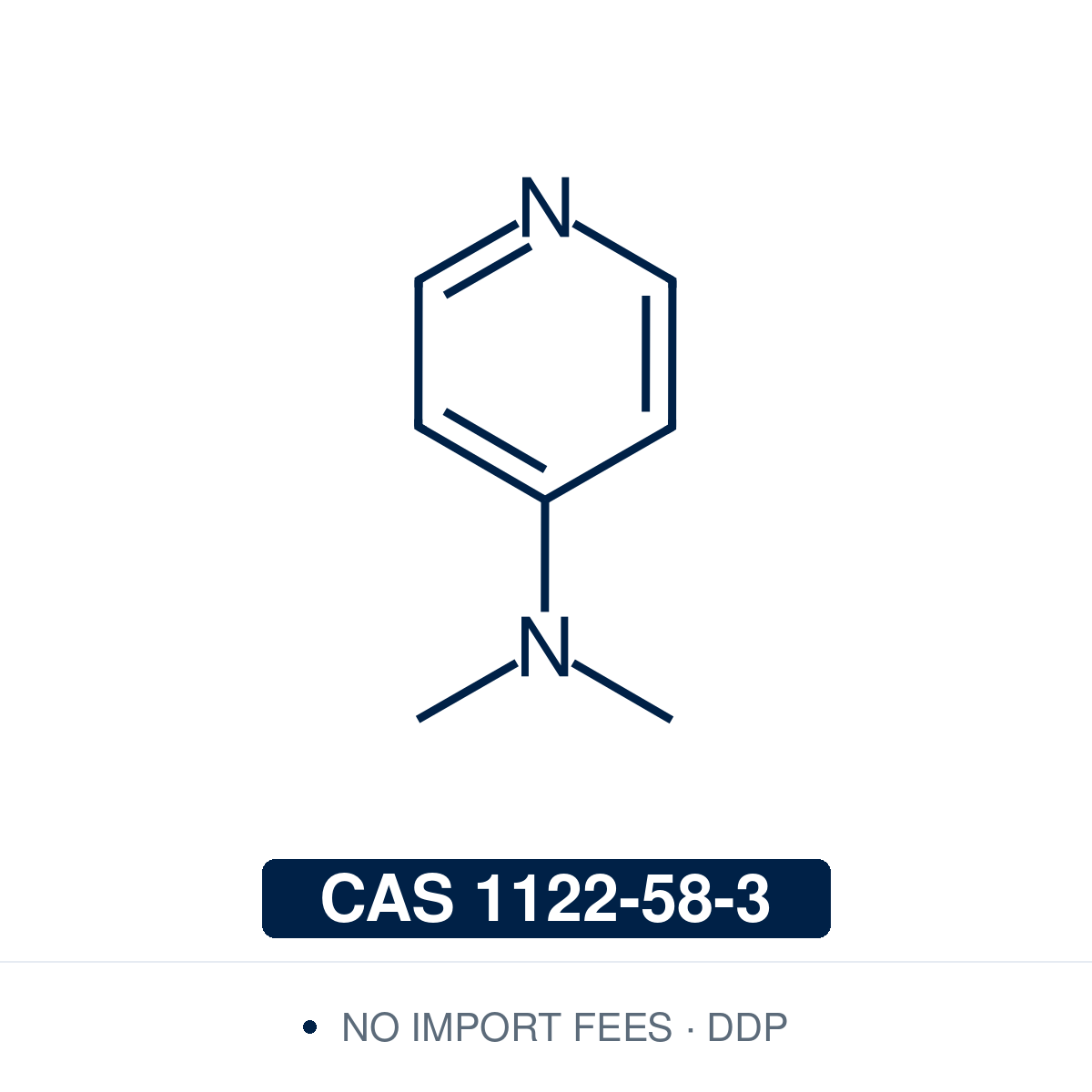
4-Dimethylaminopyridine (DMAP) | CAS 1122-58-3 | ≥99%
Couldn't load pickup availability
Technical Specifications
| CAS Number | 1122-58-3 |
| EC / EINECS Number | 214-353-5 |
| MDL Number | MFCD00006418 |
| RTECS Number | US9230000 |
| SMILES | CN(C)C1=CC=NC=C1 |
| InChI | InChI=1S/C7H10N2/c1-9(2)7-3-5-8-6-4-7/h3-6H,1-2H3 |
| InChIKey | VHYFNPMBLIVWCW-UHFFFAOYSA-N |
| PubChem CID | 14284 |
| Molecular Formula | C₇H₁₀N₂ |
| Molecular Weight | 122.17 g/mol |
| Melting Point | 108–112 °C (lit.) |
| Solubility | ~50 mg/mL in water (25 °C); soluble in methanol, DCM, chloroform, acetone, ethyl acetate |
| Log Pow | 1.34 (n-octanol/water; ECHA registration dossier) |
| Purity | ≥99.0% |
| Physical Form | Off-white crystalline powder |
| HS Code | 2933.39 |
| Country of Origin | Finland |
| Shelf Life | Retest period: 36 months from date of manufacture. |
| Storage Conditions | Store in a cool, dry place in a tightly sealed container |
Product Description & Scientific Applications
4-(Dimethylamino)pyridine (DMAP) is among the most effective nucleophilic acylation catalysts. Lone-pair donation from the 4-dimethylamino group stabilises the positive charge of the N-acylpyridinium intermediate, making the ring nitrogen far more nucleophilic and basic than pyridine itself; across standard acyl-transfer benchmarks it accelerates acylation by roughly 10⁴-fold over pyridine, with a comparable enhancement over triethylamine. In alcohol acylation, DMAP attacks the acyl donor (anhydride, mixed anhydride, acid chloride, carbodiimide-activated carboxylic acid, or carbonate) to form an N-acylpyridinium/carboxylate ion pair whose counter-anion assists deprotonation of the incoming alcohol. It transfers acyl, carbonate, and carbamoyl groups to weakly nucleophilic or sterically hindered substrates under mild, near-neutral conditions where pyridine alone is ineffective, and serves as an auxiliary catalyst for sulfonyl and selected silyl transfers.
Steglich esterification. DMAP is the catalyst that makes the DCC-mediated Steglich esterification effective. Dicyclohexylcarbodiimide first activates the carboxylic acid as its O-acylisourea; DMAP rapidly intercepts this intermediate to form a reactive N-acylpyridinium salt. This suppresses the main side reaction — 1,3-acyl migration of the O-acylisourea to the unreactive N-acylurea — and enables high-yield esterification of hindered, acid-sensitive, or epimerisation-prone substrates with secondary and tertiary alcohols under mild conditions. DCC/DMAP is therefore routine in fragment couplings in complex-molecule and natural-product synthesis, especially where strongly acidic, basic, or high-temperature conditions are excluded.
Yamaguchi macrolactonisation and mixed-anhydride esterification. In the Yamaguchi protocol the carboxylic acid is converted to a mixed anhydride with 2,4,6-trichlorobenzoyl chloride and a tertiary amine base, then activated by DMAP. In the classical model, DMAP attacks the less hindered aliphatic carbonyl of the mixed anhydride to give an acyl-DMAP (N-acylpyridinium) species, with the bulky trichlorobenzoyl fragment serving as an activating auxiliary rather than the transferred acyl group. A mechanistic study refines this: the data indicate that the mixed anhydride converts in situ to the symmetric aliphatic anhydride, which is the species that acylates the alcohol, accounting for the regioselectivity, since aliphatic carboxylates are more nucleophilic and aliphatic anhydrides more electrophilic toward DMAP and the alcohol. Under high dilution this acyl transfer closes seco-acids intramolecularly with suppressed oligomerisation, making DMAP central to medium- and large-ring lactone synthesis and to hindered intermolecular esterification.
Protecting-group installation. DMAP is the standard catalyst for acetylation and benzoylation of alcohols with anhydrides or acid chlorides, and for Boc protection of less nucleophilic or hindered nitrogen substrates such as indoles, anilines, and sulfonamides with Boc₂O, where the uncatalysed reaction is sluggish. It also serves as an auxiliary catalyst in tosylation and mesylation of hindered alcohols (TsCl/MsCl) and in demanding silyl protections, often together with imidazole. In multifunctional substrates such as polyols, carbohydrates, nucleosides, and peptide intermediates, careful stoichiometry can favour acylation at the less hindered hydroxyl, though regioselectivity remains substrate-dependent. The main caveat is over-functionalisation: Boc₂O/DMAP can give di-Boc or N,N-bis-Boc products from amines, and symmetrical dialkyl carbonates from aliphatic alcohols via carbonic–carbonic anhydride intermediates; acyl-donor equivalents, reaction time, and DMAP loading are therefore part of method design.
Ring-opening polymerisation of cyclic esters. DMAP is a foundational organocatalyst for living ring-opening polymerisation (ROP) of lactide. In bulk L-lactide with benzyl alcohol as initiator it acts as a transesterification catalyst and can deliver predictable degrees of polymerisation up to ~60 with dispersities below 1.2 under high-temperature bulk conditions; lower-temperature bulk protocols are valid but show condition-dependent control. The mechanism is distinct from simple anhydride acylpyridinium catalysis and is itself debated: the originally proposed route invoked nucleophilic attack of DMAP on the monomer to give an alkoxide/acylpyridinium zwitterion, whereas computational work favours a bifunctional mode in which the basic pyridine nitrogen and an acidic ortho-hydrogen cooperate to activate the alcohol by hydrogen bonding, energetically preferred over nucleophilic acylpyridinium formation. Related aminopyridine organocatalysts extend this metal-free approach to lactide and O-carboxyanhydride polymerisation and to other cyclic esters and carbonates.
Further applications. DMAP also serves in Steglich-modified Dakin–West conversion of amino-acid derivatives to α-acylamino methyl ketones under mild conditions; in the Morita–Baylis–Hillman annulation of salicylaldehydes with acrylonitrile to 3-cyano-2H-chromenes, where it can outperform DABCO in that substrate class; in asymmetric acyl transfer with chiral or planar-chiral DMAP analogues for kinetic resolution of secondary alcohols and amines; and as a reference nucleophile and Lewis-base catalyst in Mayr-scale reactivity benchmarking and quantitative acyl-transfer kinetics.
Further Reading. For selecting between carbodiimides, aminium/uronium salts, phosphonium salts, and other reagent classes for amide and peptide bond formation, see NorrChemica's Lab Journal guide: Choosing a Coupling Reagent for Amide and Peptide Bond Formation.
Shipping Destinations
- EU & UK only: 3–7 business days.
- Classified as dangerous goods — shipping restrictions apply outside the EU/UK.
Safety Information
| GHS Pictograms |


|
| Signal Word | Danger |
| Hazard Class | UN 2811 — Toxic solid, organic, n.o.s. (4-Dimethylaminopyridine) (Class 6.1, PG II) |
| Transport Category | DG - Class 6.1, PG II (ADR/IATA/IMDG) |
| H-Statements | H301 - H311 - H315 - H318 - H331 - H370 - H400 - H411 |
| P-Statements | P260 - P261 - P262 - P264 - P264+P265 - P270 - P271 - P273 - P280 - P301+P316 - P301+P330+P331 - P302+P352 - P302+P361+P354 - P304+P340 - P305+P351+P338 - P305+P354+P338 - P308+P316 - P316 - P317 - P319 - P321 - P330 - P332+P317 - P337+P317 - P361+P364 - P362+P364 - P363 - P391 - P403+P233 - P405 - P501 |
Documentation
| Safety Data Sheet | Download PDF |