NorrChemica™
DTNB (Ellman's Reagent)
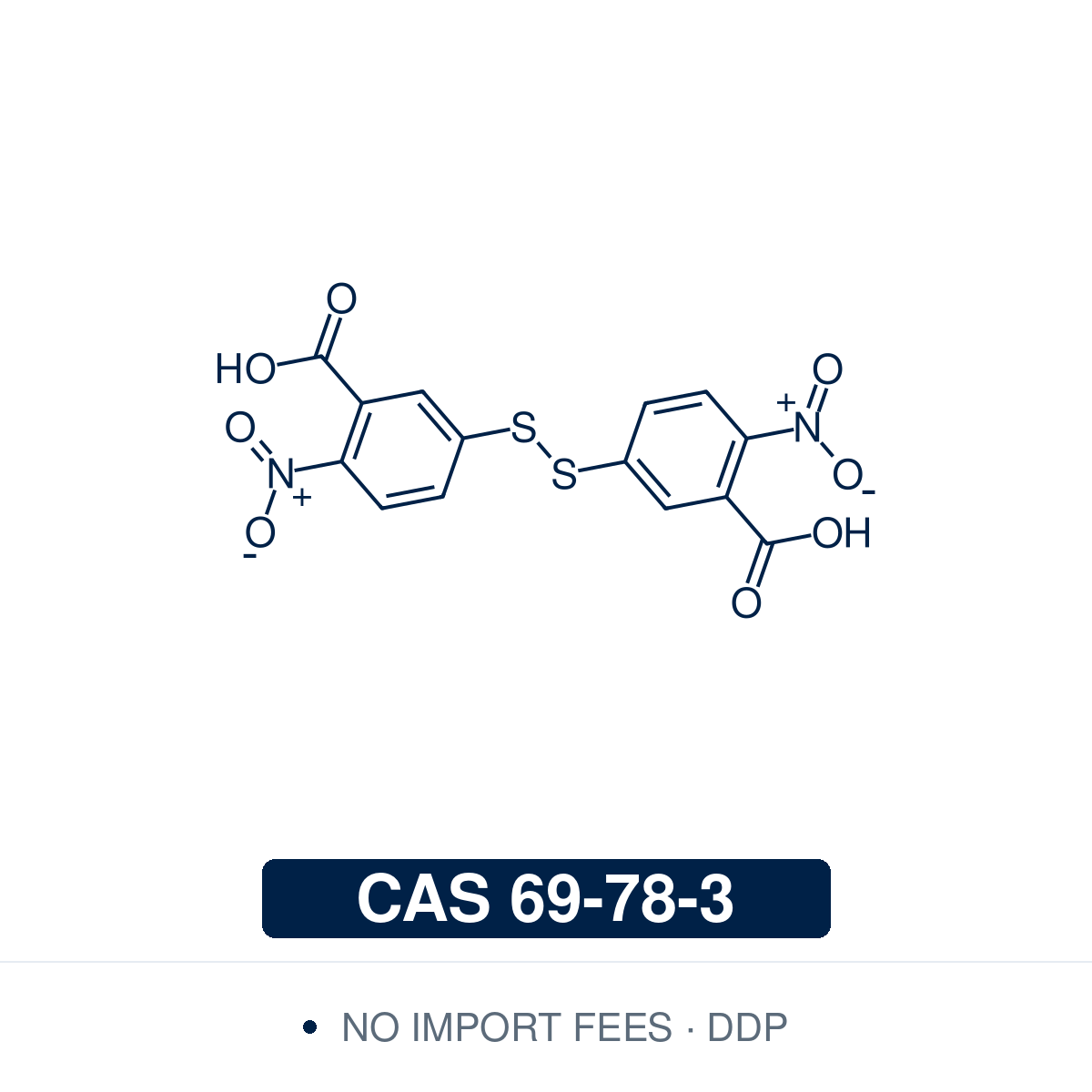
DTNB (Ellman's Reagent) | CAS 69-78-3 | ≥98%
| Pack size | Excl. VAT | Incl. VAT | Add to cart |
|---|---|---|---|
| 1.0 g | €74,90 | ||
| 5.0 g | €89,20 | ||
| 10 g | €129,20 | ||
| 25 g | €229,20 | ||
| 50 g | €398,20 | ||
| 100 g | €675,00 | ||
| 250 g | €1.595,00 | ||
| 500 g | €2.745,00 |
Taxes and fees, e.g. VAT, included in the price. Shipping calculated at checkout.Free shipping on EU, UK and EFTA orders above €250, and above €400 to the rest of the world.
Technical Specifications
| CAS Number | 69-78-3 |
| EC / EINECS Number | 200-714-4 |
| MDL Number | MFCD00007140 |
| RTECS Number | DG9650000 |
| SMILES | C1=CC(=C(C=C1SSC2=CC(=C(C=C2)[N+](=O)[O-])C(=O)O)C(=O)O)[N+](=O)[O-] |
| InChI | InChI=1S/C14H8N2O8S2/c17-13(18)9-5-7(1-3-11(9)15(21)22)25-26-8-2-4-12(16(23)24)10(6-8)14(19)20/h1-6H,(H,17,18)(H,19,20) |
| InChIKey | KIUMMUBSPKGMOY-UHFFFAOYSA-N |
| PubChem CID | 6254 |
| Molecular Formula | C₁₄H₈N₂O₈S₂ |
| Molecular Weight | 396.4 g/mol |
| Melting Point | 240–245 °C (dec.) |
| Solubility | Soluble in ethanol (10 mg/mL) and in 0.1 M phosphate buffer, pH 7.2 (about 5 mM); dissolves in water after addition of a small amount of dilute NaOH. |
| Purity | ≥98% |
| Physical Form | Yellow solid powder |
| HS Code | 2930.90 |
| Shelf Life | Retest period: 36 months from date of manufacture |
| Storage Conditions | Store tightly closed and refrigerated at 2–8 °C. Prevent exposure to light and moisture. |
Product Description & Scientific Applications
DTNB (Ellman's reagent; 5,5′-dithiobis(2-nitrobenzoic acid)) is an aromatic disulfide for the determination of sulfhydryl groups. It was first described in 1959 and tested on blood, urine, a purified protein and tissue extracts. DTNB reacts with the thiolate form of a free thiol to give a mixed disulfide and releases the 2-nitro-5-thiobenzoate anion (TNB²⁻), which is intensely yellow and is measured at 412 nm in aqueous buffer at pH 7–8. The rate of the reaction depends on the pH, on the pKa of the thiol and on steric and electrostatic effects.
Reaction of DTNB (left) with a thiol R–SH: the mixed disulfide (centre) forms and one TNB²⁻ anion (right), the yellow product measured at 412 nm, is released per thiol.
Measuring free thiols. DTNB is used to measure the free sulfhydryl content of proteins, peptides and tissues, and to label cysteine residues. The thiol content is calculated from the absorbance at 412 nm, either with the molar absorption coefficient of TNB²⁻ or against a cysteine standard curve. In 0.1 M sodium phosphate, pH 8.0, with 1 mM EDTA, the coefficient is 14,150 M⁻¹ cm⁻¹, and it does not change between pH 7.6 and 8.6. Denaturants and detergents such as urea, guanidine hydrochloride and SDS change the coefficient, so the value for the assay solvent is used. EDTA in the buffer chelates divalent metal ions, which can oxidise thiols, and a sample that reads low because its thiols are oxidised is first treated with a reducing agent.
Acetylcholinesterase activity. In the acetylcholinesterase assay, the enzyme hydrolyses acetylthiocholine to thiocholine and acetate, and thiocholine reacts with DTNB to give the yellow anion. The increase in colour gives the enzyme activity. The method was developed for tissue extracts, homogenates and cell suspensions, including human erythrocytes, and results with acetylthiocholine resemble those obtained with acetylcholine.
Hydrolysis of acetylthiocholine (left) by acetylcholinesterase gives thiocholine (right), which then reacts with DTNB as shown above.
Glutathione. In the enzymatic recycling assay for glutathione, DTNB oxidises reduced glutathione (GSH) and releases TNB, which is measured at 412 nm. Glutathione reductase with NADPH reduces the glutathione disulfide (GSSG) that forms back to GSH, so the cycle continues. The method determines both GSH and GSSG and is run in a 96-well plate format.
Light and pH sensitivity. DTNB is sensitive to light. Daylight, especially ultraviolet light near 325 nm, destroys the reagent during the assay, while light at the absorbance maximum of the yellow product has no effect. Window glass does not block the harmful wavelength, so the reaction is run under artificial room light with daylight excluded. In aqueous buffer the reagent is stable near pH 7, but its decomposition increases with pH and is fast in strong base. Phosphate-buffer stock solutions kept dark at 0–5 °C last more than two months.
Shipping Destinations
- EU & UK: Priority delivery, 2–5 business days.
- United States (DDP): 3–7 business days, duties and taxes prepaid.
- EFTA Countries (DDP): 3–7 business days, duties and taxes prepaid.
- Worldwide: 7–14 business days, selected locations.
Safety Information
| GHS Pictograms |

|
| Signal Word | Warning |
| Hazard Class | Not regulated for transport |
| Transport Category | Not classified as dangerous goods for transport (ADR/IATA/IMDG) |
| H-Statements | H315 - H319 - H335 |
| P-Statements | P261 - P264 - P271 - P280 - P302+P352 - P304+P340 - P305+P351+P338 - P312 - P332+P313 - P337+P313 - P362 - P403+P233 - P405 - P501 |
Documentation
| Safety Data Sheet | Download PDF |