NorrChemica™
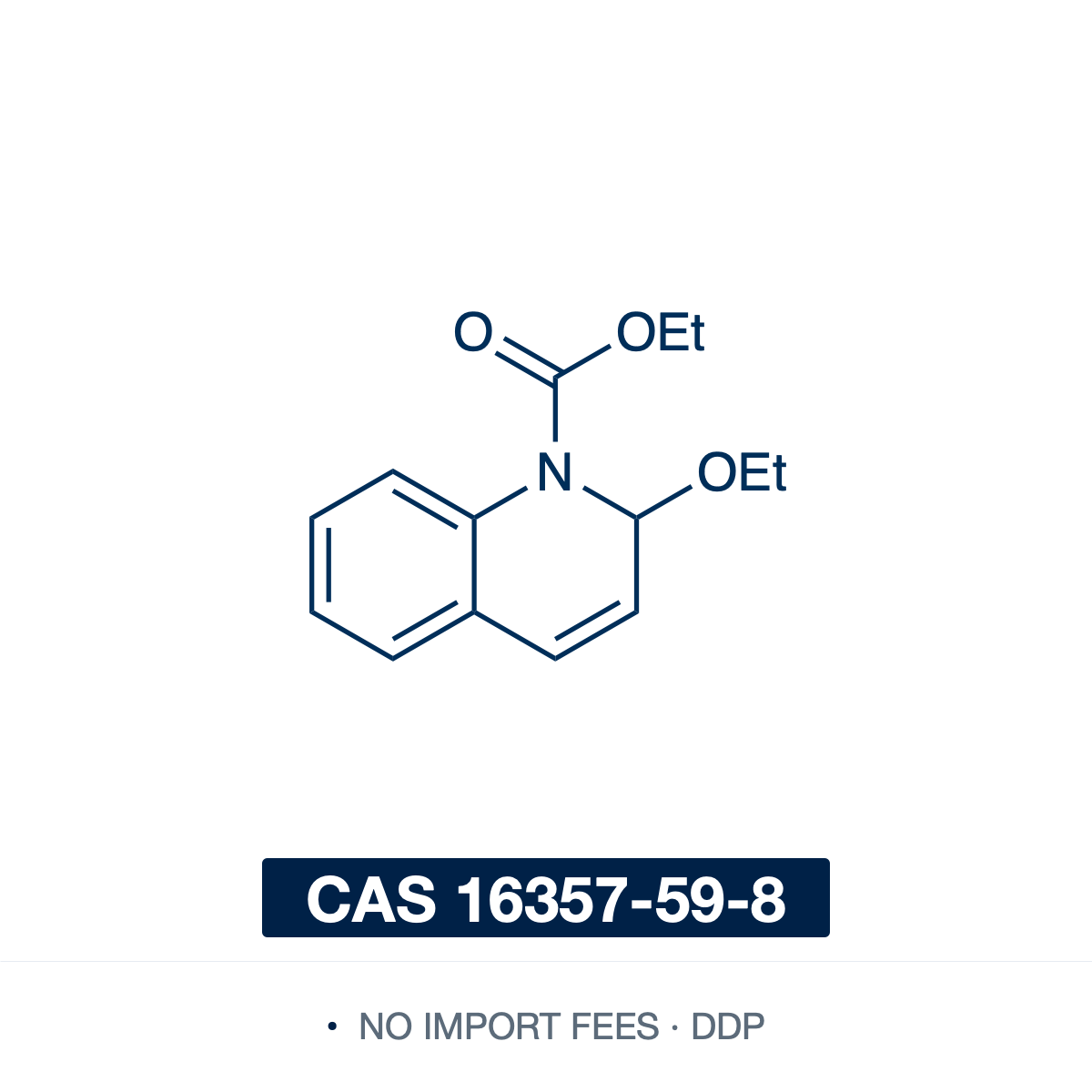
EEDQ
EEDQ | CAS 16357-59-8 | ≥95%
Couldn't load pickup availability
Technical Specifications
| CAS Number | 16357-59-8 |
| EC / EINECS Number | 240-418-2 |
| MDL Number | MFCD00006703 |
| RTECS Number | VB2010000 |
| SMILES | CCOC1C=CC2=CC=CC=C2N1C(=O)OCC |
| InChI | InChI=1S/C14H17NO3/c1-3-17-13-10-9-11-7-5-6-8-12(11)15(13)14(16)18-4-2/h5-10,13H,3-4H2,1-2H3 |
| InChIKey | GKQLYSROISKDLL-UHFFFAOYSA-N |
| PubChem CID | 27833 |
| Molecular Formula | C₁₄H₁₇NO₃ |
| Molecular Weight | 247.29 g/mol |
| Melting Point | 62–67 °C |
| Solubility | Soluble in ethanol, acetone, and dichloromethane; insoluble in water. |
| Purity | ≥95% |
| Physical Form | White to off-white crystalline powder |
| HS Code | 2933.49 |
| Shelf Life | Retest period: 36 months from date of manufacture |
| Storage Conditions | Store refrigerated (2–8 °C) in a tightly sealed container, protected from moisture |
Product Description & Scientific Applications
EEDQ — N-ethoxycarbonyl-2-ethoxy-1,2-dihydroquinoline — is a dihydroquinoline condensing reagent for amide and peptide bond formation. It activates a carboxylic acid as a mixed ethyl carbonic anhydride in situ, in the presence of the amine partner and without added tertiary amine base. EEDQ is supplied as an off-white to white crystalline solid, soluble in common organic solvents and aqueous-organic mixtures but insoluble in water.
Common Scientific Applications
- Direct amide and peptide coupling: EEDQ reacts with the carboxylic acid to form a mixed ethyl carbonic anhydride in situ; the amine attacks this intermediate as it forms, giving the amide with quinoline, ethanol and carbon dioxide as by-products.
- One-step, low-racemisation coupling: couples acylamino acids with amino acid esters in a single step with suppression of racemisation under standard solution-phase conditions.
- DNA-compatible amide coupling: reported in on-DNA amide-coupling studies for DNA-encoded library synthesis, with substrate-dependent performance.
- Polysaccharide and materials modification: employed in the regioselective quaternisation of chitosan and amphiphilic chitosan derivatives, and in the preparation of amide-modified QCM sensor surfaces.
- Carboxyl-group-selective protein modification: used in biochemical studies to covalently modify accessible protein carboxylates, including enzyme active-site studies such as F1-ATPase labelling.
Further Reading
For guidance on selecting between carbodiimides, aminium/uronium salts, phosphonium salts and other reagent classes for amide and peptide bond formation, see NorrChemica's Lab Journal guide: Choosing a Coupling Reagent for Amide and Peptide Bond Formation.
Shipping Destinations
- EU & UK: Priority delivery, 2–5 business days.
- United States (DDP): 3–7 business days, duties and taxes prepaid.
- EFTA Countries (DDP): 3–7 business days, duties and taxes prepaid.
- Worldwide: 7–14 business days, selected locations.
Safety Information
| GHS Pictograms |

|
| Signal Word | Warning |
| Hazard Class | Not regulated for transport |
| Transport Category | Not classified as dangerous goods for transport (ADR/IATA/IMDG) |
| H-Statements | H302 - H315 - H319 - H335 |
| P-Statements | P101 - P260 - P280 - P301+P330+P331 - P303+P361+P353 - P304+P340 - P305+P351+P338 - P321 - P405 - P501 |
Documentation
| Safety Data Sheet | Download PDF |