NorrChemica™
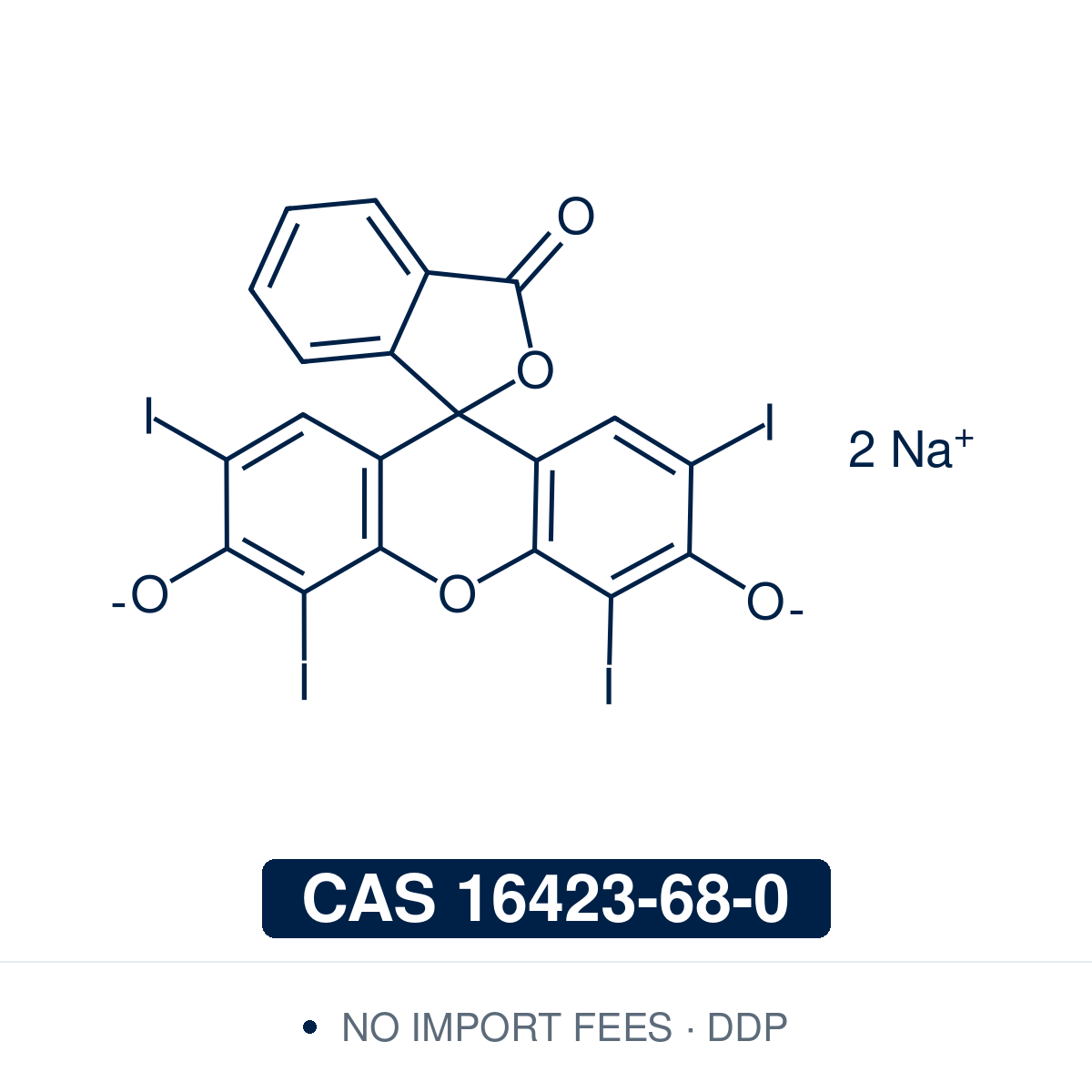
Erythrosine B
Erythrosine B | CAS 16423-68-0 | ≥90%
Couldn't load pickup availability
Technical Specifications
| CAS Number | 16423-68-0 |
| EC / EINECS Number | 240-474-8 |
| MDL Number | MFCD00144257 |
| RTECS Number | LM5950000 |
| SMILES | C1=CC=C2C(=C1)C(=O)OC23C4=CC(=C(C(=C4OC5=C(C(=C(C=C35)I)[O-])I)I)[O-])I.[Na+].[Na+] |
| InChI | InChI=1S/C20H8I4O5.2Na/c21-11-5-9-17(13(23)15(11)25)28-18-10(6-12(22)16(26)14(18)24)20(9)8-4-2-1-3-7(8)19(27)29-20;;/h1-6,25-26H;;/q;2*+1/p-2 |
| InChIKey | RAGZEDHHTPQLAI-UHFFFAOYSA-L |
| PubChem CID | 12961638 |
| Molecular Formula | C₂₀H₆I₄Na₂O₅ |
| Molecular Weight | 879.9 g/mol |
| Melting Point | >300 °C (dec.) |
| Solubility | Soluble in water; soluble in ethanol, DMSO, DMF |
| Purity | ≥90% |
| Physical Form | Red to dark red powder |
| HS Code | 3204.12 |
| Shelf Life | Retest period: 36 months from date of manufacture. |
| Storage Conditions | Store in a cool, dry place in a tightly sealed container, protected from light and moisture. |
Product Description & Scientific Applications
Erythrosine B, the tetraiodo derivative of fluorescein, is a red xanthene dye used as a food colourant. Its heavy iodine substitution gives a high triplet quantum yield — about 0.9 in aqueous solution, falling to near 0.55 on microcrystalline cellulose, where internal conversion competes — and on illumination the triplet transfers energy to molecular oxygen to generate singlet oxygen, which drives its photosensitising and photo-oxidising chemistry.
Common Scientific Applications
Plaque disclosing and antimicrobial photoinactivation. Erythrosine is the red dye of clinical dental plaque-disclosing agents, which stain plaque for visualisation. The same dye is a photosensitiser, so it doubles as a light-activated antibacterial: taken up into Streptococcus mutans biofilms and irradiated with white or blue light, it photodynamically kills the bacteria — in one biofilm study more effectively than methylene blue — by generating singlet oxygen, an action that disappears when the quencher histidine is added. Because continuous light photobleaches the dye, pulsed doses kill more.
Solar water disinfection. As an inexpensive food dye, erythrosine serves as an added photosensitiser in solar disinfection of drinking water, where sunlight drives singlet-oxygen production that inactivates viruses — over 99.99% in about five minutes, cutting treatment time by two orders of magnitude. The dye also marks completion through a photobleaching colour change.
Photoelectrochemical DNA detection. Tethered to a DNA probe, erythrosine works as a Type-II photosensitiser whose light-driven singlet oxygen produces a measurable photocurrent. On magnetic-bead electrode platforms this reports complementary DNA targets down to about 10 pM, without the enzymatic amplification that methods such as PCR require.
Triplet-state fluorescence imaging. Its heavy-atom-driven triplet population also makes erythrosine B a model dye for fluorescence-imaging methods in which a second, longer-wavelength laser optically empties the triplet state; this enhances and modulates the dye's emission, letting the signal be recovered from background.
Phosphorescence probe of amorphous solids. Erythrosine B phosphoresces when dispersed in solid matrices, and its phosphorescence lifetime is sensitive to local molecular motion. Food scientists use it to map dynamic heterogeneity and molecular mobility in amorphous sugars and sugar alcohols such as maltose, maltitol, lactose, and lactitol.
Inhibitor of ion-transport ATPases. In biochemistry, erythrosine B is an established inhibitor used to probe cation pumps. It blocks ATP-dependent calcium transport by sarcoplasmic reticulum and by brain microsomes, with half-maximal inhibition near 1 µM, and it inhibits the sodium–potassium pump, blocking high-affinity ouabain binding.
Shipping Destinations
- EU & UK: Priority delivery, 2–5 business days.
- United States (DDP): 3–7 business days, duties and taxes prepaid.
- EFTA Countries (DDP): 3–7 business days, duties and taxes prepaid.
- Worldwide: 7–14 business days, selected locations.
Safety Information
| GHS Pictograms |

|
| Signal Word | Warning |
| Hazard Class | None — not subject to transport regulations |
| Transport Category | Not classified as dangerous goods for transport (ADR/IATA/IMDG) |
| H-Statements | H302 |
| P-Statements | P264 - P270 - P301+P312 - P330 - P501 |
Documentation
| Safety Data Sheet | Download PDF |