NorrChemica™
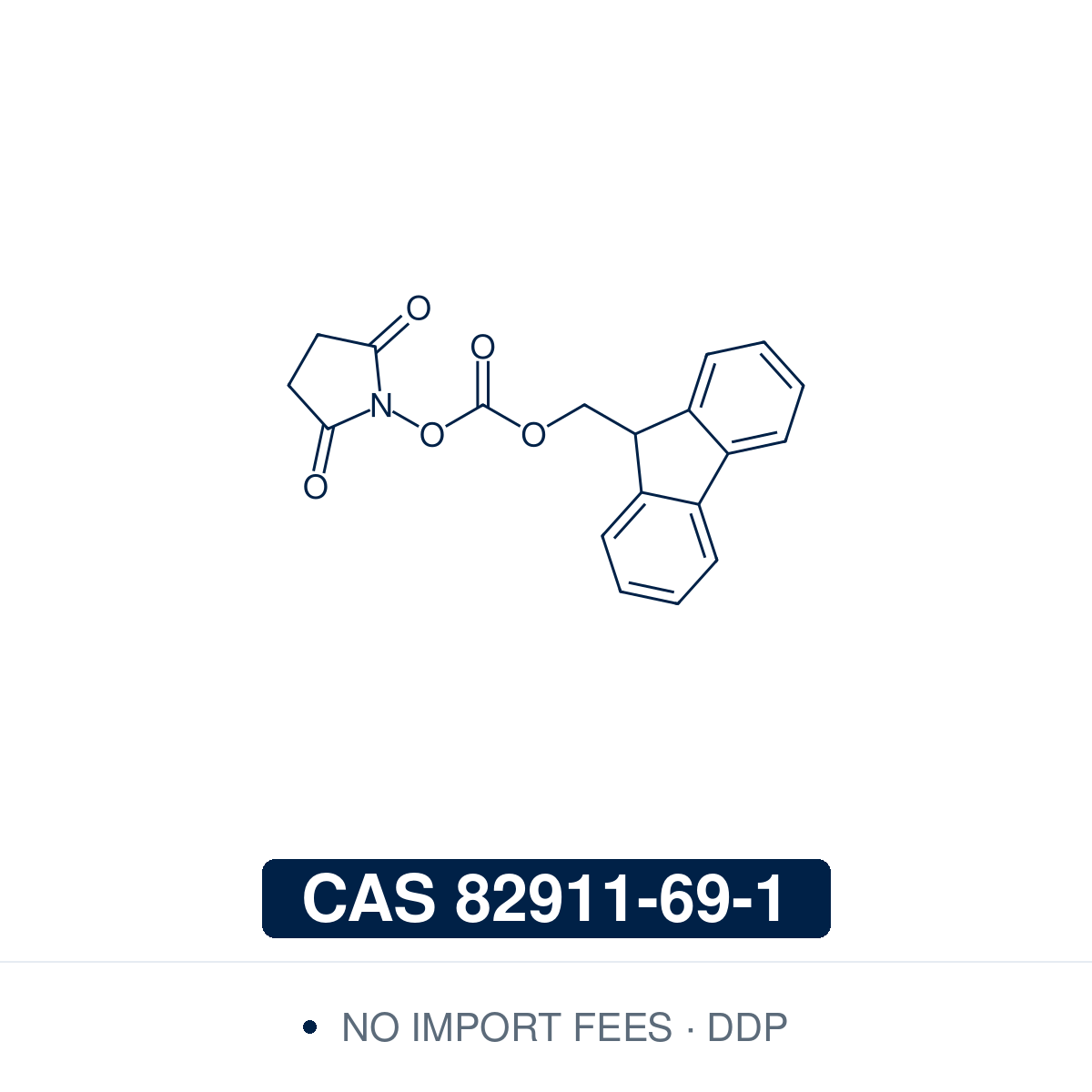
Fmoc-OSu
Fmoc-OSu | CAS 82911-69-1 | ≥98%
| Pack size | Excl. VAT | Incl. VAT | Add to cart |
|---|---|---|---|
| 10 g | €34,20 | ||
| 25 g | €47,20 | ||
| 50 g | €59,20 | ||
| 100 g | €74,20 | ||
| 250 g | €89,20 | ||
| 500 g | €129,20 | ||
| 1 kg | €249,00 |
Taxes and fees, e.g. VAT, included in the price. Shipping calculated at checkout.Free shipping on EU, UK and EFTA orders above €250, and above €400 to the rest of the world.
Technical Specifications
| CAS Number | 82911-69-1 |
| EC / EINECS Number | 433-520-5 |
| MDL Number | MFCD00010733 |
| SMILES | C1CC(=O)N(C1=O)OC(=O)OCC2C3=CC=CC=C3C4=CC=CC=C24 |
| InChI | InChI=1S/C19H15NO5/c21-17-9-10-18(22)20(17)25-19(23)24-11-16-14-7-3-1-5-12(14)13-6-2-4-8-15(13)16/h1-8,16H,9-11H2 |
| InChIKey | WMSUFWLPZLCIHP-UHFFFAOYSA-N |
| PubChem CID | 134122 |
| Molecular Formula | C₁₉H₁₅NO₅ |
| Molecular Weight | 337.3 g/mol |
| Melting Point | 150–153 °C |
| Solubility | Soluble in DMSO, DMF and dichloromethane. Insoluble in water. |
| Purity | ≥98% |
| Physical Form | White solid powder |
| HS Code | 2928.00 |
| Shelf Life | Retest period: 36 months from date of manufacture |
| Storage Conditions | Store refrigerated (2–8 °C) in a tightly sealed container, protected from moisture. |
Product Description & Scientific Applications
Fmoc-OSu (Fmoc N-hydroxysuccinimide ester) is an acylating reagent that transfers the 9-fluorenylmethoxycarbonyl (Fmoc) group onto amines. The Fmoc carbamate is removed under mildly basic conditions, for example with piperidine, diethylamine or morpholine. In peptide synthesis, the Fmoc group is the temporary protecting group in an orthogonal combination with permanent protecting groups.
Acylation conditions. Reported conditions include pyridine in methanol, and sodium hydrogen carbonate at pH 8 in water–methanol with THF.
Fmoc-amino acids. Fmoc-OSu is used to prepare Fmoc-protected amino acids, including α-methylvaline. It is the source of the Fmoc-β-Ala-OH impurity formed during this protection step. Removing this impurity from the Fmoc-amino acid increases purification cost and reduces yield. Fmoc-β-Ala-AA-OH also forms as a side product during this preparation.
Re-protection during synthesis. After an o-NBS group is removed, Fmoc-OSu protects the freed N-terminal amine again and re-forms the Fmoc-protected amino acid. Before cleavage from the resin, Fmoc-OSu caps the free N-terminal amine of peptide that was not alkylated. Reversed-phase HPLC can then separate this unreacted peptide from the alkylated product.
Core–shell beads. Fmoc-OSu protects part of the amino groups in the core region of a bead only. This allows a dye-encoded core and a separately functionalised shell to be built.
N-glycan labelling. Fmoc-OSu derivatises the glycosylamine intermediates formed when N-glycans are released by deglycosylation. This gives fluorescently tagged glycans for biomarker discovery.
Phosphopeptide analysis. Derivatisation of phosphorylated peptides, such as insulin receptor peptides, with Fmoc-OSu or Fmoc-Cl improves the electrophoretic separation of positional isomers. It also helps MS/MS identify the phosphorylation site.
Hydrogels. Aromatic and hydrophobic interactions of the Fmoc ring contribute to the co-assembly and hydrogelation of Fmoc-amino acids and peptides.
Shipping Destinations
- EU & UK only: 3–7 business days.
Safety Information
| GHS Pictograms |


|
| Signal Word | Warning |
| Hazard Class | UN 3077 — Environmentally hazardous substance, solid, n.o.s. (N-(9-fluorenylmethoxycarbonyloxy)succinimide) (Class 9, PG III) |
| Transport Category | Class 9, PG III (ADR/IATA/IMDG) |
| H-Statements | H302 - H317 - H411 |
| P-Statements | P261 - P264 - P270 - P272 - P273 - P280 - P301+P317 - P302+P352 - P321 - P330 - P333+P317 - P362+P364 - P391 - P501 |
Documentation
| Safety Data Sheet | Download PDF |