NorrChemica™
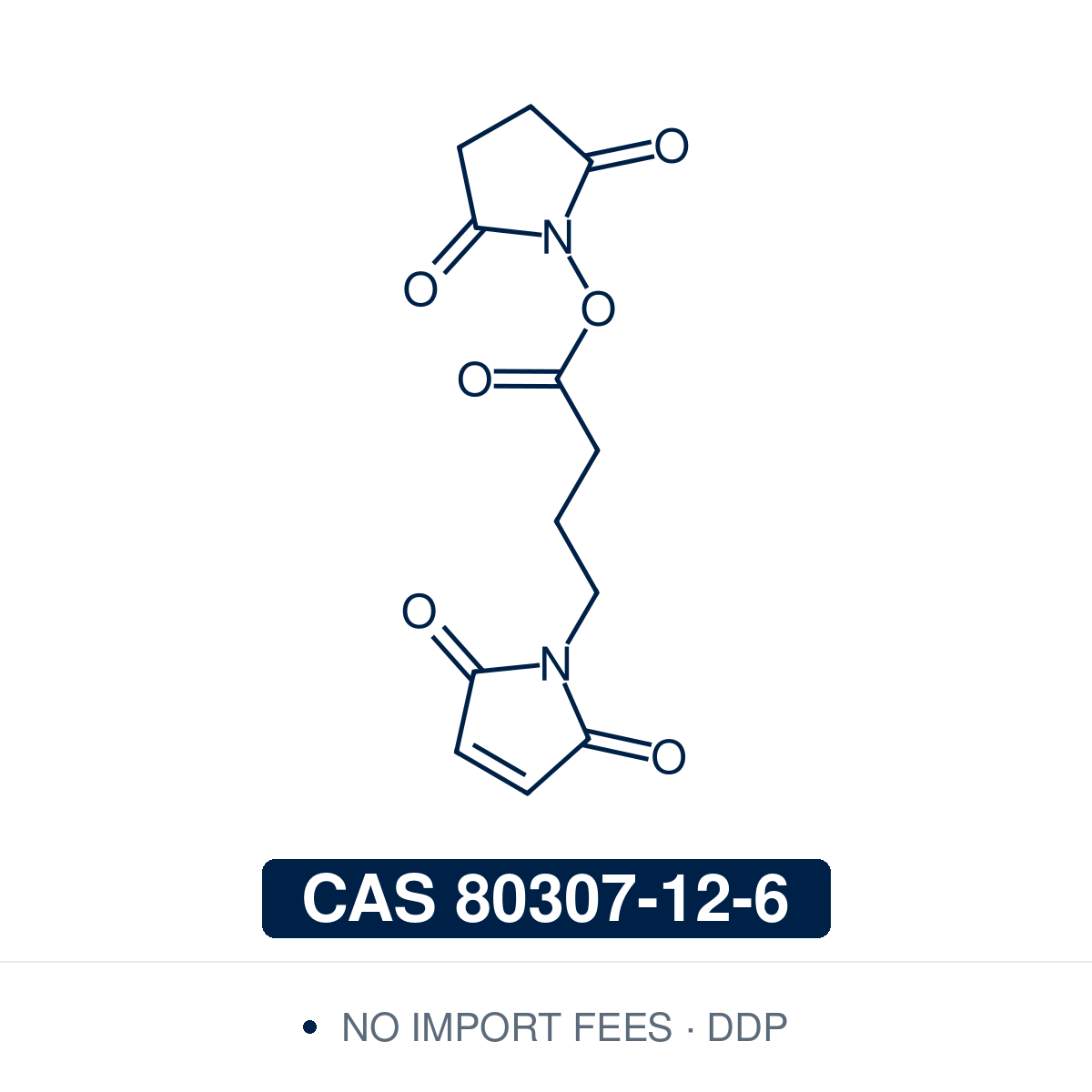
GMBS
GMBS | CAS 80307-12-6 | ≥98%
Couldn't load pickup availability
Technical Specifications
| CAS Number | 80307-12-6 |
| EC / EINECS Number | 625-693-2 |
| MDL Number | MFCD00036817 |
| SMILES | C1CC(=O)N(C1=O)OC(=O)CCCN2C(=O)C=CC2=O |
| InChI | InChI=1S/C12H12N2O6/c15-8-3-4-9(16)13(8)7-1-2-12(19)20-14-10(17)5-6-11(14)18/h3-4H,1-2,5-7H2 |
| InChIKey | PVGATNRYUYNBHO-UHFFFAOYSA-N |
| PubChem CID | 133440 |
| Molecular Formula | C₁₂H₁₂N₂O₆ |
| Molecular Weight | 280.23 g/mol |
| Melting Point | 124–125 °C |
| Solubility | Insoluble in water. Soluble in DMF and DMSO. |
| Purity | ≥98% |
| Physical Form | White to off-white powder. |
| HS Code | 2925.19 |
| Shelf Life | Retest period: 36 months from date of manufacture when stored desiccated at −20 °C. |
| Storage Conditions | Store desiccated at −20 °C in a tightly sealed container, protected from moisture. |
Product Description & Scientific Applications
GMBS (N-γ-maleimidobutyryloxysuccinimide ester; N-succinimidyl 4-maleimidobutyrate) is a short heterobifunctional crosslinker. An amine-reactive N-hydroxysuccinimide ester occupies one terminus and a thiol-reactive maleimide the other, separated by an aliphatic four-carbon γ-butyryl spacer. The two termini form distinct covalent bonds: an amide to primary amines, a thioether to free sulfhydryls.
Amine reactivity. The succinimidyl ester reacts with primary amines, principally the ε-amino group of lysine residues, by aminolysis. The reaction displaces N-hydroxysuccinimide and forms a stable amide linkage. Immunoglobulin G carries 80–90 lysine residues, those at the protein periphery having acid strengths near pKa 10.3. Hydrolysis of the ester competes with amidation and degrades coupling efficiency, so reactions run in mildly basic buffer; borate at pH 8.5 supports efficient aminolysis. Activated succinimidyl esters favour amine over thiol: in competition between N-acetyllysine and N-acetylcysteine at pH 7.5 and 8.3 the amide predominates, since the alternative thioester hydrolyses or exchanges with amines.
Thiol reactivity. The maleimide adds thiols by Michael reaction to give a thiosuccinimide thioether. Cysteine is the biological target: its low proteomic abundance, below 2%, together with the nucleophilicity of the thiolate, makes the addition site-selective. The thioether is not permanent. First-generation succinimide thioethers undergo retro-Michael cleavage and thiol exchange with competing thiols at physiological pH and temperature, regenerating the maleimide. Hydrolytic ring-opening of the succinimide forestalls this: the succinamic acid product cannot revert, and the conjugate is locked against exchange.
Sequential conjugation. Sequential coupling exploits the two reactivities. The succinimidyl ester is the labile group and is spent first — an amine-bearing protein is acylated to install a maleimide, excess reagent is removed, then a thiol-bearing partner closes the thioether. Fujiwara and colleagues coupled β-D-galactosidase to a monoclonal IgM antibody by this route, the enzyme–antibody conjugate serving as the label in a sandwich immunoassay for the tumour antigen sialosyl-Lewis x. The same amine-then-thiol logic tethers biomolecules to surfaces: Chrisey tested a series of heterobifunctional crosslinkers, GMBS among them, to bind thiol-terminated DNA oligomers to aminosilane films on silica, and Rusin immobilised the L1 neural adhesion molecule on silicon dioxide for a biosensor.
Shipping Destinations
- EU & UK: Priority delivery, 1–2 business days.
- EFTA Countries (DDP): 1–2 business days, duties and taxes prepaid.
Safety Information
| Hazard Class | Not regulated for transport |
| Transport Category | Not classified as dangerous goods for transport (ADR/IATA/IMDG) |
Documentation
| Safety Data Sheet | Download PDF |
Share