NorrChemica™
Guaiazulene
Guaiazulene | CAS 489-84-9 | ≥97%
Couldn't load pickup availability
Technical Specifications
| CAS Number | 489-84-9 |
| EC / EINECS Number | 207-701-2 |
| MDL Number | MFCD00003811 |
| RTECS Number | CO4790000 |
| SMILES | CC1=C2C=CC(=C2C=C(C=C1)C(C)C)C |
| InChI | InChI=1S/C15H18/c1-10(2)13-7-5-11(3)14-8-6-12(4)15(14)9-13/h5-10H,1-4H3 |
| InChIKey | FWKQNCXZGNBPFD-UHFFFAOYSA-N |
| PubChem CID | 3515 |
| Molecular Formula | C₁₅H₁₈ |
| Molecular Weight | 198.3 g/mol |
| Melting Point | 27–29 °C |
| Solubility | Soluble in common organic solvents, insoluble in water |
| Purity | ≥97% |
| Physical Form | Low melting crystalline solid, dark blue to violet |
| HS Code | 2902.90 |
| Country of Origin | Finland |
| Shelf Life | Retest period: 36 months from date of manufacture |
| Storage Conditions | Store refrigerated (2–8 °C) in a tightly sealed container, protected from light |
Product Description & Scientific Applications
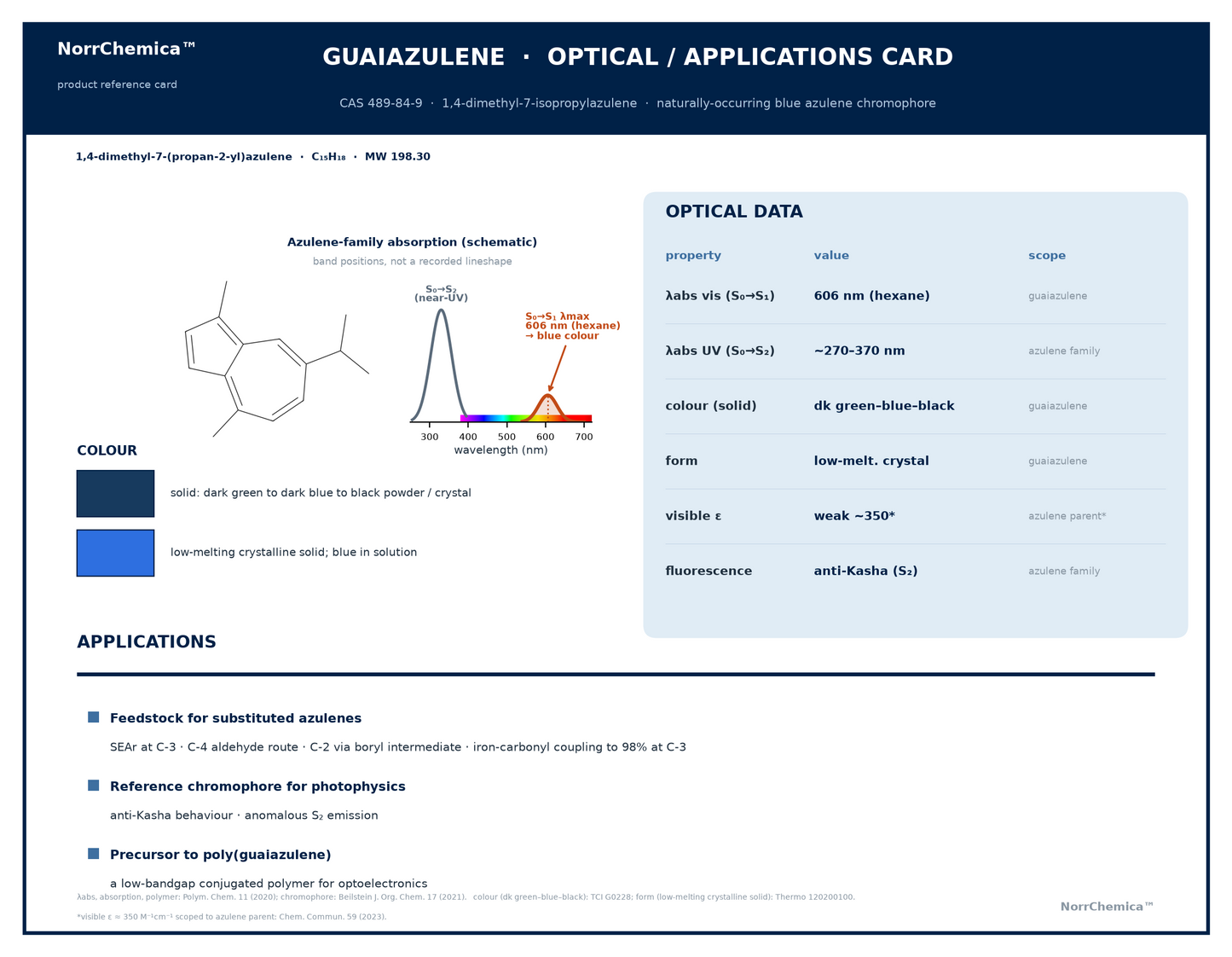
Guaiazulene (1,4-dimethyl-7-isopropylazulene) is a naturally occurring alkyl-substituted azulene, built on the fused five- and seven-membered ring system of the azulene chromophore and supplied as a research-grade organic building block. It is available at far lower cost than parent azulene.
Electronic structure of the azulene chromophore. The azulene chromophore is a non-alternant aromatic hydrocarbon. Its π-electron density is distributed unevenly across the two rings, so the highest occupied and lowest unoccupied molecular orbitals occupy different regions and overlap little. The S₀–S₁ gap is therefore unusually small: the transition falls in the visible, and the compound is blue — unlike its colourless, alternant isomer naphthalene. The parent azulene has a permanent dipole moment of 0.80–1.08 D depending on the method of determination, rare for a hydrocarbon.
A polarised, aromatic-ion framework. Electron density shifts from the seven-membered ring toward the five-membered ring, so the chromophore is described as a six-π-electron tropylium cation fused to a six-π-electron cyclopentadienyl anion within one neutral molecule. Both rings thereby attain aromatic stabilisation, and the charge separation makes the five-membered ring the nucleophilic site.
Anti-Kasha photophysics. The azulene chromophore violates Kasha's rule. The gap between the second and first excited singlet states is about 14000 cm⁻¹ in the parent, which suppresses internal conversion from S₂ and produces fluorescence from S₂ rather than S₁. That anomalous upper-state emission is a reason the framework is studied in photophysics.
Feedstock for substituted azulenes. Azulenes are potent nucleophiles for electrophilic aromatic substitution, the 1- and 3-positions being the most reactive. In guaiazulene C-1 already bears a methyl, so C-3 is the free electrophilic site, while the acidity of the protons on the C-4 methyl group provides a separate, regioselective route: the guaiazulene C-4 aldehyde, a building block for C-4-alkenylated and further derivatives. The inactive C-2 position can be reached through a boryl intermediate. Reaction with cationic iron-carbonyl diene complexes couples guaiazulene at C-3 in yields to 98%; decomplexation and onward chemistry give 1-substituted azulenes.
Precursor for functional materials. Oxidative polymerisation with earth-abundant iron oxidants converts guaiazulene to poly(guaiazulene), a low-bandgap conjugated polymer for optoelectronic applications.
Shipping Destinations
- EU & UK: Priority delivery, 2–5 business days.
- United States (DDP): 3–7 business days, duties and taxes prepaid.
- EFTA Countries (DDP): 3–7 business days, duties and taxes prepaid.
- Worldwide: 7–14 business days, selected locations.
Safety Information
| GHS Pictograms |

|
| Signal Word | Warning |
| Hazard Class | Not regulated for transport |
| Transport Category | Not classified as dangerous goods for transport (ADR/IATA/IMDG) |
| H-Statements | H302 |
| P-Statements | P264 - P270 - P301+P312 - P330 - P501 |
Documentation
| Safety Data Sheet | Download PDF |