NorrChemica™
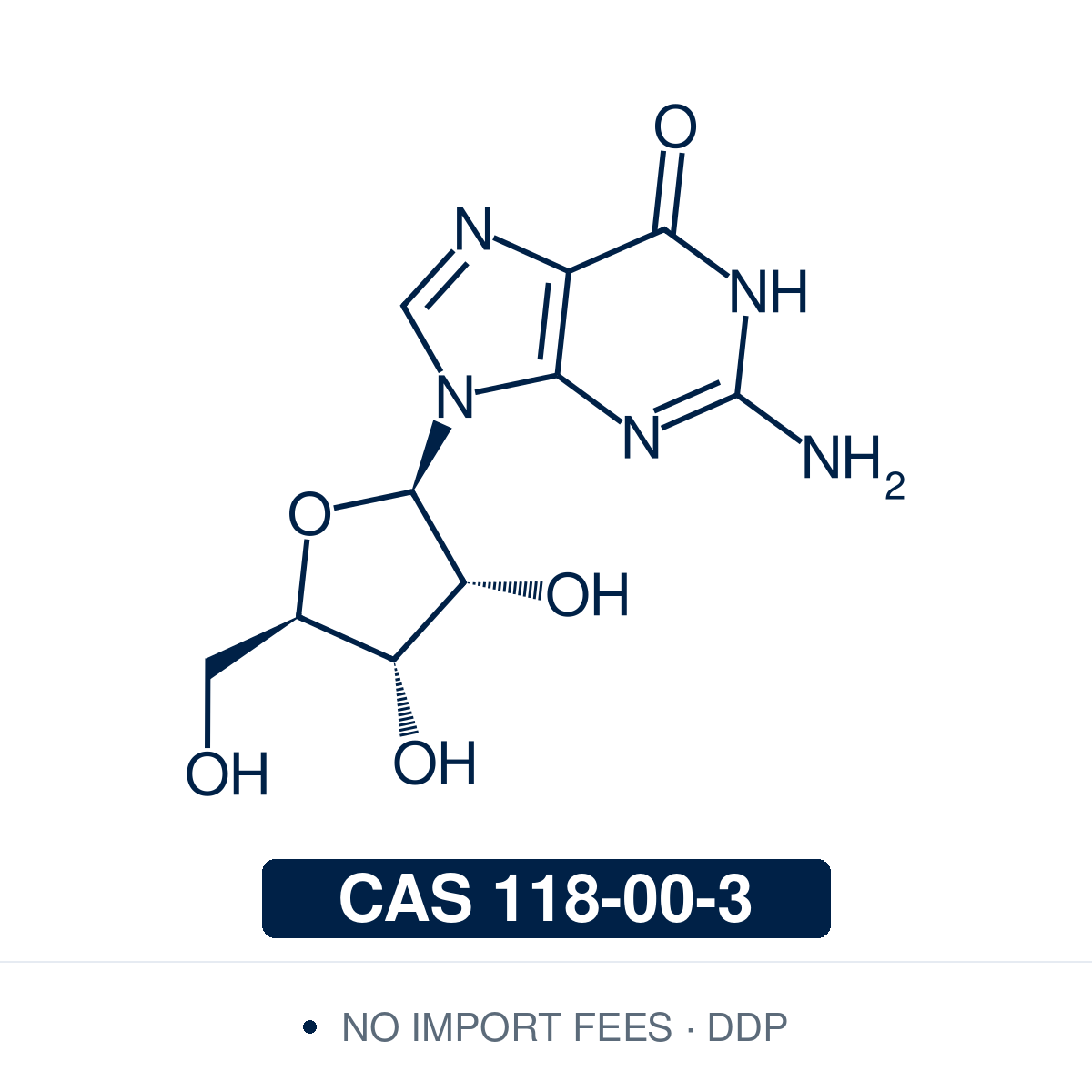
Guanosine
Guanosine | CAS 118-00-3 | ≥98.0%
Couldn't load pickup availability
Technical Specifications
| CAS Number | 118-00-3 |
| EC / EINECS Number | 204-227-8 |
| MDL Number | MFCD00010182 |
| RTECS Number | MF8750000 |
| SMILES | C1=NC2=C(N1[C@H]3[C@@H]([C@@H]([C@H](O3)CO)O)O)N=C(NC2=O)N |
| InChI | InChI=1S/C10H13N5O5/c11-10-13-7-4(8(19)14-10)12-2-15(7)9-6(18)5(17)3(1-16)20-9/h2-3,5-6,9,16-18H,1H2,(H3,11,13,14,19)/t3-,5-,6-,9-/m1/s1 |
| InChIKey | NYHBQMYGNKIUIF-UUOKFMHZSA-N |
| PubChem CID | 135398635 |
| Molecular Formula | C₁₀H₁₃N₅O₅ |
| Molecular Weight | 283.24 g/mol |
| Melting Point | 250 °C (dec.) |
| Solubility | Sparingly soluble in water; practically insoluble in ethanol |
| Purity | ≥98.0% |
| Physical Form | White crystalline powder |
| HS Code | 2934.99 |
| Country of Origin | Finland |
| Shelf Life | Retest period: 36 months from date of manufacture |
| Storage Conditions | Store at room temperature in a tightly sealed container, protected from light and moisture |
Product Description & Scientific Applications
Guanosine (β-D-guanosine; Guo) is the canonical purine ribonucleoside of RNA, with guanine joined to D-ribofuranose through a β-N9-glycosidic bond. In mammalian purine salvage it is converted to GMP via PNP-mediated phosphorolysis to guanine, then HGPRT-mediated phosphoribosylation; GMP is phosphorylated by guanylate kinase to GDP and nucleoside diphosphate kinase to GTP. The guanine base presents H-bond donors and acceptors arrayed for cyclic Hoogsteen pairing, the basis of its G-tetrad and G-quadruplex chemistry.
GTP biochemistry, translation, and cGMP signalling. Once converted to GTP, guanosine-derived nucleotides drive ribosomal initiation, elongation (EF-Tu, EF-G), and termination factors, αβ-tubulin polymerisation, and the small-GTPase switch families (Ras, Rho, Rab, Ran, Arf) that gate signal transduction, vesicle trafficking, nuclear transport, and cytoskeletal remodelling. GTP is the direct substrate for guanylyl cyclase (EC 4.6.1.2), producing 3′,5′-cyclic GMP. Guanosine and its phosphorylated derivatives feature in GTPase-cycle assays, GEF/GAP/GDI biochemistry, guanylyl cyclase activity assays, and HPLC or LC-MS quantification of guanine-nucleotide pools.
Purine salvage and nucleoside phosphorylase studies. Guanosine is the canonical 6-oxopurine substrate for purine nucleoside phosphorylase (PNP, EC 2.4.2.1), which catalyses reversible phosphorolysis of the N-glycosidic bond to give guanine and α-D-ribose-1-phosphate. PNP follows a substrate-assisted, dissociative mechanism through an oxocarbenium-ion transition state. The salvage circuit completes through hypoxanthine-guanine phosphoribosyltransferase (HGPRT, EC 2.4.2.8), which transfers a 5-phosphoribosyl group from PRPP to guanine to give GMP. Guanosine serves as a substrate in PNP kinetic and transition-state-analogue design and binding assays, and as a starting material for chemoenzymatic transglycosylation routes that exploit reversible phosphorolysis.
Modified guanosine synthesis and oligonucleotide chemistry. Guanosine is the reference scaffold for the modified-guanosine toolbox used in synthetic RNA chemistry, RNA structure-function studies, and epitranscriptomics research. The N2-amine, the C8 position of the purine ring, the O6 carbonyl, and the 2′-, 3′-, and 5′-hydroxyls each support distinct protection and functionalisation chemistry. C8 is electrophilically brominated with Br2 or NBS to give 8-bromoguanosine, the standard handle for postsynthetic Suzuki–Miyaura, Sonogashira, and Stille modification and a route into syn-biased, fluorescent, and Z-DNA-favouring nucleosides. O6 protection (typically 2-(p-nitrophenyl)ethyl, NPE) matters mechanistically: activated phosphoramidites phosphitylate the unprotected O6 lactam, and on I2/H2O oxidation this O6 modification is converted via O6→N7 phosphorus migration into a depurination-prone N7-modified guanine that cleaves the chain during deprotection. The N2-amine is masked as isobutyryl, dimethylformamidine, or acetyl during phosphoramidite synthesis, while RNA building blocks add a 2′-OH silyl layer (TBDMS or TOM). These site-specific handles support phosphoramidite preparation, fluorescent and isotopically labelled nucleoside synthesis, 5′-cap analogue chemistry, and 8-oxo-, 8-aryl-, and N2-modified guanosine probes for nucleic-acid damage and structure studies.
G-quartet self-assembly and supramolecular materials. Guanosine self-associates through cyclic Hoogsteen hydrogen bonding — N1H and N2H of one base donating to O6 and N7 of the next — to form a square-planar G-tetrad with eight hydrogen bonds and four convergent O6 carbonyls at the centre. Stacked tetrads form a G-quadruplex stabilised by a monovalent cation in the central channel, with the canonical selectivity K+ > Na+ > Li+ tracking ionic radius and dehydration energetics. This chemistry underpins telomeric, promoter, and untranslated-region G-quadruplex research, RNA G-quadruplex studies, and G4-ligand binding assays by CD, NMR, FRET-melting, and ITC. In materials chemistry, mixing guanosine with 0.5 equiv KB(OH)4 gives a guanosine-borate hydrogel in which borate diester linkages between two guanosines, together with cation-templated G4·K+ stacks, drive nanowire formation and macroscopic gelation; switching to NaB(OH)4 or LiB(OH)4 progressively weakens the gel. Arylboronic-acid and diboronic-acid crosslinkers extend the same cis-diol/boronate logic into Mg2+-bridged guanosine hydrogel systems for cell-growth-compatible scaffold and responsive-materials studies.
Further applications.
- Reference compound in HPLC and LC-MS analysis of purine ribonucleosides and nucleotides.
- Probe nucleoside in hENT1/hENT2 and hCNT2/hCNT3 nucleoside-transporter flux assays.
- Starting material for chemoenzymatic synthesis of guanine nucleotides and labelled nucleosides.
- Standard purine riboside in NMR and structural studies of base-pairing, glycosyl torsion, and sugar-pucker behaviour.
- Purine ribonucleoside additive in salvage-dependent culture systems.
Shipping Destinations
- EU & UK: Priority delivery, 2–5 business days.
- United States (DDP): 3–7 business days, duties and taxes prepaid.
- EFTA Countries (DDP): 3–7 business days, duties and taxes prepaid.
- Worldwide: 7–14 business days, selected locations.
Safety Information
| Hazard Class | None — not subject to transport regulations |
| Transport Category | Not classified as dangerous goods for transport (ADR/IATA/IMDG) |
Documentation
| Safety Data Sheet | Download PDF |
Share