NorrChemica™
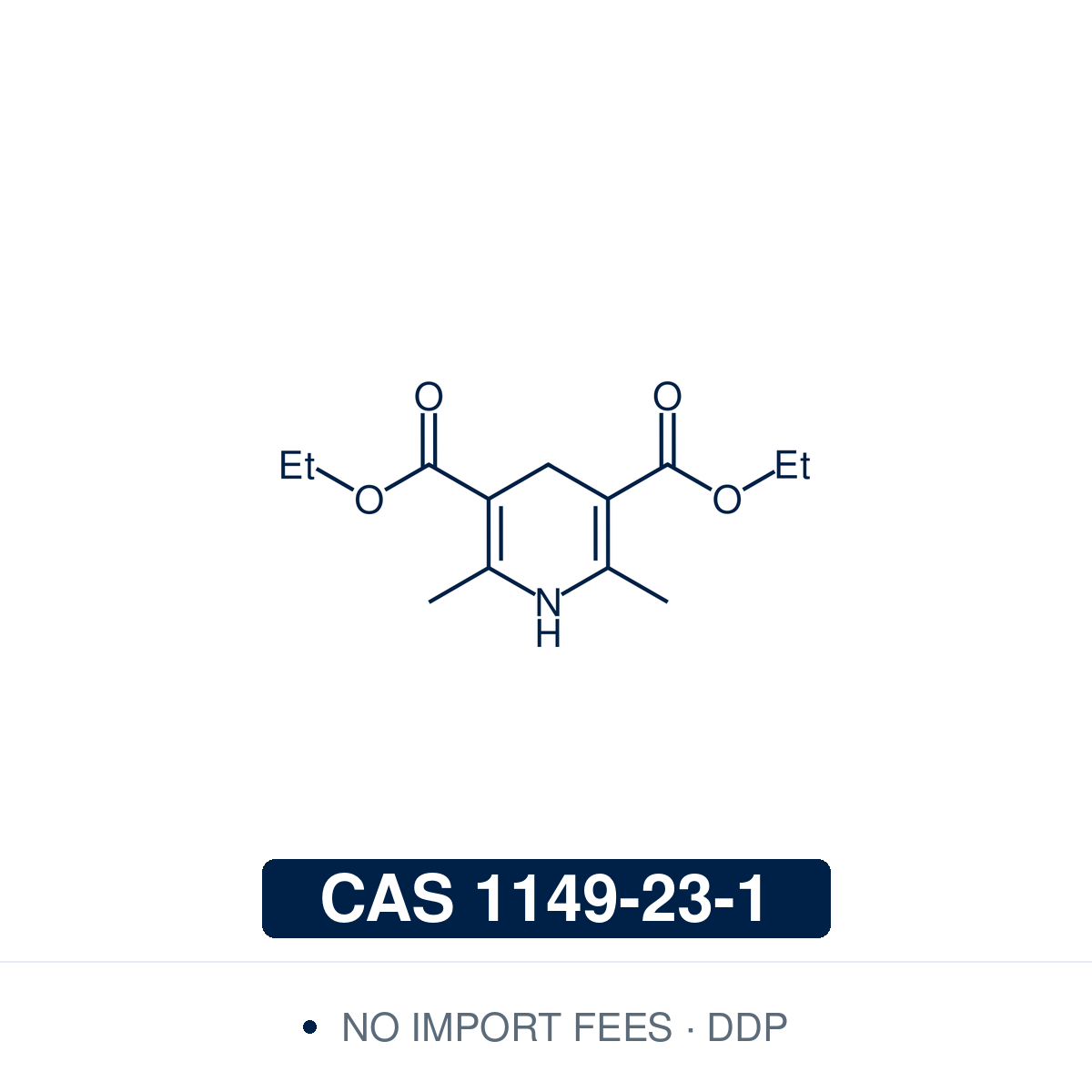
Hantzsch ester
Hantzsch ester | CAS 1149-23-1 | ≥97%
Couldn't load pickup availability
Technical Specifications
| CAS Number | 1149-23-1 |
| EC / EINECS Number | 214-561-6 |
| MDL Number | MFCD00005951 |
| RTECS Number | US7970100 |
| SMILES | CCOC(=O)C1=C(NC(=C(C1)C(=O)OCC)C)C |
| InChI | InChI=1S/C13H19NO4/c1-5-17-12(15)10-7-11(13(16)18-6-2)9(4)14-8(10)3/h14H,5-7H2,1-4H3 |
| InChIKey | LJXTYJXBORAIHX-UHFFFAOYSA-N |
| PubChem CID | 70849 |
| Molecular Formula | C₁₃H₁₉NO₄ |
| Molecular Weight | 253.29 g/mol |
| Melting Point | 175–180 °C |
| Solubility | Soluble in most common organic solvents, including ethanol, dichloromethane, and chloroform. Practically insoluble in water. |
| Purity | ≥97% |
| Physical Form | Light yellow to yellow crystalline powder |
| HS Code | 2933.39 |
| Shelf Life | Retest period: 36 months from date of manufacture. |
| Storage Conditions | Store in a cool, dry place in a tightly sealed container, protected from light. |
Product Description & Scientific Applications
Hantzsch ester (diethyl 1,4-dihydro-2,6-dimethylpyridine-3,5-dicarboxylate; HEH) is a 1,4-dihydropyridine dicarboxylate and a synthetic analogue of the reduced nicotinamide cofactor NADH. Like the cofactor, it is a mild organic hydride donor: under mild conditions it transfers hydrogen to reduce C=C, C=N and activated C=O bonds.
Reduction of imines and reductive amination. With a chiral phosphoric acid catalyst, Hantzsch ester reduces preformed ketimines to enantioenriched amines; the same catalysis reduces the imine formed in situ from a ketone and an arylamine, so the chiral amine is obtained directly by reductive amination, cleanly across a range of ketone structures.
Synthesis of α-amino esters. With a chiral phosphoric acid, it reduces α-imino esters derived from aryl and alkyl keto esters to the corresponding enantioenriched α-amino esters.
Conjugate reduction of enals. Paired with a chiral imidazolidinone catalyst that activates the substrate through iminium-ion formation, it transfers hydrogen to β,β-disubstituted α,β-unsaturated aldehydes to give β-stereogenic saturated aldehydes. The catalyst isomerises the double bond ahead of reduction, so mixtures of E- and Z-enal converge on the same enantiomer, and the delivery tolerates groups that are themselves prone to reduction such as aldehydes and halides.
Reduction of α-ketoesters. With chiral copper(II)–bisoxazoline complexes acting as alcohol-dehydrogenase mimics, it reduces α-ketoesters to the corresponding α-hydroxy esters.
Dearomatising reduction of quinolines. Under chiral Brønsted-acid catalysis, Hantzsch ester drives a cascade transfer hydrogenation of quinolines, adding hydrogen across the heterocyclic ring to give 2-aryl- and 2-alkyl-substituted 1,2,3,4-tetrahydroquinolines, a route applied in alkaloid synthesis.
Photoredox electron donor. Under violet light (390 nm), Hantzsch ester acts as an organic electron donor and photoreductant: it forms electron donor–acceptor complexes with suitable acceptors and undergoes single-electron transfer, generating carbon radicals from carboxylic-acid-derived precursors and reducing the metal catalyst — nickel(II) to catalytically active nickel(0) — so that decarboxylative cross-couplings run without a separate photocatalyst.
Shipping Destinations
- EU & UK: Priority delivery, 2–5 business days.
- United States (DDP): 3–7 business days, duties and taxes prepaid.
- EFTA Countries (DDP): 3–7 business days, duties and taxes prepaid.
- Worldwide: 7–14 business days, selected locations.
Safety Information
| Hazard Class | Not regulated for transport |
| Transport Category | Not classified as dangerous goods for transport (ADR/IATA/IMDG) |
Documentation
| Safety Data Sheet | Download PDF |
Share