NorrChemica™
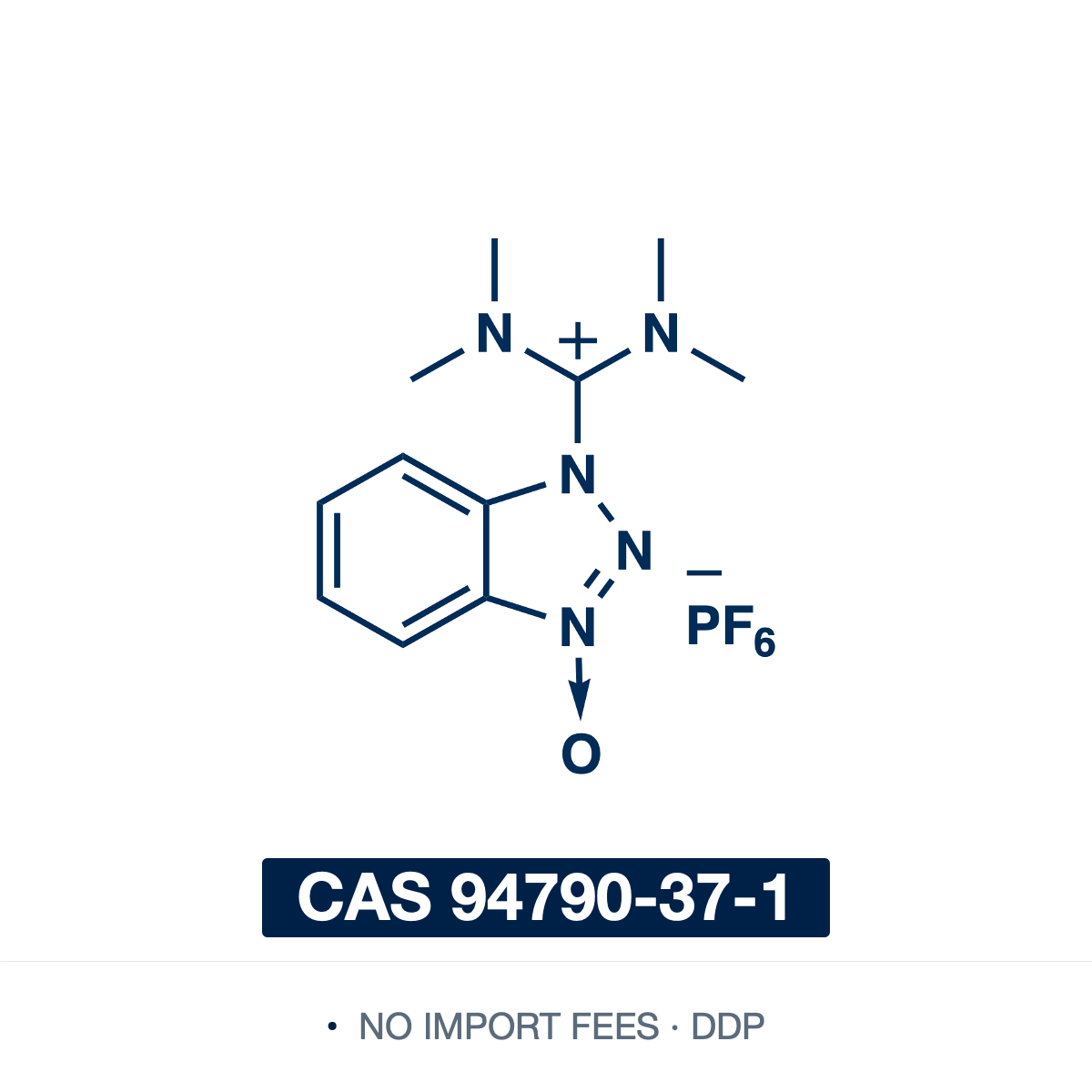
HBTU
HBTU | CAS 94790-37-1 | ≥98%
Couldn't load pickup availability
Technical Specifications
| CAS Number | 94790-37-1 |
| EC / EINECS Number | 423-020-5 |
| MDL Number | MFCD00075445 |
| SMILES | CN(C)C(=[N+](C)C)N1C2=CC=CC=C2[N+](=N1)[O-].F[P-](F)(F)(F)(F)F |
| InChI | InChI=1S/C11H16N5O.F6P/c1-13(2)11(14(3)4)15-9-7-5-6-8-10(9)16(17)12-15;1-7(2,3,4,5)6/h5-8H,1-4H3;/q+1;-1 |
| InChIKey | BSKUEERROYGAFF-UHFFFAOYSA-N |
| PubChem CID | 51341376 |
| Molecular Formula | C₁₁H₁₆F₆N₅OP |
| Molecular Weight | 379.24 g/mol |
| Melting Point | ~200 °C (dec.) |
| Solubility | Soluble in acetonitrile and DMF |
| Purity | ≥98% |
| Physical Form | White to off-white crystalline powder |
| HS Code | 2933.99 |
| Shelf Life | Retest period: 36 months from date of manufacture |
| Storage Conditions | Store refrigerated (2–8 °C) in a tightly sealed container, protected from light and moisture |
Product Description & Scientific Applications
HBTU (commonly named O-(1H-benzotriazol-1-yl)-N,N,N′,N′-tetramethyluronium hexafluorophosphate; structurally the guanidinium N-oxide salt, 1-[bis(dimethylamino)methylene]-1H-benzotriazolium 3-oxide hexafluorophosphate) is a benzotriazole-based uronium/guanidinium coupling reagent for Fmoc solid-phase and solution-phase peptide synthesis. X-ray and solution studies confirm the guanidinium N-oxide structure. HBTU activates carboxylic acids to reactive 1-hydroxybenzotriazolyl (OBt) active esters under mild conditions, giving high coupling yields with low racemisation.
Common Scientific Applications
Fmoc solid-phase peptide synthesis (SPPS): a standard coupling reagent for the dominant methodology for assembling peptides of up to roughly fifty residues on polymeric resin supports. The Fmoc-amino acid is pre-activated with HBTU and a tertiary-amine base (DIPEA or NMM) in DMF to form a benzotriazolyl active ester that acylates the free α-amino group of the resin-bound chain. It is compatible with standard Fmoc-amino acid building blocks on manual and automated synthesisers; its fast, mild activation suits high-throughput parallel synthesis.
Racemisation suppression with HOBt: adding 1-hydroxybenzotriazole (HOBt) as an auxiliary nucleophile further suppresses racemisation at the α-carbon during activation of sterically demanding or racemisation-prone residues such as cysteine and histidine.
Solution-phase amide-bond formation: activates a broad range of carboxylic acids — N-protected amino acids, aromatic acids, and sterically hindered substrates — for coupling with primary and secondary amines under mild conditions. The water-soluble tetramethylurea by-product is removed by aqueous extraction, unlike the insoluble urea precipitates from carbodiimide reagents such as DCC and EDC.
Macrolactamisation and cyclic peptides: drives head-to-tail intramolecular ring closure at high dilution, suppressing oligomerisation, to give cyclic peptides with distinct conformational and metabolic-stability properties relative to linear analogues.
Fragment condensation: enables convergent peptide synthesis by coupling protected fragments; it carries a risk of C-terminal epimerisation via oxazolone formation unless the activated residue is glycine or proline.
Acyl azides, ureas, and carbamates: HBTU activates carboxylic acids toward reaction with an azide source such as sodium azide to give acyl azides; on warming, these undergo the Curtius rearrangement to isocyanates, trapped by amines or alcohols to furnish ureas and carbamates — including dipeptidyl urea esters and symmetric and asymmetric ureas in one-pot procedures. The chemistry tolerates Fmoc, Boc, and Cbz protecting groups across diverse functional groups.
Quinoxaline synthesis: serves as a non-metal condensing catalyst for quinoxaline derivatives from 1,2-diamines and 1,2-diketones such as benzil, under mild, short-reaction-time conditions.
Comparison with related coupling reagents: HBTU and HATU share the same tetramethyl uronium/guanidinium cation but differ in the heteroaromatic leaving group — benzotriazol-1-yl (OBt) for HBTU, 7-azabenzotriazol-1-yl (OAt) for HATU. HATU couples faster and gives lower epimerisation at higher cost; HBTU is the routine choice, HATU reserved for difficult sequences, hindered residues, and fragment condensations. Related reagents include TBTU (tetrafluoroborate counter-ion), HCTU (6-chloro-1-hydroxybenzotriazole-derived), and COMU (morpholino-based, improved safety profile).
Further Reading
Choosing a Coupling Reagent for Amide and Peptide Bond Formation.
Shipping Destinations
- EU & UK: Priority delivery, 2–5 business days.
- United States (DDP): 3–7 business days, duties and taxes prepaid.
- EFTA Countries (DDP): 3–7 business days, duties and taxes prepaid.
- Worldwide: 7–14 business days, selected locations.
Safety Information
| GHS Pictograms |


|
| Signal Word | Warning |
| Hazard Class | None — not subject to transport regulations |
| Transport Category | Not classified as dangerous goods for transport (ADR/IATA/IMDG) |
| H-Statements | H315 - H317 - H319 - H335 |
| P-Statements | P261 - P264 - P271 - P272 - P280 - P302+P352 - P304+P340 - P305+P351+P338 - P333+P313 - P337+P313 - P362+P364 - P501 |
Documentation
| Safety Data Sheet | Download PDF |