NorrChemica™
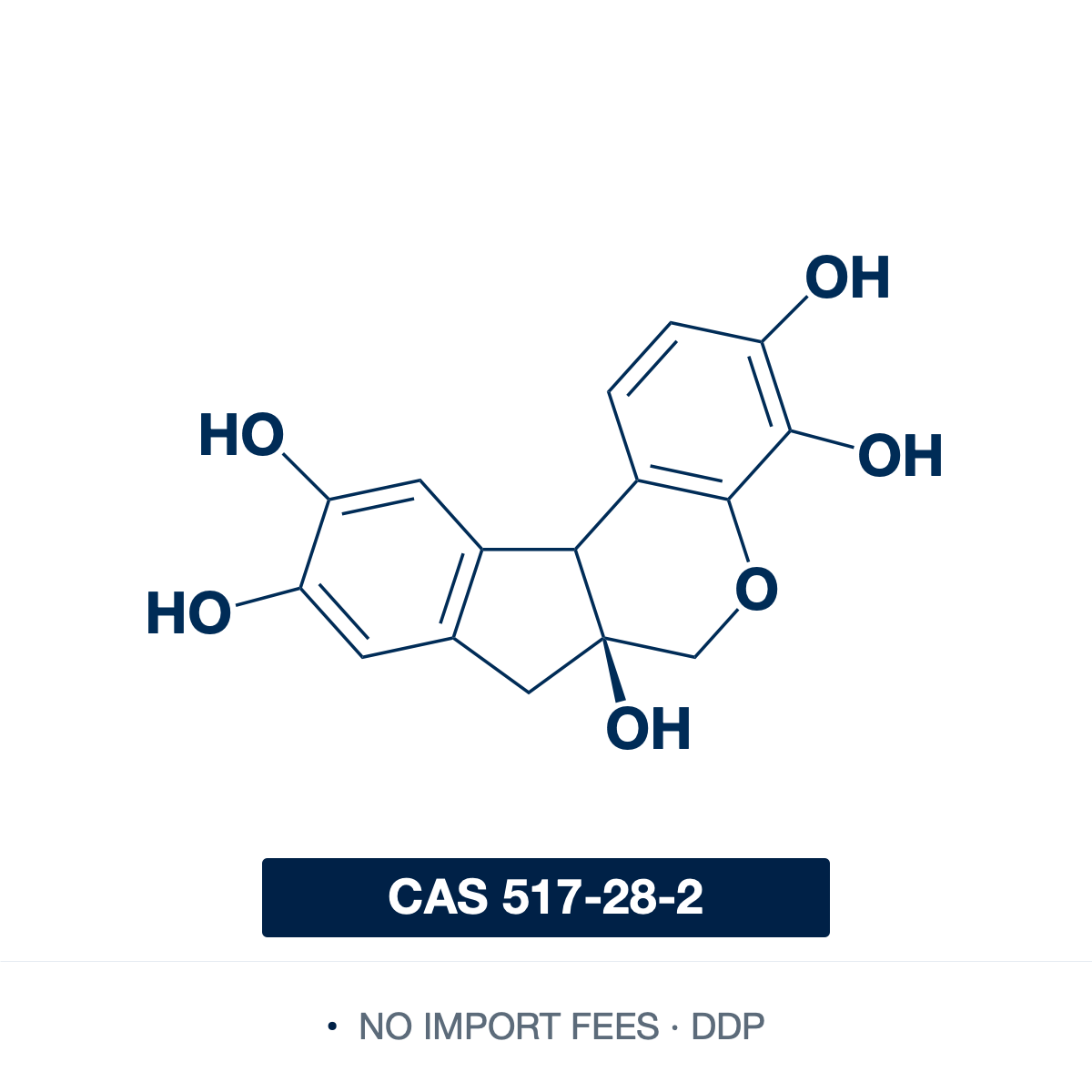
Hematoxylin
Hematoxylin | CAS 517-28-2 | ≥99.0%
Couldn't load pickup availability
Technical Specifications
| CAS Number | 517-28-2 |
| EC / EINECS Number | 208-237-3 |
| MDL Number | MFCD00078111 |
| RTECS Number | MH7875000 |
| SMILES | C1C2=CC(=C(C=C2[C@H]3[C@@]1(COC4=C3C=CC(=C4O)O)O)O)O |
| InChI | InChI=1S/C16H14O6/c17-10-2-1-8-13-9-4-12(19)11(18)3-7(9)5-16(13,21)6-22-15(8)14(10)20/h1-4,13,17-21H,5-6H2/t13-,16+/m0/s1 |
| InChIKey | WZUVPPKBWHMQCE-XJKSGUPXSA-N |
| PubChem CID | 442514 |
| Molecular Formula | C₁₆H₁₄O₆ |
| Molecular Weight | 302.28 g/mol |
| Melting Point | 200 °C (dec.) |
| Solubility | 18.3 g/L in water (20 °C, OECD TG 105) |
| Log Pow | <0.3 (30 °C, OECD TG 117) |
| Purity | ≥99.0% |
| Physical Form | Yellowish to brownish crystalline powder (Note: Oxidizes in air/light, may appear reddish/darker) |
| HS Code | 3203.00 |
| Country of Origin | Finland |
| Shelf Life | Retest period: 36 months from date of manufacture |
| Storage Conditions | Store in a cool, dry place in a tightly sealed container, protected from light |
Product Description & Scientific Applications
Hematoxylin (C.I. Natural Black 1; hydroxybrazilin; CAS 517-28-2) is a natural polyphenolic compound isolated from the heartwood of the logwood tree Haematoxylum campechianum and one of the most important reagents in biological microscopy. Hematoxylin itself is nearly colourless with poor direct affinity for tissue; the active chromogen is its oxidation product hematein. Oxidation occurs via atmospheric oxygen during prolonged "ripening" or, in modern preparations, chemical oxidants such as sodium iodate, potassium permanganate, hydrogen peroxide, or iodine. Hematein is itself anionic and weakly tissue-binding, developing intense staining only when complexed with polyvalent metal mordants — chiefly aluminium and iron, with chromium, tungsten, and molybdenum used in specialised formulations — to form positively charged dye-mordant lakes that bind nuclear chromatin and other anionic cellular components. The mordant, oxidation state, and working-solution pH together determine the colour, intensity, selectivity, and tissue affinity of the stain.
Mordant Chemistry and Hematoxylin Formulations
Aluminium-mordanted (alum) hematoxylins such as Ehrlich, Harris, Mayer, Delafield, and Gill give the standard blue-purple nuclear staining of routine histology; these are progressive (incubation to a defined endpoint, e.g. Mayer, Gill) or regressive (deliberate overstaining followed by acid-alcohol differentiation, e.g. Harris). Iron-mordanted preparations such as Weigert iron hematoxylin give intensely black, acid-resistant nuclear staining that withstands acidic counterstains. Phosphotungstic acid hematoxylin (PTAH) adds selectivity for fibrous and cytoskeletal components, while chromium- and molybdenum-based formulations have been used for specialised applications.
Nuclear Counterstaining and the H&E Stain
Hematoxylin is the nuclear chromogen of the Hematoxylin and Eosin (H&E) stain, the most widely used staining combination in histology: alum hematoxylin gives deep blue-purple nuclei contrasting with eosin-stained pink to red cytoplasm and extracellular components. It is also the nuclear counterstain in immunohistochemistry and chromogenic in situ hybridisation; in the former, progressive formulations give controlled contrast compatible with chromogenic detection based on diaminobenzidine (DAB), aminoethylcarbazole (AEC), and related substrates when applied lightly enough not to mask the signal.
Connective Tissue and Trichrome Staining
Weigert iron hematoxylin is the nuclear component of connective-tissue and trichrome procedures, where acidic counterstains would otherwise strip alum-mordanted stains; its acid-resistant black nuclei allow polychrome differentiation of collagen, muscle, elastic fibres, cytoplasm, and nuclei in one procedure. Masson trichrome distinguishes collagen, muscle and cytoplasm, and nuclei in three colours, used in connective-tissue architecture, fibrosis, cardiac and skeletal muscle, and skin histology. Verhoeff elastic stain combines iron hematoxylin with ferric chloride and iodine to show elastic fibres in black against a van Gieson counterstain, for vascular and elastic-tissue research.
Neuroanatomical and Muscle Histochemistry
Hematoxylin-based myelin methods stain myelin sheaths deep blue-black for research on central nervous system architecture, myelination, and white matter; these include the chromate-mordant Weigert-Pal method and iron-hematoxylin variants such as Loyez and Spielmeyer. Mallory phosphotungstic acid hematoxylin (PTAH) demonstrates astrocytes, neuroglial fibres, and fibrin. Heidenhain iron hematoxylin is a regressive cytological stain demonstrating mitochondria, chromatin, chromosomes, nucleoli, and muscle cross-striations, supporting skeletal and cardiac muscle research and studies of cell division and subcellular architecture.
Other Applications
- Botanical histology and plant tissue section staining research
Shipping Destinations
- EU & UK: Priority delivery, 2–5 business days.
- United States (DDP): 3–7 business days, duties and taxes prepaid.
- EFTA Countries (DDP): 3–7 business days, duties and taxes prepaid.
- Worldwide: 7–14 business days, selected locations.
Safety Information
| GHS Pictograms |

|
| Signal Word | Warning |
| Hazard Class | None — not subject to transport regulations |
| Transport Category | Not classified as dangerous goods for transport (ADR/IATA/IMDG) |
| H-Statements | H319 |
| P-Statements | P264 - P280 - P305+P351+P338 - P337+P313 |
Documentation
| Safety Data Sheet | Download PDF |