NorrChemica™
HEPES
HEPES | CAS 7365-45-9 | ≥98.0%
Couldn't load pickup availability
Technical Specifications
| CAS Number | 7365-45-9 |
| EC / EINECS Number | 230-907-9 |
| MDL Number | MFCD00006158 |
| RTECS Number | TL6809000 |
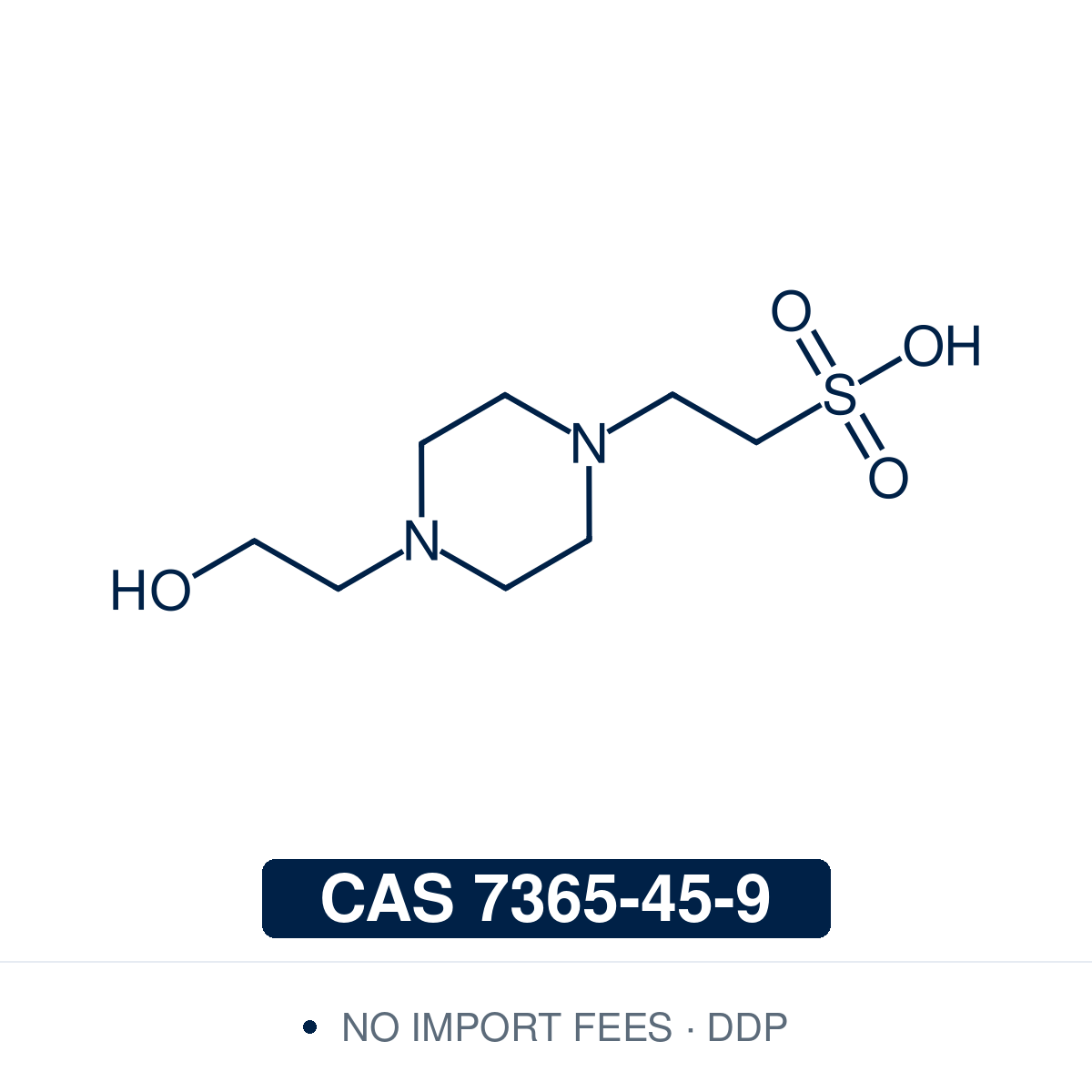
| SMILES | C1CN(CCN1CCO)CCS(=O)(=O)O |
| InChI | InChI=1S/C8H18N2O4S/c11-7-5-9-1-3-10(4-2-9)6-8-15(12,13)14/h11H,1-8H2,(H,12,13,14) |
| InChIKey | JKMHFZQWWAIEOD-UHFFFAOYSA-N |
| PubChem CID | 23831 |
| Molecular Formula | C₈H₁₈N₂O₄S |
| Molecular Weight | 238.3 g/mol |
| Melting Point | ~200 °C (dec.) |
| Solubility | ~500 mg/mL in water (clear, colourless) |
| Log Pow | <-3.85 |
| Purity | ≥ 98.0 % |
| Physical Form | White crystalline powder |
| HS Code | 2921.59 |
| Country of Origin | Finland |
| Shelf Life | Retest period: 36 months from date of manufacture |
| Storage Conditions | Store in a cool, dry place in a tightly sealed container, protected from light |
Product Description & Scientific Applications
HEPES is a zwitterionic N-substituted aminosulfonic acid and one of the most widely used Good's buffers in biochemical, physiological, and cell-based research. Its conjugate-acid pKa is ≈ 7.48–7.50 at 25 °C, with an effective range of pH 6.8–8.2, covering the near-physiological window. It is highly water-soluble (≥ 400 mg/mL); the piperazine nitrogen is the titratable buffering group and the sulfonate confers zwitterionic character.
Buffer chemistry and temperature dependence. HEPES has a small temperature coefficient for a biological buffer (dpKa/dT ≈ −0.014 per °C; pKa ≈ 7.48 at 25 °C, ≈ 7.31 at 37 °C), less temperature-sensitive than Tris (≈ −0.028 per °C) and useful across cold-room, room-temperature, and physiological conditions. ITC studies show no detectable affinity for Ca²⁺, Mg²⁺, Mn²⁺, Co²⁺, or Ni²⁺, mild affinity for Cu²⁺ and Pb²⁺, and weak affinity for Zn²⁺ and Cd²⁺ — supporting Mg²⁺- or Mn²⁺-dependent enzyme assays, though HEPES is not fully non-coordinating: a CuL⁺ complex with log β ≈ 3.22 is documented, so copper-dependent assays and metal-speciation work need controls. HEPES media should be protected from prolonged visible light when riboflavin or other photosensitisers are present, since irradiation can generate hydrogen peroxide and alter readouts.
CO₂-independent buffering in cell culture and live-cell imaging. HEPES is widely used as a supplementary or primary buffer in mammalian cell culture when bicarbonate/CO₂ buffering cannot be maintained, stabilising extracellular pH in imaging media, balanced salt solutions, perfusion buffers, and short-term handling buffers under ambient atmosphere. This suits live-cell and confocal microscopy, benchtop manipulation between incubators, harvesting and washing, transport assays, and electrophysiology recording solutions. Typical media levels run from low-millimolar to tens of millimolar, depending on whether it supplements bicarbonate or serves as the main non-CO₂-dependent buffer.
Calcium phosphate transfection and molecular biology. HEPES-buffered saline (HBS) is the classical system for calcium phosphate transfection of eukaryotic cells: slow mixing of HBS containing sodium phosphate with a CaCl₂/DNA solution generates a fine calcium phosphate–DNA co-precipitate taken up by endocytosis. Formulations commonly use 2× HBS at pH 7.05, reflecting the narrow pH dependence of precipitate formation and transfection performance. HEPES also serves washing, short-term storage, transfection handling, and cell-suspension preparation for downstream analysis.
Protein biochemistry, enzyme assays, and analytical workflows. Its low interaction with Mg²⁺, Mn²⁺ and Ca²⁺ supports kinase, phosphatase, polymerase, and other metal-dependent enzyme assays. HEPES is also used in protein purification by ion-exchange, size-exclusion, and affinity chromatography; in capillary electrophoresis and isoelectric focusing; in native PAGE of protein complexes; and in protein biophysics including ITC, surface plasmon resonance, and fluorescence spectroscopy. Low absorbance at 260/280 nm supports UV/visible and fluorescence-compatible assays with matched blanks. Further uses include selected nucleic-acid hybridisation and in situ-hybridisation/FISH workflows, and protein-crystallography screening and optimisation buffers.
Shipping Destinations
- EU & UK: Priority delivery, 2–5 business days.
- United States (DDP): 3–7 business days, duties and taxes prepaid.
- EFTA Countries (DDP): 3–7 business days, duties and taxes prepaid.
- Worldwide: 7–14 business days, selected locations.
Safety Information
| Hazard Class | None — not subject to transport regulations |
| Transport Category | Not classified as dangerous goods for transport (ADR/IATA/IMDG) |
Documentation
| Safety Data Sheet | Download PDF |
Share