NorrChemica™
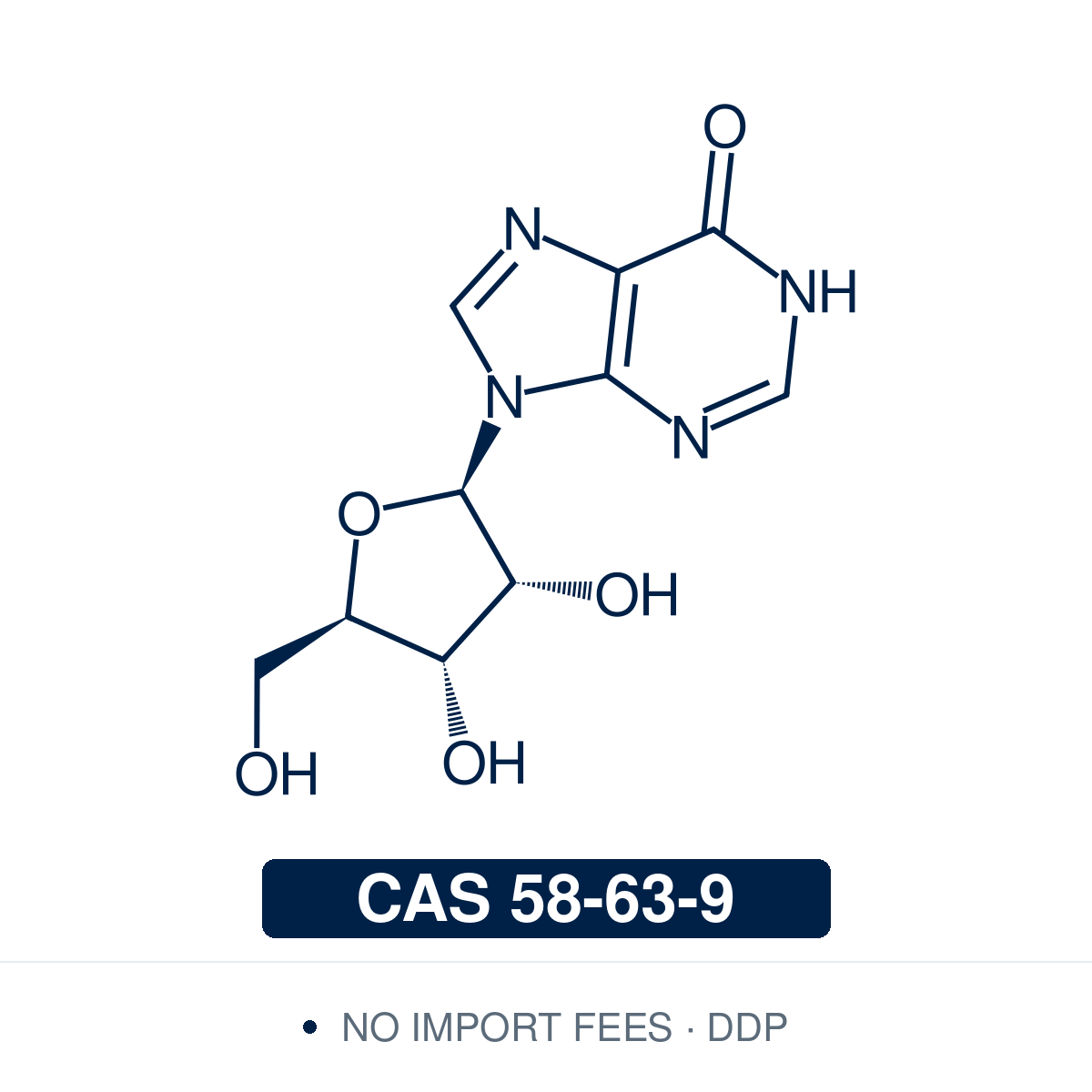
Inosine
Inosine | CAS 58-63-9 | ≥98%
Couldn't load pickup availability
Technical Specifications
| CAS Number | 58-63-9 |
| EC / EINECS Number | 200-390-4 |
| MDL Number | MFCD00066770 |
| RTECS Number | NM7460000 |
| SMILES | C1=NC2=C(C(=O)N1)N=CN2[C@H]3[C@@H]([C@@H]([C@H](O3)CO)O)O |
| InChI | InChI=1S/C10H12N4O5/c15-1-4-6(16)7(17)10(19-4)14-3-13-5-8(14)11-2-12-9(5)18/h2-4,6-7,10,15-17H,1H2,(H,11,12,18)/t4-,6-,7-,10-/m1/s1 |
| InChIKey | UGQMRVRMYYASKQ-KQYNXXCUSA-N |
| PubChem CID | 135398641 |
| Molecular Formula | C₁₀H₁₂N₄O₅ |
| Molecular Weight | 268.23 g/mol |
| Melting Point | 222–226 °C (dec.) |
| Solubility | Sparingly soluble in water; soluble in dilute acids and DMSO; practically insoluble in ethanol |
| Purity | ≥98% |
| Physical Form | White crystalline powder |
| HS Code | 2934.99 |
| Country of Origin | Finland |
| Shelf Life | Retest period: 36 months from date of manufacture |
| Storage Conditions | Store at room temperature in a tightly sealed container, protected from light and moisture |
Product Description & Scientific Applications
Inosine (hypoxanthine 9-β-D-ribofuranoside; Ino) is a purine ribonucleoside of hypoxanthine, linked to D-ribofuranose through a β-N9-glycosidic bond. In mammalian purine metabolism it is generated by irreversible hydrolytic deamination of adenosine by adenosine deaminase (ADA; EC 3.5.4.4) and cleaved by purine nucleoside phosphorylase (PNP; EC 2.4.2.1) en route to IMP.
A-to-I RNA editing. Inosine is the product of adenosine-to-inosine (A-to-I) RNA editing, one of the most abundant post-transcriptional modifications in the mammalian transcriptome, catalysed by the ADAR family (ADAR1–3) through hydrolytic C6 deamination of adenosines in double-stranded RNA. Because inosine is read as guanosine in reverse transcription and primarily decoded as guanosine in translation, A-to-I editing can recode amino acids, alter splice-site recognition, modulate microRNA biogenesis and targeting, and mark endogenous double-stranded RNA as "self" relative to MDA5-mediated cytosolic dsRNA sensing. It is the analytical target in epitranscriptomic mapping by ICE-seq, Endonuclease V-mediated cleavage and high-resolution LC-MS/MS.
Wobble tRNA decoding. Inosine forms at the wobble position (position 34) of eukaryotic tRNA anticodons, where adenosine is deaminated to inosine by the ADAT2/ADAT3 heterodimer. A single tRNA carrying I34 decodes three synonymous codons (NNU, NNC, NNA), expanding codon-recognition capacity and compressing the tRNA repertoire. The bacterial homologue TadA has been adapted as the deaminase module of adenine base editors (ABEs) for programmable A-to-G genome editing.
Purine salvage and chemoenzymatic synthesis. Inosine is a substrate for purine salvage and a starting material for chemoenzymatic nucleoside synthesis. Mammalian PNP, highly specific for 6-oxopurine nucleosides, catalyses reversible phosphorolysis of inosine to hypoxanthine and α-D-ribose-1-phosphate; hypoxanthine is condensed with PRPP by HGPRT (EC 2.4.2.8) to give IMP, the gateway to AMP and GMP nucleotide pools. This reversibility lets trans-glycosylation through the α-D-ribose-1-phosphate intermediate transfer the sugar to modified purine bases, giving purine nucleoside analogues; pyrimidine analogues require a pyrimidine-specific nucleoside phosphorylase coupled with PNP.
Degenerate oligonucleotide design. Inosine and 2'-deoxyinosine pair with all four canonical bases, making them useful as "wobble positions" in degenerate primer and probe design. In deoxyinosine-containing DNA duplexes pairing stability follows I:C > I:A > I:T ≈ I:G. They reduce the number of oligonucleotides needed to cover sequence variants in consensus primer design across divergent species, conserved-region targeting and probe rescue, but are most useful at positions of true sequence ambiguity, not as a substitute for full specificity.
Analytical and spectroscopic reference. Inosine has a UV absorption maximum near 248–250 nm (ε ≈ 12,000 M⁻¹cm⁻¹ at neutral pH) and a monoisotopic mass of 268.08 Da, and serves as a retention and quantitation standard in reverse-phase and LC-MS analysis of purine nucleosides and nucleotides. Diagnostic ¹H NMR signals include the H1' anomeric proton (δ ≈ 5.9–6.1 ppm, D₂O) and the hypoxanthine H8 and H2 singlets (δ ≈ 8.2–8.3 ppm).
Enzyme-assay reagent. Inosine is a substrate for PNP assays and a product or reference standard in ADA, ADAR and ADAT workflows.
Shipping Destinations
- EU & UK: Priority delivery, 2–5 business days.
- United States (DDP): 3–7 business days, duties and taxes prepaid.
- EFTA Countries (DDP): 3–7 business days, duties and taxes prepaid.
- Worldwide: 7–14 business days, selected locations.
Safety Information
| Hazard Class | None — not subject to transport regulations |
| Transport Category | Not classified as dangerous goods for transport (ADR/IATA/IMDG) |
Documentation
| Safety Data Sheet | Download PDF |
Share