NorrChemica™
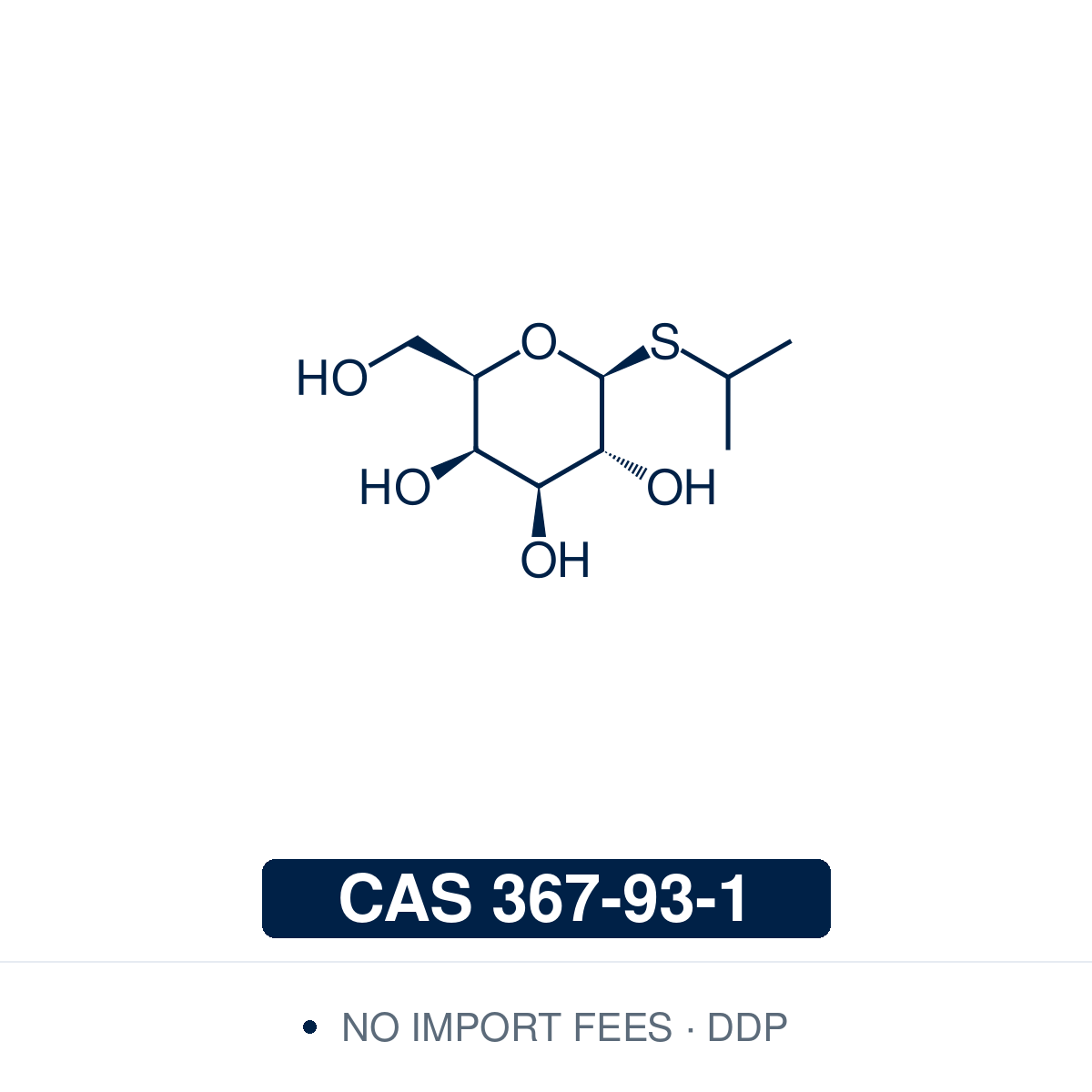
Isopropyl β-D-1-thiogalactopyranoside
Isopropyl β-D-1-thiogalactopyranoside | CAS 367-93-1 | ≥98%
Pack sizes & prices
| Pack size | Excl. VAT | Incl. VAT | Add to cart |
|---|---|---|---|
| 5.0 g | €64,20 | ||
| 10 g | €84,20 | ||
| 25 g | €149,20 | ||
| 50 g | €229,20 | ||
| 100 g | €329,20 | ||
| 250 g | €649,20 | ||
| 500 g | €1.069,00 |
Taxes and fees, e.g. VAT, included in the price. Shipping calculated at checkout.Free shipping on EU, UK and EFTA orders above €250, and above €400 to the rest of the world.
Technical Specifications
| CAS Number | 367-93-1 |
| EC / EINECS Number | 206-703-0 |
| MDL Number | MFCD00063273 |
| SMILES | CC(C)S[C@H]1[C@@H]([C@H]([C@H]([C@H](O1)CO)O)O)O |
| InChI | InChI=1S/C9H18O5S/c1-4(2)15-9-8(13)7(12)6(11)5(3-10)14-9/h4-13H,3H2,1-2H3/t5-,6+,7+,8-,9+/m1/s1 |
| InChIKey | BPHPUYQFMNQIOC-NXRLNHOXSA-N |
| PubChem CID | 656894 |
| Molecular Formula | C₉H₁₈O₅S |
| Molecular Weight | 238.3 g/mol |
| Melting Point | 113-115 °C |
| Solubility | Soluble in water. |
| Purity | ≥98% |
| Physical Form | White to off-white powder |
| HS Code | 2940.00 |
| Shelf Life | Retest period: 36 months from date of manufacture |
| Storage Conditions | Store refrigerated (2–8 °C) in a tightly sealed container, protected from light and moisture. |
Product Description & Scientific Applications
IPTG (isopropyl β-D-1-thiogalactopyranoside) is an inducer of the Escherichia coli lac operon. It is an analogue of allolactose. IPTG binds the lac repressor (LacI) and changes its conformation, which prevents repression of the β-galactosidase gene lacZ. Crystal structures of the lac repressor alone, bound to IPTG and bound to operator DNA show the repressor in both its induced and repressed states.
Inducible expression in bacteria. Most of the expression systems commonly used in bacteria are based on the E. coli lac promoter, and in most cases IPTG or TMG, another inducer, is used. In the pET system, target genes under bacteriophage T7 promoters are expressed in host strains that carry the T7 RNA polymerase gene under lacUV5 control, and expression is induced by adding IPTG. One study in E. coli found that IPTG is taken up by the lactose permease at low concentrations, but can also enter cells without it at higher concentrations. The same study's results indicate that the enzyme LacA (a transacetylase) can lower the IPTG concentration below the level needed for induction, which should be considered when small amounts of inducer are used.
Blue–white screening. With plasmid vectors that rely on α-complementation, a fragment of β-galactosidase made from the plasmid joins a fragment made by the host cell to give active enzyme, and bacteria with this active enzyme form blue colonies with the chromogenic substrate X-Gal. A DNA insert in the cloning site almost always prevents this, so bacteria carrying plasmids with an insert form white colonies. In this screen, IPTG is added as the inducer, together with X-Gal. In one published protocol, both are mixed with the bacteria in molten top agar and spread on agar plates containing the appropriate antibiotic.
Inducible expression in mammalian cells and fission yeast. In one study in mouse cells, the lac repressor blocked transcription of a reporter gene when a lac operator was placed in its promoter region. Adding IPTG markedly relieved this repression. Another study, in the fission yeast Schizosaccharomyces pombe, showed that a lac operator placed at a suitable position in the nmt promoter allowed gene expression to be regulated by the lac repressor in response to IPTG.
Shipping Destinations
- EU & UK: Priority delivery, 2–5 business days.
- United States (DDP): 3–7 business days, duties and taxes prepaid.
- EFTA Countries (DDP): 3–7 business days, duties and taxes prepaid.
- Worldwide: 7–14 business days, selected locations.
Safety Information
| Hazard Class | Not regulated for transport |
| Transport Category | Not classified as dangerous goods for transport (ADR/IATA/IMDG) |
Documentation
| Safety Data Sheet | Download PDF |
Share