NorrChemica™
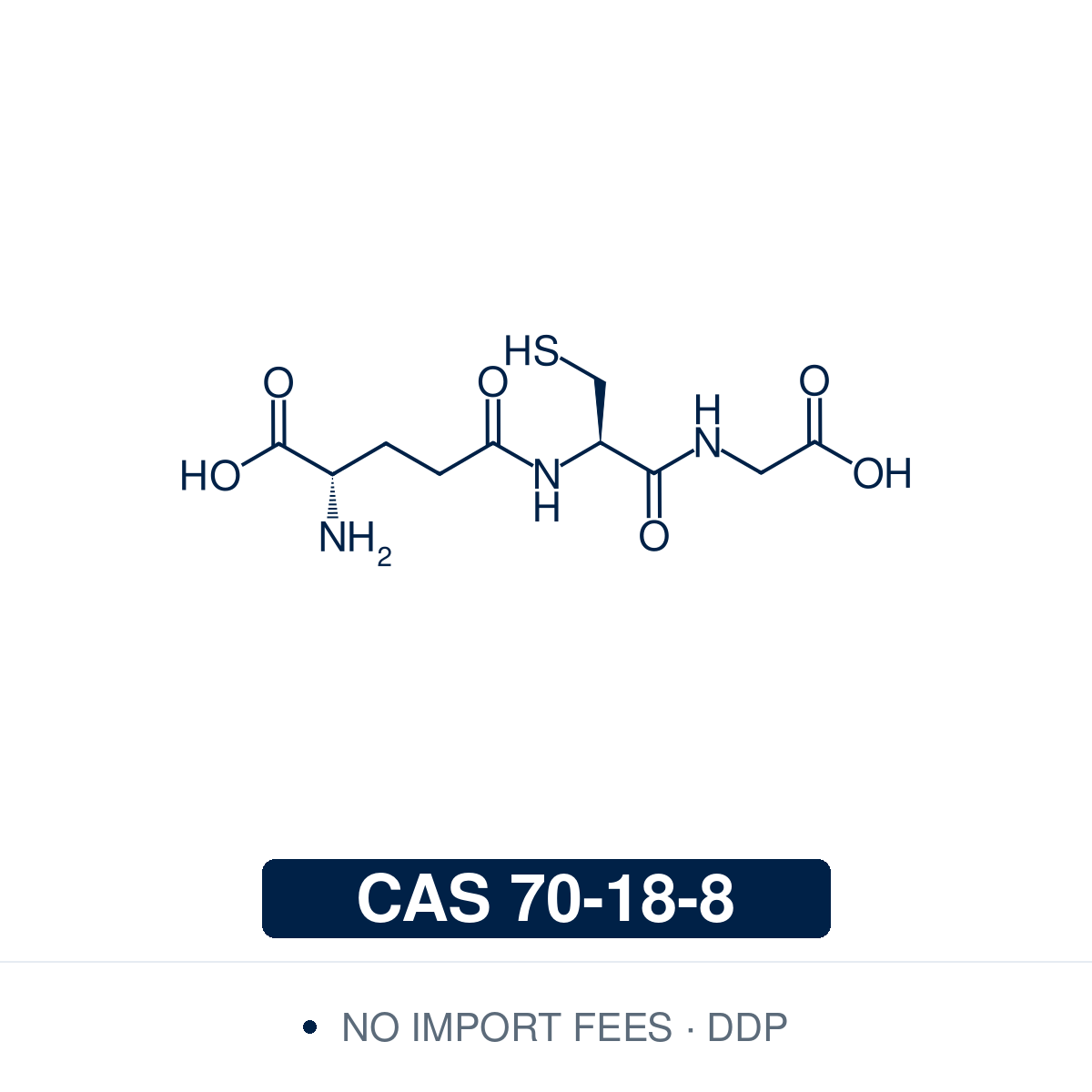
L-Glutathione, Reduced
L-Glutathione, Reduced | CAS 70-18-8 | ≥97%
Pack sizes & prices
| Pack size | Excl. VAT | Incl. VAT | Add to cart |
|---|---|---|---|
| 1.0 g | €39,20 | ||
| 5.0 g | €89,20 | ||
| 10 g | €129,20 | ||
| 25 g | €179,20 | ||
| 50 g | €269,20 | ||
| 100 g | €398,20 | ||
| 250 g | €698,20 | ||
| 500 g | €995,00 |
Taxes and fees, e.g. VAT, included in the price. Shipping calculated at checkout.Free shipping on EU, UK and EFTA orders above €250, and above €400 to the rest of the world.
Technical Specifications
| CAS Number | 70-18-8 |
| EC / EINECS Number | 200-725-4 |
| MDL Number | MFCD00065939 |
| RTECS Number | MC0556000 |
| SMILES | C(CC(=O)N[C@@H](CS)C(=O)NCC(=O)O)[C@@H](C(=O)O)N |
| InChI | InChI=1S/C10H17N3O6S/c11-5(10(18)19)1-2-7(14)13-6(4-20)9(17)12-3-8(15)16/h5-6,20H,1-4,11H2,(H,12,17)(H,13,14)(H,15,16)(H,18,19)/t5-,6-/m0/s1 |
| InChIKey | RWSXRVCMGQZWBV-WDSKDSINSA-N |
| PubChem CID | 124886 |
| Molecular Formula | C₁₀H₁₇N₃O₆S |
| Molecular Weight | 307.33 g/mol |
| Melting Point | 192–195 °C (decomposes) |
| Solubility | Very soluble in water. Freely soluble in dilute alcohol and DMF. Soluble in DMSO. Almost insoluble in ethanol. |
| Purity | ≥97% |
| Physical Form | White powder |
| HS Code | 2930.90 |
| Shelf Life | Retest period: 36 months from date of manufacture |
| Storage Conditions | Keep container tightly closed in a dry and well-ventilated place. Keep refrigerated. |
Product Description & Scientific Applications
L-Glutathione, Reduced (GSH) is the tripeptide γ-glutamylcysteinylglycine. It is the most abundant endogenous non-protein antioxidant. Oxidation joins two molecules of GSH into glutathione disulfide (GSSG), and glutathione reductase converts GSSG back to GSH with NADPH.
Oxidation joins two molecules of GSH (left) through a disulfide bond to give GSSG (right); glutathione reductase with NADPH converts GSSG back to GSH.
Redox state in cells. Glutathione is the major redox buffer of the secretory pathway. The ratio of GSH to GSSG there is much lower than in the cell as a whole, so the secretory pathway is more oxidising than the cytosol. Glutathione also forms mixed disulfides with cysteine residues of proteins. This S-glutathionylation is a reversible modification that can regulate protein activity.
Purification of GST fusion proteins. Proteins expressed in Escherichia coli as fusions with glutathione S-transferase (GST) are purified by affinity chromatography on immobilised glutathione. Reduced glutathione then elutes the bound fusion protein under mild, non-denaturing conditions. Competitive elution with reduced glutathione has also been used in binding assays, to recover a GST fusion protein together with the proteins bound to it.
Protein refolding. Mixtures of reduced and oxidised glutathione are used as redox buffers to refold reduced, denatured proteins, so that they form their correct disulfide bonds. In a study on chymotrypsinogen, molecules with wrongly paired disulfides were renatured by thiol-catalysed interchange of disulfide bonds. In a study on ribonuclease, refolding in a glutathione buffer was not inhibited by EDTA, unlike air oxidation, and it worked at much higher protein concentrations. Reduced and oxidised glutathione have been used to refold recombinant proteins expressed in E. coli, such as a malaria vaccine candidate antigen and a cysteine protease.
Enzyme assays. Liver glutathione S-transferase B catalyses the conjugation of glutathione with electrophiles such as 1-chloro-2,4-dinitrobenzene (CDNB), and incubation with CDNB is used to measure GST activity in protein extracts. Glutathione peroxidase oxidises GSH to GSSG with hydrogen peroxide, and this reaction can be coupled to glutathione reductase and NADPH.
Drug metabolism and covalent inhibitors. GSH is added to microsomal incubations as a trapping reagent, so that reactive metabolites are captured as glutathione conjugates. The conjugates are commonly screened by LC–MS/MS for a neutral loss of 129 Da, which is pyroglutamic acid lost from the γ-glutamyl part of glutathione. Rates of reaction with GSH are measured to compare electrophiles such as acrylamides in the design of cysteine-targeted covalent inhibitors.
Measuring glutathione. GSH is measured with 5,5′-dithiobis(2-nitrobenzoic acid) (DTNB), which oxidises it and forms the yellow 5-thio-2-nitrobenzoic acid (TNB), read at 412 nm. In the enzymatic recycling assay, glutathione reductase and NADPH convert GSSG back to GSH, so the assay measures total glutathione.
Reduction-sensitive carriers. Solutions of GSH have been used to trigger and test drug release from carriers that contain disulfide links, such as reduction-sensitive micelles.
Shipping Destinations
- EU & UK: Priority delivery, 2–5 business days.
- United States (DDP): 3–7 business days, duties and taxes prepaid.
- EFTA Countries (DDP): 3–7 business days, duties and taxes prepaid.
- Worldwide: 7–14 business days, selected locations.
Safety Information
| Hazard Class | Not regulated for transport |
| Transport Category | Not classified as dangerous goods for transport (ADR/IATA/IMDG) |
Documentation
| Safety Data Sheet | Download PDF |
Share