NorrChemica™
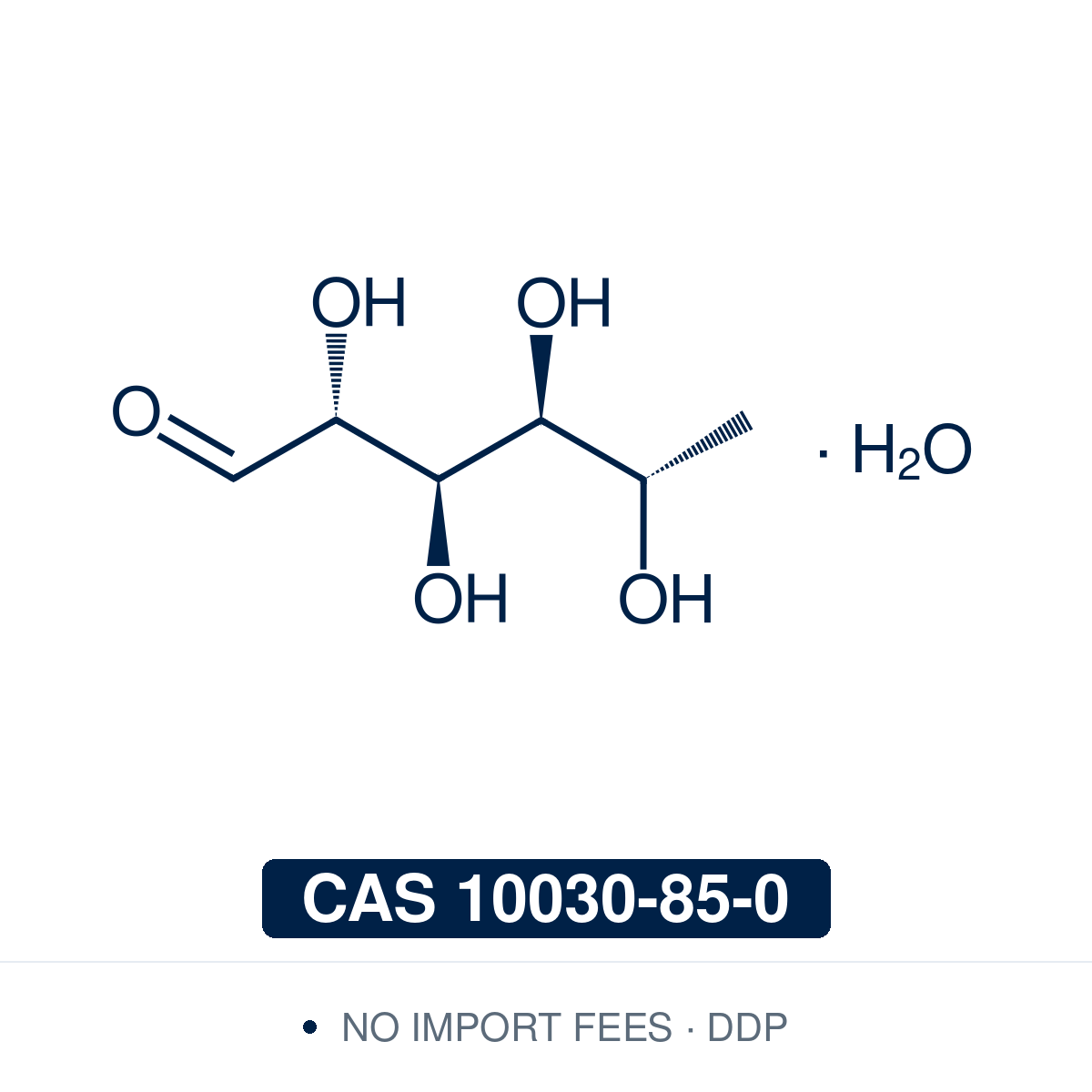
L-Rhamnose Monohydrate
L-Rhamnose Monohydrate | CAS 10030-85-0 | ≥98%
Couldn't load pickup availability
Technical Specifications
| CAS Number | 10030-85-0 |
| EC / EINECS Number | 600-058-2 |
| MDL Number | MFCD00071591 |
| SMILES | C[C@@H]([C@@H]([C@H]([C@H](C=O)O)O)O)O.O |
| InChI | InChI=1S/C6H12O5.H2O/c1-3(8)5(10)6(11)4(9)2-7;/h2-6,8-11H,1H3;1H2/t3-,4-,5-,6-;/m0./s1 |
| InChIKey | CBDCDOTZPYZPRO-DEZHIRTDSA-N |
| PubChem CID | 20849066 |
| Molecular Formula | C6H14O6 |
| Molecular Weight | 182.17 g/mol |
| Melting Point | 90–95 °C |
| Solubility | Soluble in water (~300 g/L at 20 °C); soluble in methanol, ethanol, DMSO |
| Purity | ≥98% |
| Physical Form | White crystalline powder |
| HS Code | 2940.00 |
| Shelf Life | Retest period: 36 months from date of manufacture. |
| Storage Conditions | Store in a cool, dry place in a tightly sealed container |
Product Description & Scientific Applications
L-Rhamnose monohydrate is the monohydrate of L-rhamnose (6-deoxy-L-mannose), a naturally occurring 6-deoxy sugar of the L-series and a constituent of bacterial and plant glycans.
Common Scientific Applications
Bacterial cell-wall sugar and antibacterial target. Many pathogenic bacteria require L-rhamnose as a cell-wall sugar: in Mycobacterium tuberculosis it forms the N-acetylglucosamine–rhamnose linker joining arabinogalactan to peptidoglycan, while in group A Streptococcus it forms the polyrhamnose backbone of the Lancefield group A carbohydrate, an antigenic and virulence determinant. The sugar is delivered from the activated donor dTDP-L-rhamnose, assembled from glucose-1-phosphate in a conserved four-step sequence by the enzymes RmlA–D. Because this route is essential for bacterial viability and virulence yet absent in humans, the Rml enzymes and the rhamnosyltransferase WbbL are pursued as antibacterial and anti-tuberculosis drug targets.
Plant cell-wall (pectin) component. L-rhamnose alternates with galacturonic acid in the backbone of rhamnogalacturonan I, a major pectic polysaccharide of the plant cell wall; the repeat is built by specific rhamnosyltransferases and cleaved by dedicated rhamnogalacturonan hydrolases and lyases.
Rhamnose-inducible gene expression. L-rhamnose induces the positively regulated Escherichia coli rhaBAD promoter, used to drive recombinant protein production. The system is tightly regulated and titratable, combining low uninduced expression with dose-dependent, high-level yield, which suits proteins poorly served by the leakier lac/IPTG systems.
Intestinal permeability probe. L-rhamnose is the monosaccharide marker in the lactulose–L-rhamnose dual-sugar test, a non-invasive assessment of intestinal barrier function in which two orally administered sugars probe the mucosa by transcellular and paracellular routes and the result is read as the ratio of their urinary recovery.
Glycoside component and glycosyl donor. L-rhamnose occurs as the sugar in plant flavonoid glycosides, for example quercetin-3-O-rhamnose. It also serves as an α-L-rhamnopyranosyl building block in glycan synthesis: an α-(1→2)-linked rhamnose disaccharide has been prepared as a structural model of the α-rhamnan polysaccharides of bacteria.
Rhamnose-binding lectins. L-rhamnose-binding lectins from fish and invertebrates are isolated and characterised on L-rhamnose affinity matrices, and free L-rhamnose serves as the inhibitory hapten that defines their sugar specificity.
Rhamnolipid biosurfactants. L-rhamnose is the sugar head group of rhamnolipids, the glycolipid biosurfactants produced by Pseudomonas aeruginosa, in which one or two rhamnose units cap β-hydroxy fatty-acid chains as mono- and di-rhamnolipids; these biosurfactants are applied in enhanced oil recovery.
Maillard flavour precursor. On heating with an amino compound, L-rhamnose undergoes the Maillard reaction to give the flavour compound 4-hydroxy-2,5-dimethyl-3(2H)-furanone (furaneol) and methylfurfural, and this reaction is studied in model systems of aroma-active furanone formation.
Shipping Destinations
- EU & UK: Priority delivery, 2–5 business days.
- United States (DDP): 3–7 business days, duties and taxes prepaid.
- EFTA Countries (DDP): 3–7 business days, duties and taxes prepaid.
- Worldwide: 7–14 business days, selected locations.
Safety Information
| Hazard Class | None — not subject to transport regulations |
| Transport Category | Not classified as dangerous goods for transport (ADR/IATA/IMDG) |
Documentation
| Safety Data Sheet | Download PDF |
Share