NorrChemica™
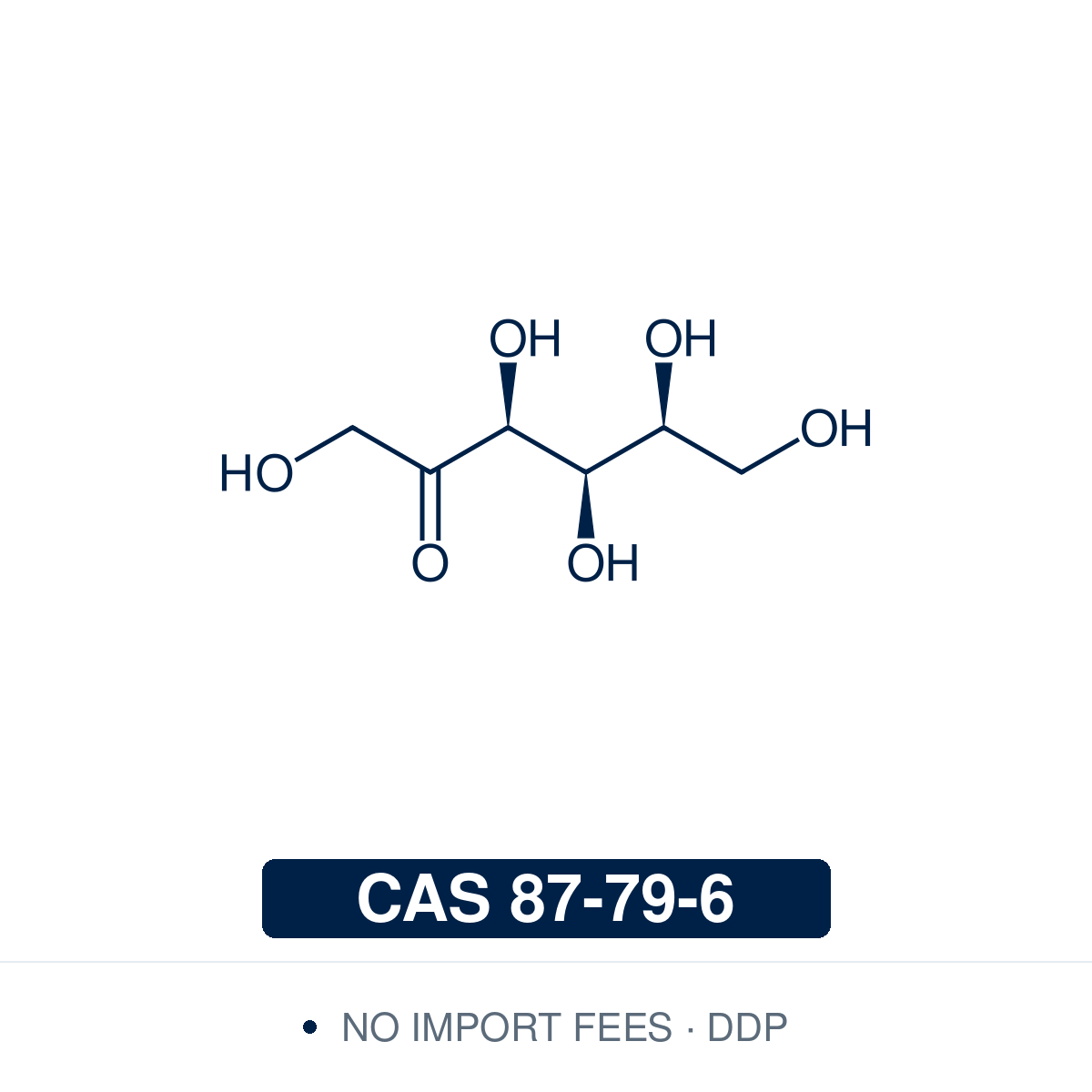
L-(-)-Sorbose
L-(-)-Sorbose | CAS 87-79-6 | ≥95%
Pack sizes & prices
| Pack size | Excl. VAT | Incl. VAT | Add to cart |
|---|---|---|---|
| 10 g | €89,20 | ||
| 25 g | €189,20 | ||
| 100 g | €475,00 |
Taxes and fees, e.g. VAT, included in the price. Shipping calculated at checkout.Free shipping on EU, UK and EFTA orders above €250, and above €400 to the rest of the world.
Technical Specifications
| CAS Number | 87-79-6 |
| EC / EINECS Number | 201-771-8 |
| MDL Number | MFCD00151097 |
| RTECS Number | WG3195025 |
| SMILES | C([C@@H]([C@H]([C@@H](C(=O)CO)O)O)O)O |
| InChI | InChI=1S/C6H12O6/c7-1-3(9)5(11)6(12)4(10)2-8/h3,5-9,11-12H,1-2H2/t3-,5+,6+/m0/s1 |
| InChIKey | BJHIKXHVCXFQLS-OTWZMJIISA-N |
| PubChem CID | 6904 |
| Molecular Formula | C₆H₁₂O₆ |
| Molecular Weight | 180.16 g/mol |
| Melting Point | 163–165 °C |
| Solubility | Soluble in water; a 0.1 g/mL solution is clear. |
| Purity | ≥95% |
| Physical Form | White to almost white powder or crystals |
| HS Code | 2940.00 |
| Shelf Life | Retest period: 36 months from date of manufacture |
| Storage Conditions | Keep container tightly closed in a dry and well-ventilated place. |
Product Description & Scientific Applications
L-(-)-Sorbose is a ketohexose. It has been described as a rare sugar, a monosaccharide of low natural abundance.
Oxidation to 2-keto-L-gulonic acid. Some acetic acid bacteria oxidise L-sorbose to 2-keto-L-gulonic acid (2-KLG) through L-sorbose and L-sorbosone dehydrogenases. In Gluconobacter oxydans T-100, L-sorbose dehydrogenase gives L-sorbosone, and L-sorbosone dehydrogenase converts L-sorbosone to 2-KLG. Both enzymes have been purified from this strain and their genes cloned. 2-KLG is the direct precursor of vitamin C (L-ascorbic acid) in industrial synthesis. Industrially, 2-KLG is mainly made from L-sorbose by Ketogulonicigenium vulgare aided by Bacillus megaterium. In K. vulgare WSH-001, a group of pyrroloquinoline quinone (PQQ)-dependent dehydrogenases is involved in the conversion of L-sorbose to 2-KLG. In another bacterial strain, a single quinoprotein dehydrogenase catalyses both the oxidation of L-sorbose to L-sorbosone and that of L-sorbosone to 2-KLG.
Oxidation of L-sorbose to 2-keto-L-gulonic acid (2-KLG) in Gluconobacter oxydans T-100: L-sorbose dehydrogenase gives L-sorbosone, and L-sorbosone dehydrogenase converts L-sorbosone to 2-KLG, the direct precursor of vitamin C in industrial synthesis. Open-chain forms shown.
Rare sugar biocatalysis. In one study, directed evolution of a thermostable D-tagatose epimerase gave a variant with improved activity for the C-3 epimerisation of L-sorbose to L-tagatose. In a two-step enzymatic route to the rare aldohexose L-galactose, L-sorbose was first epimerised to L-tagatose with an immobilised epimerase, and an immobilised L-rhamnose isomerase then converted L-tagatose to L-galactose. An L-ribose isomerase of broad substrate specificity has been shown to catalyse the isomerisation between L-gulose and L-sorbose. Pyranose 2-oxidase oxidises L-sorbose regioselectively to 5-keto-D-fructose, a starting material for pyrrolidine iminosugars.
Iminosugar synthesis. 1-Deoxynojirimycin (1-DNJ), a glycoprocessing inhibitor, has been synthesised from an intermediate prepared from L-sorbose. In one strategy, organometallic reagents are added to an L-sorbose-derived imine, and internal reductive amination then gives nojirimycin C-glycosides with full stereocontrol. L-Sorbose is also a starting material for pyrrolidine iminosugars. Derivatives of 2,5-dideoxy-2,5-imino-D-mannitol (DMDP) have been prepared from it, and so has 2,5-dideoxy-2,5-imino-D-glucitol (DGDP), the C-2 diastereomer of DMDP. Polyhydroxylated quinolizidines made from an L-sorbose-derived ketonitrone were found to be selective α-glucosidase inhibitors.
Fungal biology. L-Sorbose induces hyperbranching of hyphae in the fungus Neurospora crassa, which results in colonial growth. In N. crassa, acid hydrolysates of cell walls from sorbose-grown hyphae contain more glucosamine and less glucose than those from normally growing hyphae. In N. crassa, sor-4, a gene encoding a glucose sensor that acts in carbon catabolite repression, has been identified as a sorbose resistance gene.
Shipping Destinations
- EU & UK: Priority delivery, 2–5 business days.
- United States (DDP): 3–7 business days, duties and taxes prepaid.
- EFTA Countries (DDP): 3–7 business days, duties and taxes prepaid.
- Worldwide: 7–14 business days, selected locations.
Safety Information
| Hazard Class | Not regulated for transport |
| Transport Category | Not classified as dangerous goods for transport (ADR/IATA/IMDG) |
Documentation
| Safety Data Sheet | Download PDF |
Share