NorrChemica™
Luminol (Powder)
Luminol (Powder) | CAS 521-31-3 | ≥98%
Couldn't load pickup availability
Technical Specifications
| CAS Number | 521-31-3 |
| EC / EINECS Number | 208-309-4 |
| MDL Number | MFCD00006890 |
| RTECS Number | TH8890060 |
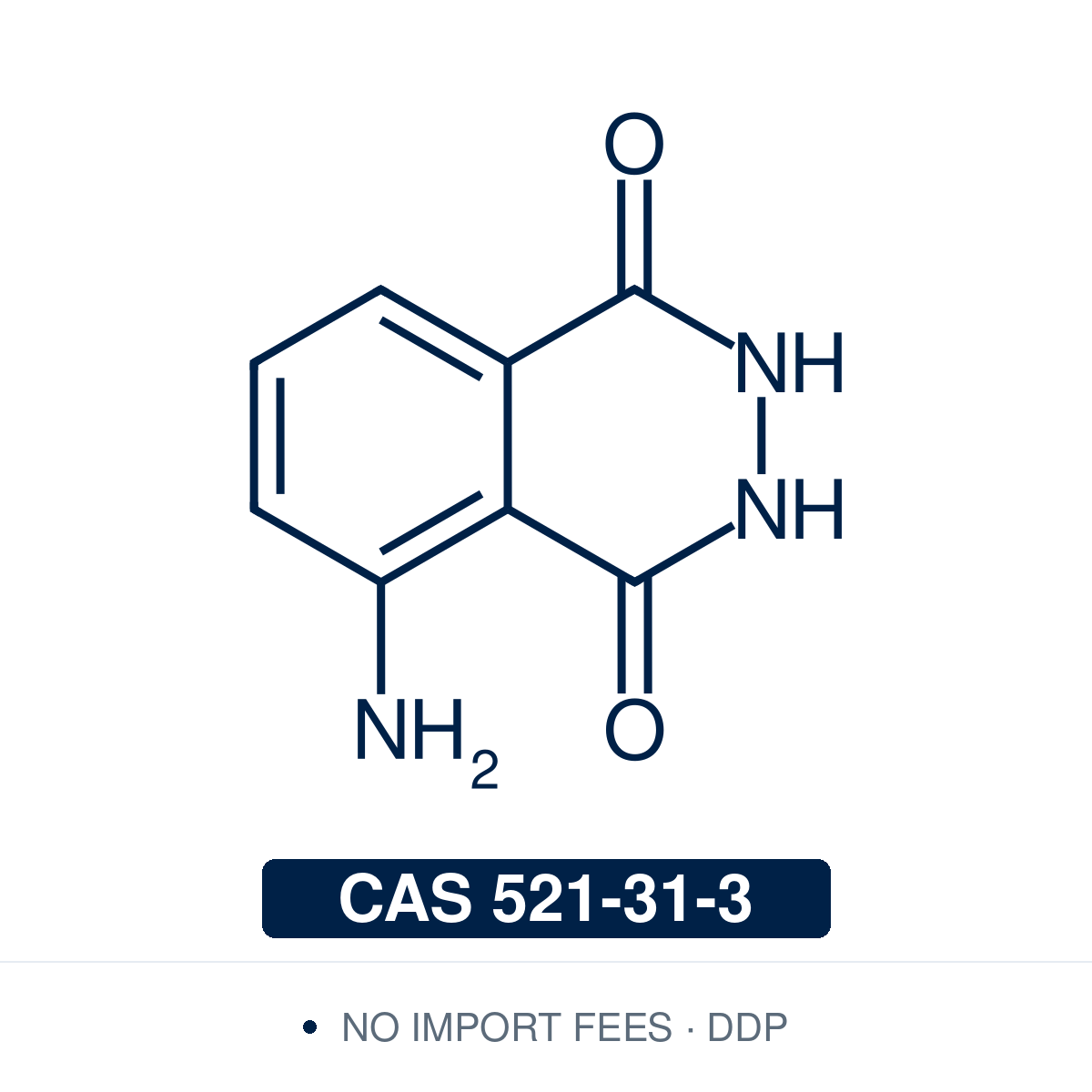
| SMILES | C1=CC2=C(C(=C1)N)C(=O)NNC2=O |
| InChI | InChI=1S/C8H7N3O2/c9-5-3-1-2-4-6(5)8(13)11-10-7(4)12/h1-3H,9H2,(H,10,12)(H,11,13) |
| InChIKey | HWYHZTIRURJOHG-UHFFFAOYSA-N |
| PubChem CID | 10638 |
| Molecular Formula | C₈H₇N₃O₂ |
| Molecular Weight | 177.16 g/mol |
| Melting Point | 319–320 °C |
| Solubility | Soluble in DMSO; sparingly soluble in dilute alkali; insoluble in water |
| Purity | ≥98.0% |
| Physical Form | Light yellow to light green powder |
| HS Code | 2933.99 |
| Shelf Life | Retest period: 36 months from date of manufacture |
| Storage Conditions | Store in a cool, dry place in a tightly sealed container, protected from light and moisture. |
Product Description & Scientific Applications
Luminol emits light when it is oxidised. In alkaline solution it reacts with an oxidant, usually hydrogen peroxide, in the presence of a catalyst such as a transition-metal ion; the reaction passes through reactive oxygen species and leaves the product, 3-aminophthalate, in an excited state. That excited species is the emitter, giving a single, blue chemiluminescence band at 425 nm. Emission intensity scales with the amount of catalyst present.
Common Scientific Applications
Forensic latent-blood detection. The iron of haemoglobin catalyses the reaction, so applying luminol reveals bloodstains too faint to see, including ones that have been washed. It is the most sensitive of the common presumptive blood tests, and the glowing pattern can be photographed and the marked stain taken forward for DNA typing. Prior heating of a stain intensifies the glow, attributed to conversion of haemoglobin into the brighter catalyst methaemoglobin, while hypochlorite bleach gives a false positive that fades over hours.
Enhanced chemiluminescence detection. With horseradish peroxidase as the catalyst, luminol, hydrogen peroxide, and an enhancer such as p-iodophenol give a strong, long-lived glow. Because the enzyme is used as an antibody or probe label, the reaction reads out immunoassays and Western blots, the light captured on film or by a camera. Detection reaches the femtomole-to-attomole range, and the prolonged signal allows exposures to be timed and repeated.
Reactive-oxygen-species assay. Luminol-dependent chemiluminescence measures the oxidants made by activated neutrophils during the respiratory burst. With added horseradish peroxidase it follows hydrogen peroxide from the NADPH oxidase, detectable within seconds of stimulation, and without it the signal reports the oxidants generated by myeloperoxidase. Unlike fluorometric assays, the light gives an instantaneous and highly sensitive readout, a direct measure of oxidase activity.
Chemiluminescent sensing. Because the light responds to anything that feeds or scavenges the reaction, luminol underlies sensitive assays: catecholamines, for example, are measured at nanomolar levels by the emission they suppress. Driven electrically at an electrode, luminol electrochemiluminescence detects hydrogen peroxide into the nanomolar range, and coupled to oxidase enzymes it quantifies their substrates, such as glucose, in disposable and wearable biosensors.
Shipping Destinations
- EU & UK: Priority delivery, 2–5 business days.
- United States (DDP): 3–7 business days, duties and taxes prepaid.
- EFTA Countries (DDP): 3–7 business days, duties and taxes prepaid.
- Worldwide: 7–14 business days, selected locations.
Safety Information
| GHS Pictograms |

|
| Signal Word | Warning |
| Hazard Class | None — not subject to transport regulations |
| Transport Category | Not classified as dangerous goods for transport (ADR/IATA/IMDG) |
| H-Statements | H302 - H319 |
| P-Statements | P264 - P270 - P280 - P301+P312 - P305+P351+P338 - P330 - P337+P313 - P501 |
Documentation
| Safety Data Sheet | Download PDF |