1
/
of
1
NorrChemica™
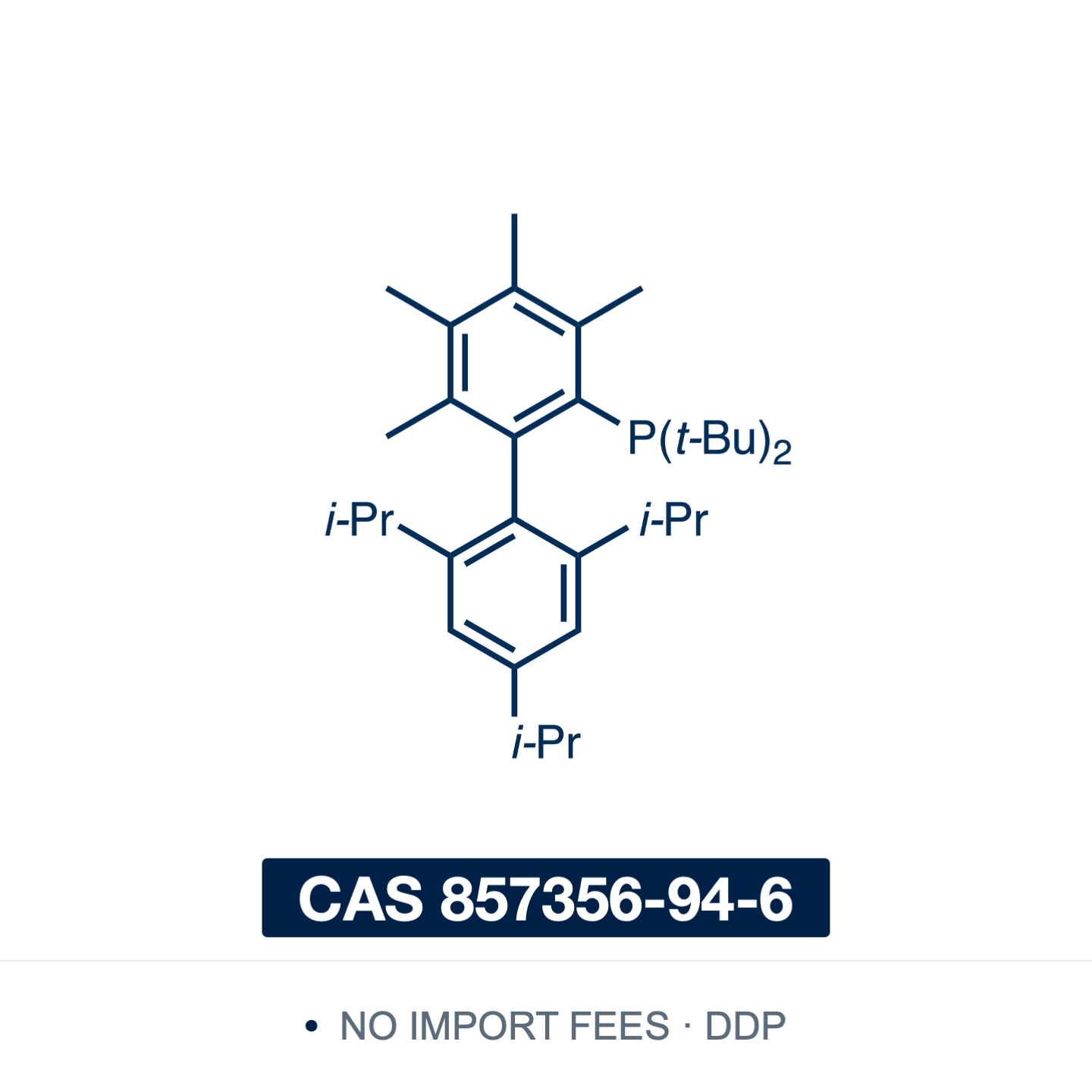
Me4tBuXPhos
CAS 857356-94-6
≥98%
Me4tBuXPhos | CAS 857356-94-6 | ≥98%
Regular price
€37,20 EUR (incl. VAT)
Regular price
Sale price
€37,20 EUR
Taxes included.
Shipping calculated at checkout.
Quantity
Couldn't load pickup availability
Technical Specifications
| CAS Number | 857356-94-6 |
| EC / EINECS Number | 813-582-3 |
| MDL Number | MFCD09038436 |
| SMILES | CC1=C(C(=C(C(=C1C)C2=C(C=C(C=C2C(C)C)C(C)C)C(C)C)P(C(C)(C)C)C(C)(C)C)C)C |
| InChI | InChI=1S/C33H53P/c1-19(2)26-17-27(20(3)4)30(28(18-26)21(5)6)29-24(9)22(7)23(8)25(10)31(29)34(32(11,12)13)33(14,15)16/h17-21H,1-16H3 |
| InChIKey | RCRYEYMHBHPZQD-UHFFFAOYSA-N |
| PubChem CID | 11953610 |
| Molecular Formula | C₃₃H₅₃P |
| Molecular Weight | 480.75 g/mol |
| Melting Point | 168 - 172 °C |
| Solubility | Insoluble in water, soluble in common organic solvents |
| Purity | ≥98% |
| Physical Form | White to off-white solid |
| HS Code | 2931.49 |
| Shelf Life | Retest period: 36 months from date of manufacture |
| Storage Conditions | Store under inert gas (N₂ or Ar) in a tightly sealed container at room temperature |
Product Description & Scientific Applications
Me4tBuXPhos is tBuXPhos carrying four additional methyl groups on the phosphorus-bearing ring, and in practice the two ligands divide the substrate scope between them.
It is supplied and stored under inert gas at room temperature.
Applications and Reactions
- Phenols from aryl halides: the founding application, and a demanding one. The catalyst has to overcome inhibition by free hydroxide, a difficult carbon–oxygen reductive elimination given how small the hydroxide group is, and over-arylation of the product phenol to the diaryl ether. The first hydroxylation of aryl bromides and chlorides with a hydroxide salt used a palladium catalyst supported by this ligand or by tBuXPhos, at 80–100 °C, with the optimal ligand chosen substrate by substrate. Palladium systems for this transformation offer wider scope, lower catalyst loadings and milder conditions.
- Why the bulk matters: ligand bulk raises the rate of carbon–oxygen reductive elimination, and hydroxide attack on the arylpalladium intermediate outpaces phenoxide transmetalation.
- Choosing between the two ligands: this one performed best on aryl chlorides without an ortho substituent, while tBuXPhos gave consistently excellent yields above 90% on ortho-substituted substrates. The source states this as a substrate-dependent optimum rather than one ligand being generally better.
- Onward chemistry: the phenol need not be isolated. Tandem sequences convert it in the same pot to benzofurans, or alkylate it to alkyl aryl ethers.
- Documented limits: in gold catalysis one cyclisation was sluggish on its gold chloride with silver triflate, where a triphenylphosphine gold chloride succeeded instead. In one solvent screen another ligand outperformed it alongside RockPhos, tBuBrettPhos and AdBrettPhos.
Further Reading
Practical guidance on choosing a phosphine ligand for palladium- and nickel-catalysed cross-coupling in NorrChemica's Lab Journal: Phosphine Ligands for Cross-Coupling.
Shipping Destinations
- EU & UK: Priority delivery, 2–5 business days.
- United States (DDP): 3–7 business days, duties and taxes prepaid.
- EFTA Countries (DDP): 3–7 business days, duties and taxes prepaid.
- Worldwide: 7–14 business days, selected locations.
Safety Information
| Hazard Class | Not regulated for transport |
| Transport Category | Not classified as dangerous goods for transport (ADR/IATA/IMDG) |
Documentation
| Safety Data Sheet | Download PDF |
Share