NorrChemica™
Meldrum's Acid
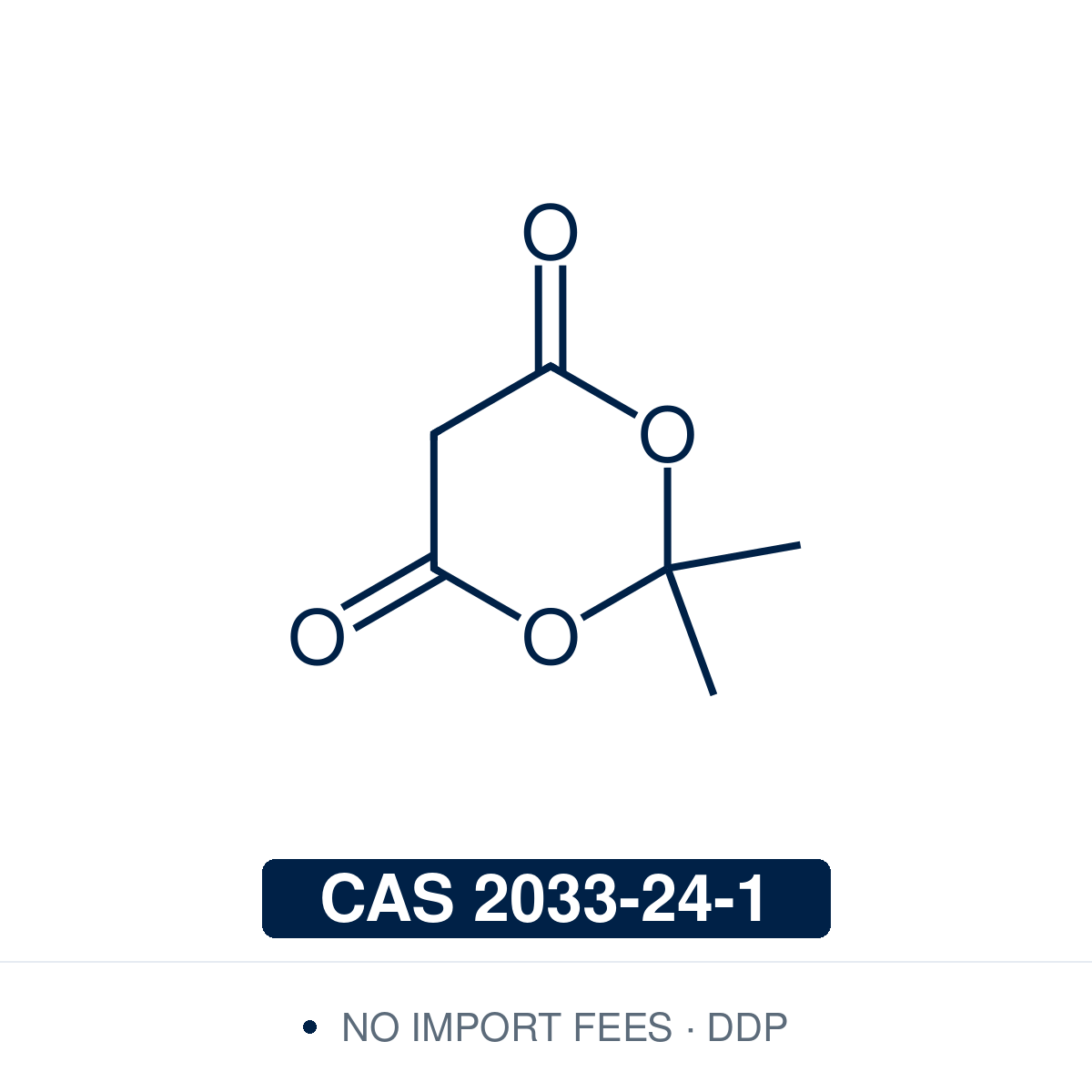
Meldrum's Acid | CAS 2033-24-1 | ≥98%
Pack sizes & prices
| Pack size | Excl. VAT | Incl. VAT | Add to cart |
|---|---|---|---|
| 50 g | €45,00 | ||
| 100 g | €84,20 | ||
| 250 g | €109,20 | ||
| 500 g | €129,20 | ||
| 1 kg | €149,20 |
Taxes and fees, e.g. VAT, included in the price. Shipping calculated at checkout.Free shipping on EU, UK and EFTA orders above €250, and above €400 to the rest of the world.
Technical Specifications
| CAS Number | 2033-24-1 |
| EC / EINECS Number | 217-992-8 |
| MDL Number | MFCD00006638 |
| RTECS Number | JH0800000 |
| SMILES | CC1(OC(=O)CC(=O)O1)C |
| InChI | InChI=1S/C6H8O4/c1-6(2)9-4(7)3-5(8)10-6/h3H2,1-2H3 |
| InChIKey | GXHFUVWIGNLZSC-UHFFFAOYSA-N |
| PubChem CID | 16249 |
| Molecular Formula | C₆H₈O₄ |
| Molecular Weight | 144.12 g/mol |
| Melting Point | 94–95 °C (dec.) |
| Solubility | Water: 2.5 g/100 mL (20 °C). Slightly soluble in ethanol and chloroform. Recrystallised from acetone, acetone–water or acetone–hexane. |
| Purity | ≥98% |
| Physical Form | White to beige-brown crystalline powder |
| HS Code | 2932.99.9090 |
| Shelf Life | Retest period: 36 months from date of manufacture |
| Storage Conditions | Store refrigerated (2–8 °C) in a tightly sealed container. |
Shipping Destinations
- EU & UK: Priority delivery, 2–5 business days.
- United States (DDP): 3–7 business days, duties and taxes prepaid.
- EFTA Countries (DDP): 3–7 business days, duties and taxes prepaid.
- Worldwide: 7–14 business days, selected locations.
Product Description & Scientific Applications
Meldrum’s Acid (2,2-dimethyl-1,3-dioxane-4,6-dione) is widely used in organic synthesis, especially for C–C bond formation. In water it has a remarkably low pKa of about 4.9. Its C5 position readily takes part in electrophilic substitution, while the C4 and C6 positions are easily attacked by nucleophiles. When heated, it decomposes by distinctive pathways that are used in cycloaddition and acylation reactions.
Knoevenagel condensation. Aryl aldehydes condense with Meldrum’s acid to give 5-arylidene Meldrum’s acids.
condensation
General reaction: aryl aldehyde + Meldrum’s acid → 5-arylidene Meldrum’s acid.
Conjugate additions. Arylidene Meldrum’s acids act as acceptors in the rhodium-catalysed, enantioselective 1,4-addition of organoboron reagents. With a 2-(benzyloxy)phenyl group on the arylidene, the adducts are converted into 4-arylchroman-2-ones by hydrolysis and decarboxylation, removal of the benzyl group and intramolecular esterification.
1,4-addition
General reaction: arylidene Meldrum’s acid + organoboron reagent (Rh catalyst) → 1,4-adduct → 4-arylchroman-2-one.
β-Keto esters. Acylated Meldrum’s acids act as synthetic equivalents of mixed ketenes and readily undergo alcoholysis to give β-keto esters. Fatty β-keto esters have been made from fatty acids and Meldrum’s acid, with DCC and DMAP as coupling reagents.
General reaction: acyl Meldrum’s acid + alcohol → β-keto ester.
Friedel–Crafts acylation. Meldrum’s acid derivatives act as acylating agents in intramolecular Friedel–Crafts reactions catalysed by metal trifluoromethanesulfonates. Benzyl Meldrum’s acids give polysubstituted 1-indanones in this way. These derivatives are easily prepared, functionalised, handled and purified.
General reaction: benzyl Meldrum’s acid (metal triflate catalyst) → 1-indanone.
Heterocycles. Meldrum’s acid is a starting material for the synthesis of heterocycles. Together with isocyanides, it is a basic component of multicomponent reactions that give many classes of heterocycles in one pot.
General reaction: isocyanide + Meldrum’s acid + further components → heterocycles (one pot).
Safety Information
| Hazard Class | Not classified as dangerous goods |
| Transport Category | Not dangerous goods (ADR/IATA/IMDG) |
Documentation
| Safety Data Sheet | Download PDF |
Share