NorrChemica™
MES
MES | CAS 4432-31-9 | ≥98%
Couldn't load pickup availability
Technical Specifications
| CAS Number | 4432-31-9 |
| EC / EINECS Number | 224-632-3 |
| MDL Number | MFCD00006181 |
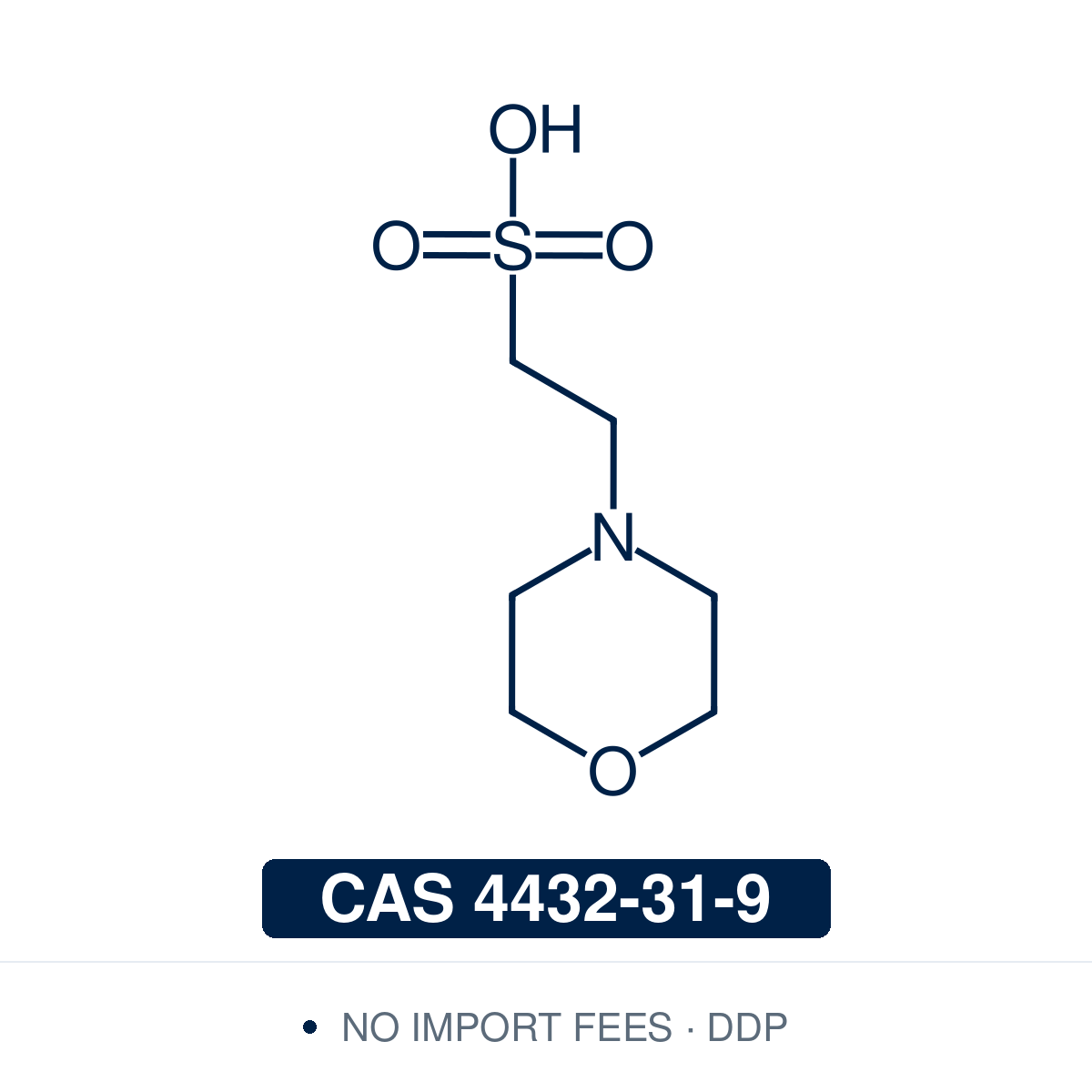
| SMILES | C1COCCN1CCS(=O)(=O)O |
| InChI | InChI=1S/C6H13NO4S/c8-12(9,10)6-3-7-1-4-11-5-2-7/h1-6H2,(H,8,9,10) |
| InChIKey | SXGZJKUKBWWHRA-UHFFFAOYSA-N |
| PubChem CID | 78165 |
| Molecular Formula | C₆H₁₃NO₄S |
| Molecular Weight | 195.24 g/mol |
| Melting Point | >300 °C (dec.) |
| Solubility | Very soluble in water (~195 mg/mL, i.e. ~1.0 M at 20 °C) |
| Purity | ≥98% |
| Physical Form | White crystalline powder |
| HS Code | 2934.99 |
| Country of Origin | Finland |
| Shelf Life | Retest period: 36 months from date of manufacture |
| Storage Conditions | Store tightly closed in a cool, dry place |
Product Description & Scientific Applications
2-(N-Morpholino)ethanesulfonic acid (MES) is a zwitterionic Good's buffer used to control pH in mildly acidic biochemical, molecular-biology, cell-system, and analytical work. It has a pKa of approximately 6.1 at 25 °C and a buffering range between pH 5.5 and 6.7. Its working pH drifts little between room and refrigerated conditions because it features one of the smallest temperature coefficients among the common Good's buffers (d(pKa)/dT ≈ −0.011 pH unit/°C) — far lower than Tris and only slightly lower than HEPES. The morpholine-ethanesulfonate scaffold makes MES highly water-soluble and gives it very low UV absorbance at the wavelengths used for nucleic-acid and protein quantitation; with no primary amines or free carboxylates, it stays out of downstream chemistry. It is also one of the cleanest, effectively non-coordinating Good's buffers in its working range, showing no measurable complexation of Mg²⁺, Ca²⁺, Mn²⁺, Co²⁺, Ni²⁺, Zn²⁺, or Cd²⁺ and only imperceptible-to-weak interaction with Cu²⁺ and Pb²⁺ — unlike the HEPES family, which can form strong Cu²⁺-binding species. Supplied as the free acid, it is dissolved and titrated to the working pH with NaOH or KOH, while the sodium salt offers a ready-to-dissolve alternative.
Bis-Tris/MES SDS-PAGE for small-to-medium proteins. In commercial Bis-Tris discontinuous SDS-PAGE, MES acts as the trailing ion of the running buffer against a Bis-Tris/Cl⁻ gel buffer. Its lower pKa relative to MOPS (about 6.1 against 7.2) makes the MES running buffer migrate faster and shift the stacking-to-resolving boundary, which sharpens the resolution of smaller proteins on the same gel chemistry. In practice MES separates over roughly 1–200 kDa and performs best below about 50 kDa, whereas MOPS covers roughly 14–260 kDa and favours larger proteins. MES is therefore the running buffer of choice whenever low-molecular-weight resolution, clean Western-blot input near the dye front, or excision of small bands matters more than separating high-molecular-weight species.
EDC/sulfo-NHS carbodiimide bioconjugation. MES is the canonical activation buffer for carbodiimide bioconjugation with EDC and EDC/sulfo-NHS, which couple carboxyl groups to primary amines. EDC first activates a carboxyl as an amine-reactive O-acylisourea, and trapping that short-lived intermediate with sulfo-NHS converts it into a far more stable amine-reactive ester. Because activation runs best in mildly acidic conditions, the standard two-step protocol activates the carboxyl in MES at about pH 5–6 and only then raises the pH to near neutral to react with the amine partner. MES suits this chemistry precisely because it carries no primary amine to consume EDC, no free carboxylate to be activated as a competing substrate, and little metal coordination to perturb metal-sensitive mixtures — whereas Tris, TBS, and glycine fail because their own amines compete, and phosphate works but couples less efficiently.
Plant tissue culture and defined biological media. In plant tissue culture, MES is a standard pH stabiliser in Murashige–Skoog and Arabidopsis-style media, holding the mildly acidic pH that seedling, callus, organ, and plant-cell cultures require. It is typically added at low-millimolar levels to defined media adjusted to around pH 5.6–5.8, and many commercial formulations already include it. Its appeal is that it decouples pH control from the rest of the recipe — the mineral salts, carbon source, growth regulators, and chelation-sensitive components such as iron-EDTA — without the metal complexation or biochemical reactivity of phosphate or organic-acid buffers. The same quality carries over to microbial, archaeal, and selected mammalian-cell media, wherever pH must be held independently of nutrient composition and metal-containing supplements.
Further applications.
- Cation- and ion-exchange chromatography in its mildly acidic window — for protein and peptide purification, and for acidic proteins, virus particles, and bioprocess samples.
- Reaction buffer for metalloenzyme and metal-sensitive assays that Tris, phosphate, or HEPES-family buffers would otherwise distort through metal speciation.
- SPR and surface-functionalisation workflows, suited to its mildly acidic, amine-free character.
Shipping Destinations
- EU & UK: Priority delivery, 2–5 business days.
- United States (DDP): 3–7 business days, duties and taxes prepaid.
- EFTA Countries (DDP): 3–7 business days, duties and taxes prepaid.
- Worldwide: 7–14 business days, selected locations.
Safety Information
| Hazard Class | None — not subject to transport regulations |
| Transport Category | Not classified as dangerous goods for transport (ADR/IATA/IMDG) |
Documentation
| Safety Data Sheet | Download PDF |
Share