NorrChemica™
Methylene Blue Trihydrate
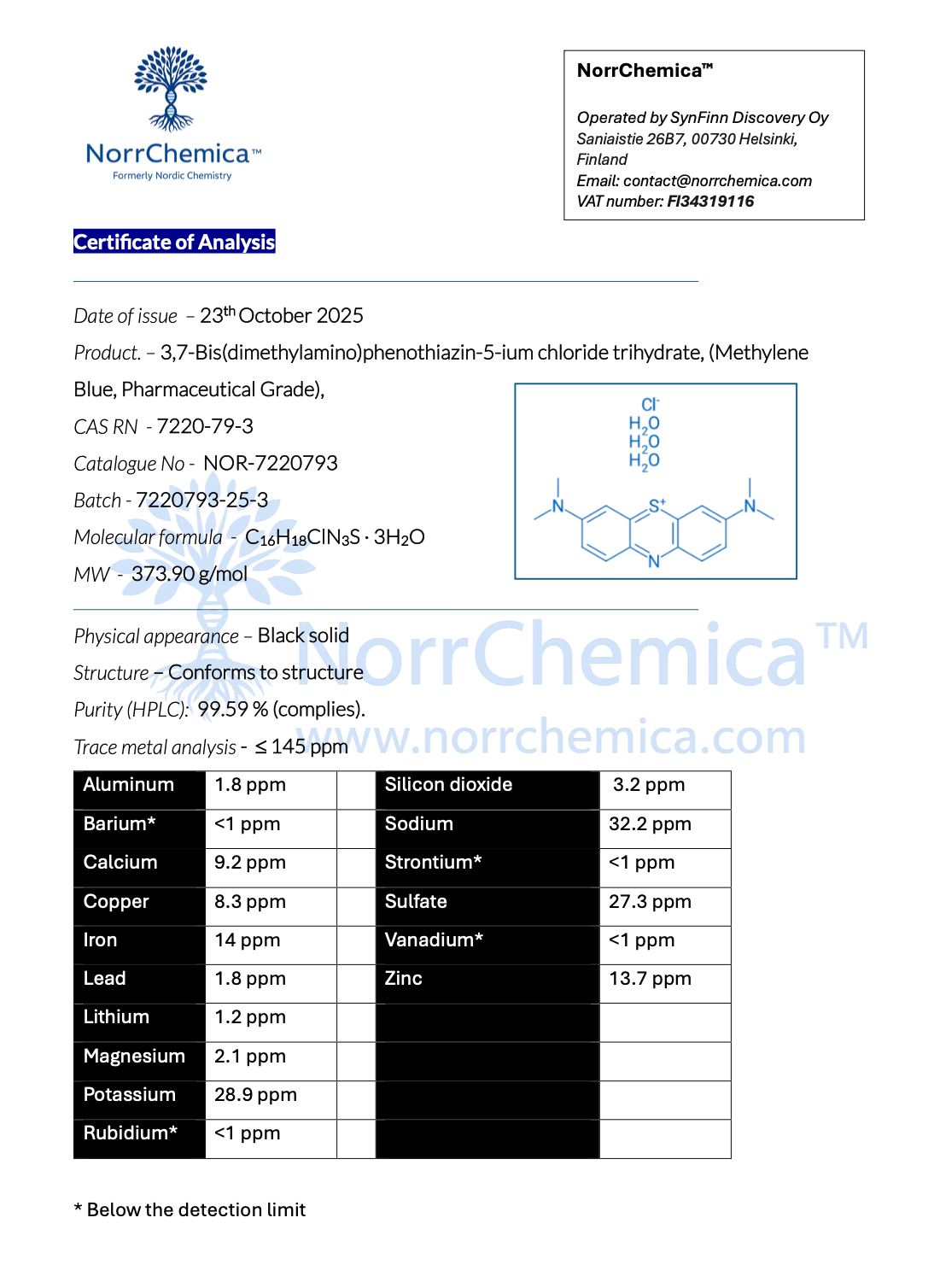
Methylene Blue Trihydrate | CAS 7220-79-3 | ≥99.5%
Couldn't load pickup availability
Technical Specifications
| CAS Number | 7220-79-3 |
| EC / EINECS Number | 615-731-6 |
| MDL Number | MFCD00150008 |
| RTECS Number | SP5740000 |
| SMILES | CN(C)C1=CC2=C(C=C1)N=C3C=CC(=[N+](C)C)C=C3S2.O.O.O.[Cl-] |
| InChI | InChI=1S/C16H18N3S.ClH.3H2O/c1-18(2)11-5-7-13-15(9-11)20-16-10-12(19(3)4)6-8-14(16)17-13;;;;/h5-10H,1-4H3;1H;3*1H2/q+1;;;;/p-1 |
| InChIKey | XQAXGZLFSSPBMK-UHFFFAOYSA-M |
| PubChem CID | 104827 |
| Molecular Formula | C16H24ClN3O3S |
| Molecular Weight | 373.9 g/mol |
| Melting Point | 190 °C (dec.) |
| Solubility | Soluble in water (gives deep blue solution); partially soluble in ethanol |
| Purity | ≥99.5% |
| Physical Form | Dark green crystalline powder |
| HS Code | 3204.13 |
| Country of Origin | Finland |
| Shelf Life | Retest period: 36 months from date of manufacture. |
| Storage Conditions | Store in a cool, dry place in a tightly sealed container, protected from light. |
Product Description & Scientific Applications
Methylene Blue Trihydrate is the trihydrate of methylthioninium chloride (Basic Blue 9), a cationic phenothiazinium dye that dissolves in water to give an intense blue solution, in which it exists in a concentration- and medium-dependent monomer–dimer equilibrium — the monomer absorbing near 664 nm and the dimer near 605 nm. On excitation it populates a triplet state that transfers energy to molecular oxygen to generate singlet oxygen.
Biological staining. As a cationic basic dye it stains bacterial cells and nucleic-acid-rich structures such as nuclei, the positive charge binding anionic cellular components.
Nucleic-acid binding. With calf-thymus DNA it binds by intercalation and by electrostatic interaction with the phosphate backbone; the electrostatic contribution dominates at low ionic strength and is screened as salt rises.
Redox indicator. It is reversibly reduced from the blue oxidised form to colourless leucomethylene blue, the couple illustrated by the classical “blue bottle” experiment, in which alkaline glucose reduces the dye and shaking re-admits oxygen to restore the colour.
Photosensitiser. It is widely used as a reference photosensitiser for singlet-oxygen and photo-oxidation research.
Anionic-surfactant assay (MBAS). It forms an extractable ion pair with anionic surfactants, the basis of the Methylene Blue Active Substances method for determining surfactants in water.
Adsorption model dye. It is a standard cationic dye for evaluating adsorption onto activated carbon, graphene oxide and carbon nanotubes, where uptake is commonly described by Langmuir isotherms and attributed to π–π and electrostatic interactions.
Shipping Destinations
- EU & UK: Priority delivery, 2–5 business days.
- United States (DDP): 3–7 business days, duties and taxes prepaid.
- EFTA Countries (DDP): 3–7 business days, duties and taxes prepaid.
- Worldwide: 7–14 business days, selected locations.
Safety Information
| GHS Pictograms |

|
| Signal Word | Warning |
| Hazard Class | None — not subject to transport regulations |
| Transport Category | Not classified as dangerous goods for transport (ADR/IATA/IMDG) |
| H-Statements | H302 |
| P-Statements | P264 - P270 - P301+P312 - P330 - P501 |
Documentation
| Safety Data Sheet | Download PDF |