NorrChemica™
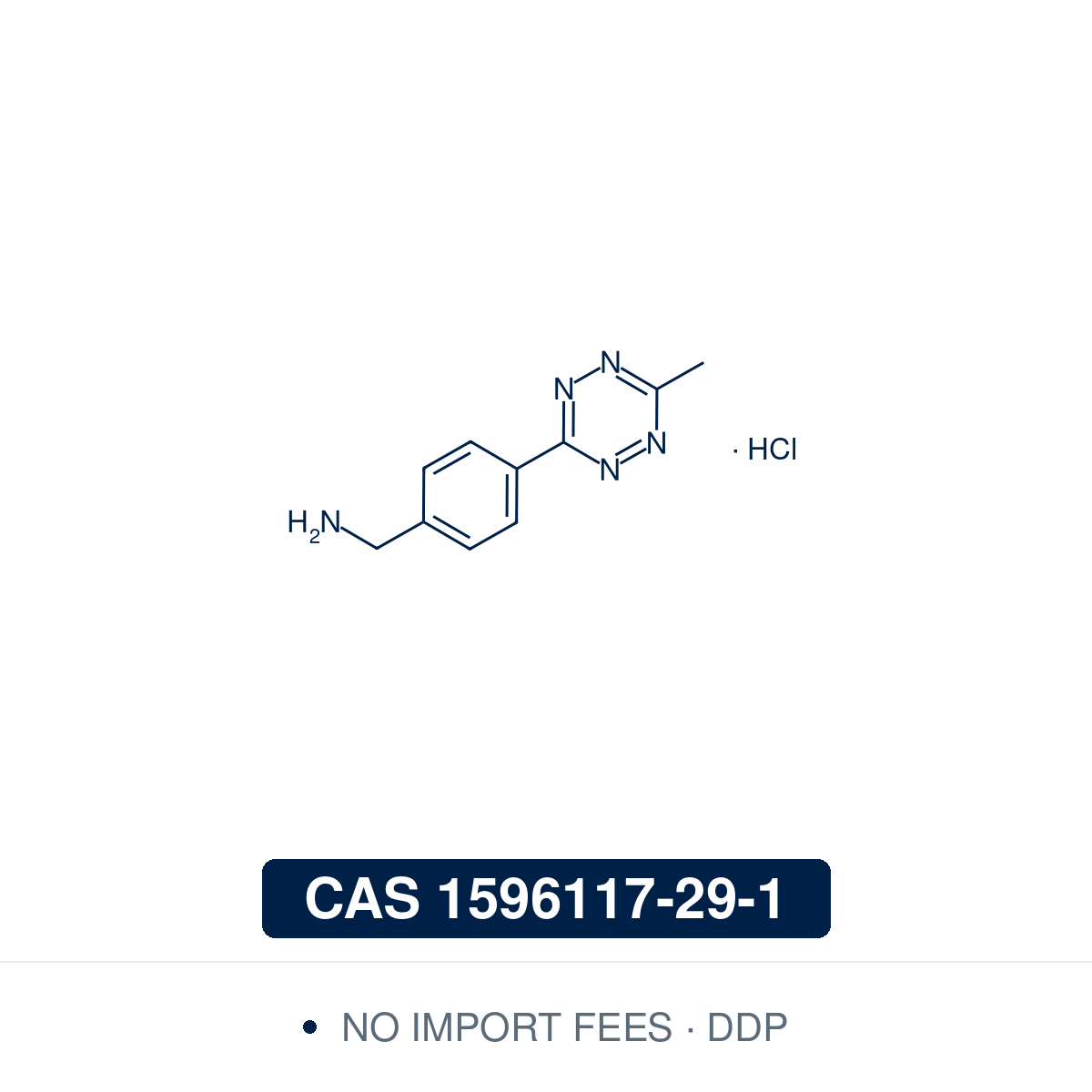
Methyltetrazine-amine HCl
Methyltetrazine-amine HCl | CAS 1596117-29-1 | ≥97%
| Pack size | Excl. VAT | Incl. VAT | Add to cart |
|---|---|---|---|
| 100 mg | €179,20 | ||
| 250 mg | €389,20 | ||
| 1 g | €749,00 |
Taxes and fees, e.g. VAT, included in the price. Shipping calculated at checkout.Free shipping on EU, UK and EFTA orders above €250, and above €400 to the rest of the world.
Technical Specifications
| CAS Number | 1596117-29-1 |
| EC / EINECS Number | 806-094-7 |
| MDL Number | MFCD32061909 |
| SMILES | CC1=NN=C(N=N1)C2=CC=C(C=C2)CN.Cl |
| InChI | InChI=1S/C10H11N5.ClH/c1-7-12-14-10(15-13-7)9-4-2-8(6-11)3-5-9;/h2-5H,6,11H2,1H3;1H |
| InChIKey | NIGOLWATPZTKQT-UHFFFAOYSA-N |
| PubChem CID | 118239091 |
| Molecular Formula | C₁₀H₁₂ClN₅ |
| Molecular Weight | 237.69 g/mol |
| Solubility | Soluble in DMSO, methanol and DMF. |
| Purity | ≥97% |
| Physical Form | Pink to purple solid |
| HS Code | 2933.99 |
| Shelf Life | Retest period: 36 months from date of manufacture |
| Storage Conditions | Store at -20 °C under inert gas in a tightly sealed container, protected from light and moisture. |
| SDS / CoA | Download PDF |
Product Description & Scientific Applications
Methyltetrazine-amine hydrochloride (Me-Tet-amine) has a primary benzylamine at one end and a 3-methyl-1,2,4,5-tetrazine at the other. The amine couples to NHS esters, isothiocyanates and activated acids, which is how the tetrazine gets onto an antibody, peptide, dye or chelator. That tetrazine then ligates to trans-cyclooctene or norbornene by inverse electron-demand Diels-Alder. The methyl is electron-donating and buys stability and aqueous solubility; the hydrogen-substituted tetrazine is more reactive and less stable.
The ligation. Rate constants with trans-cyclooctene exceed 100000 per molar per second, orders of magnitude faster than the Staudinger or strain-promoted azide-alkyne ligations and among the fastest of the click methods. Rate constants above 50000 per molar per second are reported as important for efficient reaction inside an animal.
Partners beyond cyclooctene. Norbornene clicks with methyltetrazine by the same inverse electron-demand cycloaddition. Nanogels are formed by that click reaction between methyl tetrazines and norbornenes.
Pretargeted imaging and live cells. An antibody conjugated to a stable methyl-tetrazine was dosed into tumour-bearing mice. Genetic encoding aimed at small, physiologically stable tetrazine groups for quantitative protein labelling in living cells.
Documented limits. Against a strained alkyne partner, rates with disubstituted methyl tetrazines are diminished. Tetrazinyl groups are known to undergo degradation or side reactions in complex biological media. The hydrogen-substituted analogue degraded rapidly after synthesis unless ascorbic acid was added as stabiliser.
Shipping Destinations
- EU & UK: Priority delivery, 2–5 business days.
- United States (DDP): 3–7 business days, duties and taxes prepaid.
- EFTA Countries (DDP): 3–7 business days, duties and taxes prepaid.
- Worldwide: 7–14 business days, selected locations.
Safety Information
| GHS Pictograms |

|
| Signal Word | Warning |
| Hazard Class | Not regulated for transport |
| Transport Category | Not classified as dangerous goods for transport (ADR/IATA/IMDG) |
| H-Statements | H315 - H319 - H335 |
| P-Statements | P264 - P280 - P302+P352 - P305+P351+P338 - P332+P313 - P337+P313 - P362+P364 |
Documentation
| Safety Data Sheet | Download PDF |