NorrChemica™
MorDalPhos
MorDalPhos | CAS 1237588-12-3 | ≥98%
Couldn't load pickup availability
Technical Specifications
| CAS Number | 1237588-12-3 |
| MDL Number | MFCD17018759 |
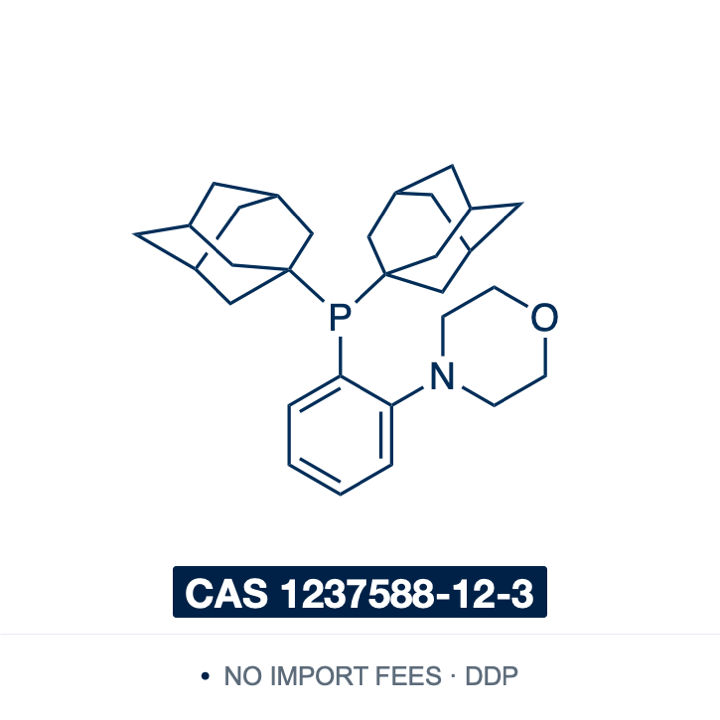
| SMILES | C1COCCN1C2=CC=CC=C2P(C34CC5CC(C3)CC(C5)C4)C67CC8CC(C6)CC(C8)C7 |
| InChI | InChI=1S/C30H42NOP/c1-2-4-28(27(3-1)31-5-7-32-8-6-31)33(29-15-21-9-22(16-29)11-23(10-21)17-29)30-18-24-12-25(19-30)14-26(13-24)20-30/h1-4,21-26H,5-20H2 |
| InChIKey | CCBRRSUORFMQCZ-UHFFFAOYSA-N |
| PubChem CID | 46848051 |
| Molecular Formula | C₃₀H₄₂NOP |
| Molecular Weight | 463.63 g/mol |
| Melting Point | 219–224 °C |
| Solubility | Soluble in THF, 1,4-dioxane, toluene, dichloromethane and ethyl acetate. Air-sensitive in solution — prepare in degassed solvents under inert atmosphere. |
| Purity | ≥98% |
| Physical Form | Solid |
| HS Code | 2934.99 |
| Shelf Life | Retest period: 36 months from date of manufacture |
| Storage Conditions | Store refrigerated (2–8 °C) in a tightly sealed container |
Product Description & Scientific Applications
Mor-DalPhos is an electron-rich, sterically hindered P,N ligand: a di(1-adamantyl)phosphine on a phenyl ring bearing a morpholine, so phosphorus and nitrogen both coordinate. It is a lead variant of the DalPhos family, alongside MeDalPhos, which handles primary and secondary amines as well as ammonia.
Ammonia monoarylation. This is the ligand's primary application. Its remit is selective monoarylation of ammonia at mild temperatures, together with hydrazine cross-coupling and acetone arylation. Electron-rich and electron-poor aryl chlorides alike couple to ammonia with high monoarylation selectivity, and it is the ligand used in a reactivity survey aimed at establishing what would enable that amination at room temperature.
Hydrazine. With two related ligands it promotes palladium-catalysed cross-coupling of aryl chlorides with hydrazine.
Acetone monoarylation. A cinnamyl palladium system with this ligand achieved the first selective monoarylation of acetone, with chloride, bromide, iodide, tosylate and mesylate all serving as the electrophile. That selectivity is described as an unusual ability of these catalyst mixtures. The reaction feeds a one-pot, multicomponent synthesis of 2-methylindoles, a core found in an anti-inflammatory, an antipsychotic and an anticancer drug.
Alkyne hydroamination. As a P,N ligand it also supports gold-catalysed stereoselective hydroamination of internal alkynes with dialkylamines, giving the E-amines.
Chemoselectivity. A precatalyst and ligand mixture monoarylated octylamine with 1-chloro-2-iodobenzene in 96% isolated yield, leaving the chloride untouched.
Limits. In one comparison against other phosphine ligands it gave poor catalytic activity under those reaction conditions.
Further reading: For phosphine-ligand selection, palladium sources and precatalysts, and Suzuki–Miyaura and Buchwald–Hartwig reagent choice, see NorrChemica's Lab Journal guide: Phosphine Ligands for Cross-Coupling.
Shipping Destinations
- EU & UK: Priority delivery, 2–5 business days.
- United States (DDP): 3–7 business days, duties and taxes prepaid.
- EFTA Countries (DDP): 3–7 business days, duties and taxes prepaid.
- Worldwide: 7–14 business days, selected locations.
Safety Information
| Hazard Class | Not regulated for transport |
| Transport Category | Not classified as dangerous goods for transport (ADR/IATA/IMDG) |
Documentation
| Safety Data Sheet | Download PDF |
Share