NorrChemica™
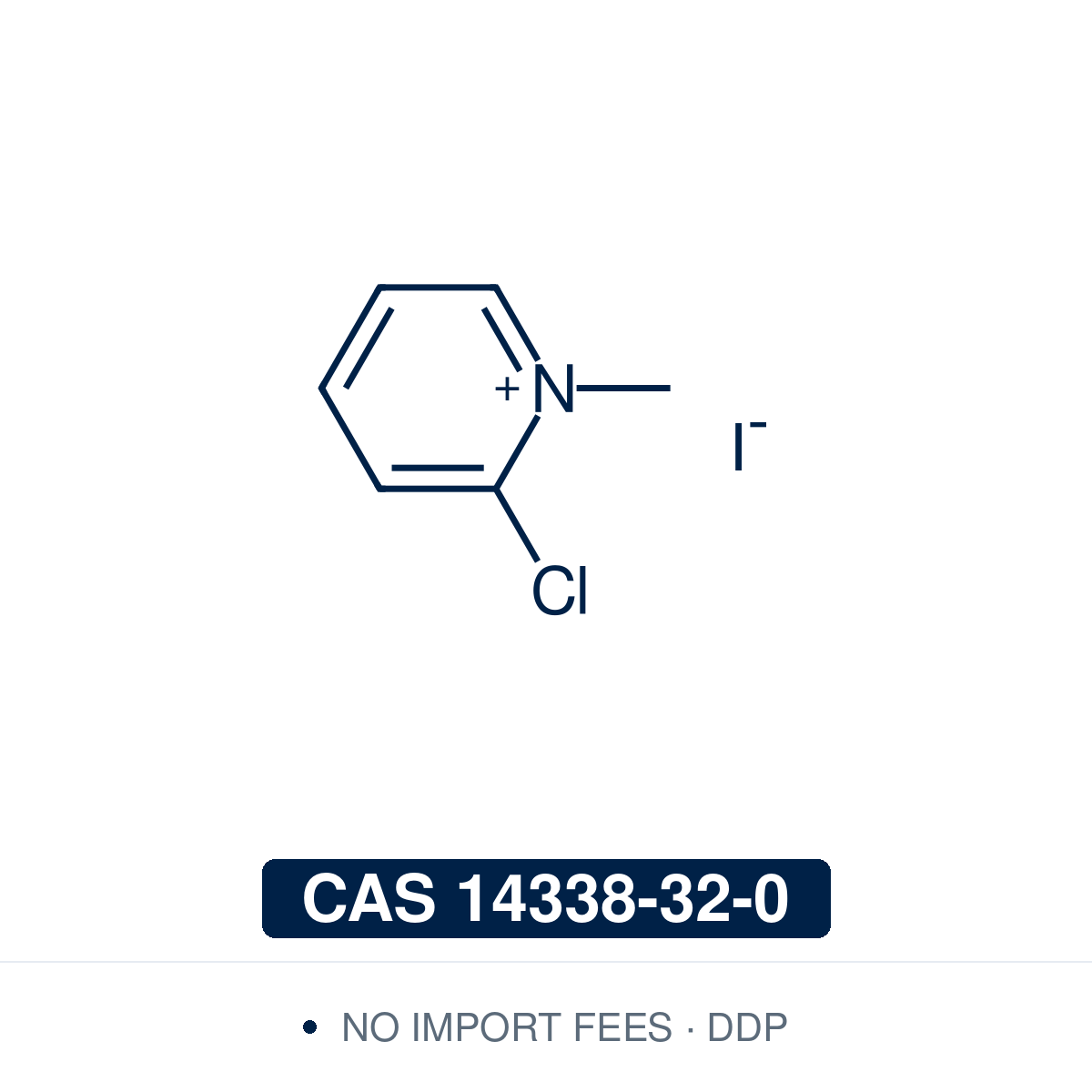
Mukaiyama's reagent (CMPI)
Mukaiyama's reagent (CMPI) | CAS 14338-32-0 | ≥95%
Pack sizes & prices
| Pack size | Excl. VAT | Incl. VAT | Add to cart |
|---|---|---|---|
| 10 g | €69,20 | ||
| 25 g | €89,20 | ||
| 100 g | €239,20 | ||
| 500 g | €1.149,00 |
Taxes and fees, e.g. VAT, included in the price. Shipping calculated at checkout.Free shipping on EU, UK and EFTA orders above €250, and above €400 to the rest of the world.
Technical Specifications
| CAS Number | 14338-32-0 |
| EC / EINECS Number | 238-288-7 |
| MDL Number | MFCD00011984 |
| SMILES | C[N+]1=CC=CC=C1Cl.[I-] |
| InChI | InChI=1S/C6H7ClN.HI/c1-8-5-3-2-4-6(8)7;/h2-5H,1H3;1H/q+1;/p-1 |
| InChIKey | ABFPKTQEQNICFT-UHFFFAOYSA-M |
| PubChem CID | 167069 |
| Molecular Formula | C₆H₇ClIN |
| Molecular Weight | 255.48 g/mol |
| Melting Point | 204–206 °C |
| Solubility | Soluble in dichloromethane, tetrahydrofuran and acetonitrile. |
| Purity | ≥95% |
| Physical Form | Light yellow to amber to dark green powder to crystal |
| HS Code | 2933.39 |
| Shelf Life | Retest period: 36 months from date of manufacture |
| Storage Conditions | Store at room temperature in a tightly sealed container, protected from moisture |
Product Description & Scientific Applications
Mukaiyama's reagent, 2-chloro-1-methylpyridinium iodide or CMPI (C6H7ClIN, 255.48 g/mol), is a dehydrative condensation reagent. It works as an oxygen sink, converting a carboxylic acid's poor hydroxyl leaving group into a good one by nucleophilic addition–elimination. It is consumed rather than turned over: the pyridine leaves with the oxygen, so the reagent is used above one equivalent, not catalytically.
The practical advantage over carbodiimides is the byproduct. N-Methylpyridine-2(1H)-thione is soluble and removed by chromatography, where the ureas and thioureas that carbodiimides leave behind are not.
Applications and Reactions
- Esterification: with triethylamine it esterifies hindered carboxylic acids smoothly, where DCC/DMAP is hampered by a difficult separation. For transesterification, CMPI combined with 4-DMAP is a prerequisite for conversion.
- Amide bond formation: with DIPEA in dry dichloromethane it couples carboxylic acids to anilino derivatives; at 100 °C with DIPEA it gives amides in 56–62% yield.
- N-Acyl sulfonamides: formed directly from carboxylic acids and sulfonamides, a coupling that failed with EDC.
- Peptide coupling: a dipeptide acid coupled to N-Me-Ala-OtBu gives the tripeptide in 47% over three steps.
- Macrocyclisation: at 0.00014 M it closes a macrocyclic peptidomimetic, 61% over three steps including Fmoc deprotection. Where other lactonisation conditions failed to give useful yields, switching to CMPI delivered the macrolactone in 64% over two steps.
- β-Lactams: with triethylamine in refluxing acetonitrile at high dilution, 65–71% yield with the intermolecular reaction suppressed. Through ketene generation, CMPI and triethylamine activate phthalimidoacetic acid in dichloromethane at 0 to −5 °C; adding the imine and stirring overnight gives cis- and trans-3-phthalimido β-lactams in about 2:1 ratio. With sorbic acid and tripropylamine, azetidinones in 16–55%.
- Five-membered heterocycles: as a promoter with CS2 or CO2 it gives imidazolidin-2-ones, oxazolidin-2-ones, 1,3-dioxolan-2-ones and their thione analogues.
- Peptide–nucleotide conjugation: under visible light at 400 or 420–430 nm it drives desulfurative modification of peptides and proteins with nucleotides, generating configurationally stable alanyl radicals and avoiding the side effects of UVA irradiation.
- Biomaterial crosslinking: it forms intra- and intermolecular ester bonds between the carboxyl and hydroxyl groups of hyaluronic acid, giving films with higher crosslink density and better hydrolytic resistance than EDC-crosslinked films.
- Stoichiometry: above one equivalent is required, but excess is counterproductive. Raising it from 2.4 to 3.6 mmol per 2 mmol of amino acid dropped the ester yield from 77% to 25%.
- Storage: room temperature in a tightly sealed container, protected from moisture.
Shipping Destinations
- EU & UK: Priority delivery, 2–5 business days.
- United States (DDP): 3–7 business days, duties and taxes prepaid.
- EFTA Countries (DDP): 3–7 business days, duties and taxes prepaid.
- Worldwide: 7–14 business days, selected locations.
Safety Information
| Hazard Class | Not classified as dangerous goods |
| Transport Category | Not dangerous goods (ADR/IATA/IMDG) |
Documentation
| Safety Data Sheet | Download PDF |
Share