NorrChemica™
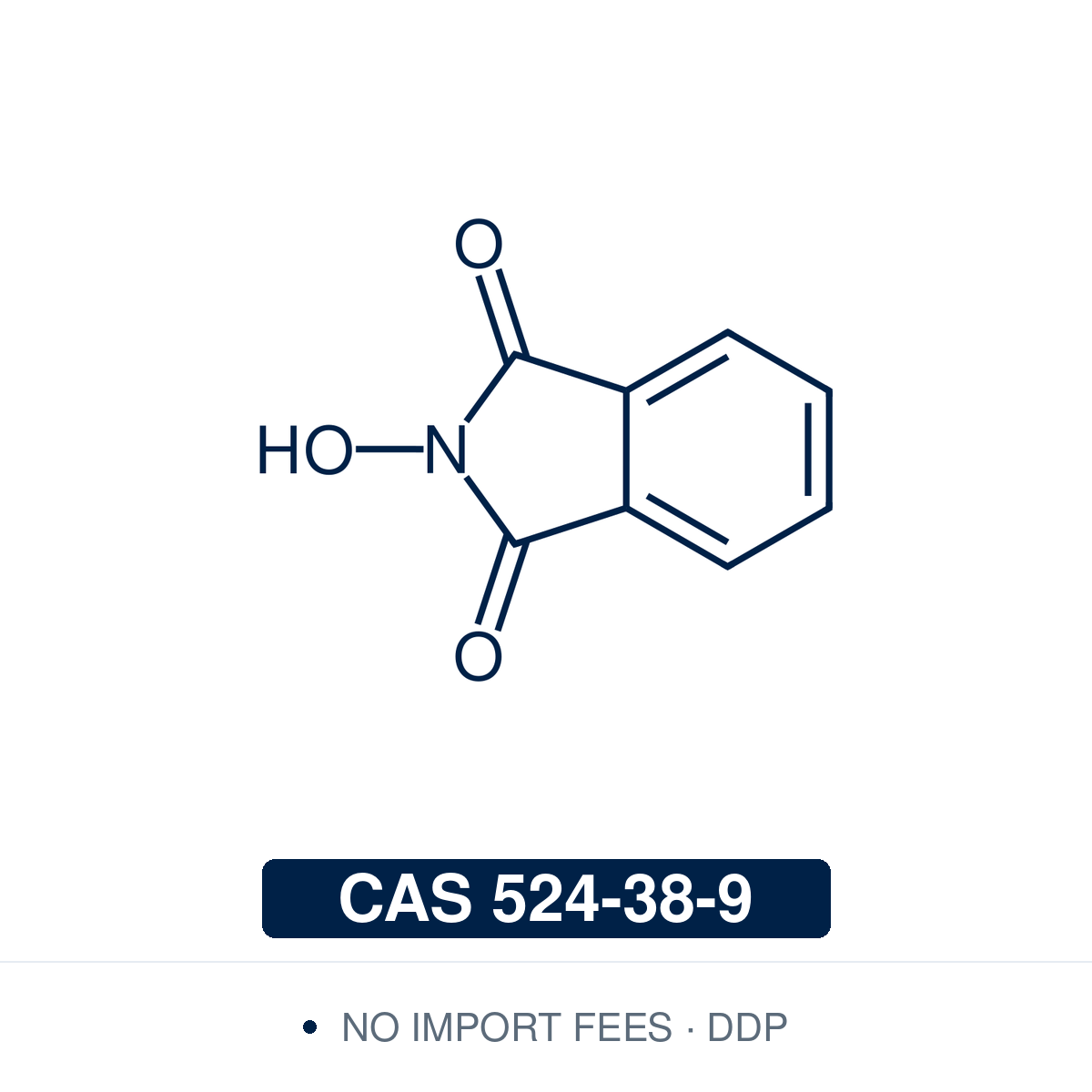
N-Hydroxyphthalimide (NHPI)
N-Hydroxyphthalimide (NHPI) | CAS 524-38-9 | ≥98%
Couldn't load pickup availability
Technical Specifications
| CAS Number | 524-38-9 |
| EC / EINECS Number | 208-358-1 |
| MDL Number | MFCD00005891 |
| RTECS Number | TI5200000 |
| SMILES | C1=CC=C2C(=C1)C(=O)N(C2=O)O |
| InChI | InChI=1S/C8H5NO3/c10-7-5-3-1-2-4-6(5)8(11)9(7)12/h1-4,12H |
| InChIKey | CFMZSMGAMPBRBE-UHFFFAOYSA-N |
| PubChem CID | 10665 |
| Molecular Formula | C₈H₅NO₃ |
| Molecular Weight | 163.13 g/mol |
| Melting Point | 233 °C (dec.) |
| Solubility | Slightly soluble in water; soluble in polar organic solvents (DMF, DMSO, acetonitrile, ethanol, acetic acid). |
| Purity | ≥98% |
| Physical Form | White crystalline solid |
| HS Code | 2925.19 |
| Shelf Life | Retest period: 36 months from date of manufacture |
| Storage Conditions | Store in a cool, dry place in a tightly sealed container |
Product Description & Scientific Applications
N-Hydroxyphthalimide (NHPI) is polar and poorly soluble in non-polar media, so oxidation protocols generally use polar co-solvents; the phthalimide-N-oxyl (PINO) radical derived from it self-decomposes by a first-order path that becomes significant above 80 °C, favouring low-temperature activation.
Mechanistic basis
NHPI supports three distinct roles, each rooted in its N–OH group.
As a hydrogen-atom-transfer (HAT) catalyst, NHPI is oxidised in situ to PINO, whose generation from NHPI under O₂ was confirmed by ESR in 1995. PINO abstracts a hydrogen atom from an activated C–H bond, regenerating NHPI and forming a carbon radical; that radical adds O₂ to give a peroxyl radical, which a second NHPI molecule traps to yield a hydroperoxide and a fresh PINO. The O–H bond dissociation enthalpy (ΔH) of NHPI is 88.1 kcal/mol in acetonitrile — about 18 kcal/mol above that of TEMPO–H — placing hydrogen abstraction by PINO near thermoneutrality for many substrates. PINO abstracts hydrogen faster than a generic peroxyl radical owing to its greater electrophilic character, and NHPI re-traps peroxyl radicals with a rate constant of 7.2 × 10³ M⁻¹ s⁻¹, sustaining the chain. PINO is also generated electrochemically, its base-promoted formation proceeding by multiple-site concerted proton–electron transfer.
As a radical precursor, NHPI is esterified with a carboxylic acid to give a redox-active N-acyloxyphthalimide ester; single-electron reduction expels CO₂ and phthalimide to release an alkyl radical, converting the acid into an alkyl-halide surrogate.
As a hydroxylamine synthon, the acidic N–OH is O-alkylated — by the Mitsunobu reaction or an alkyl halide with base — to N-alkoxyphthalimides, which are cleaved by hydrazinolysis or aminolysis.
Applications and Reactions
- Aerobic C–H oxidation. With O₂ and an initiator or metal co-catalyst (Mn, Co, Cu, V, Fe), NHPI oxidises alkanes, alkylaromatics, alcohols, ethers, amines, amides, and silanes, and — via an in-situ peracid from an aldehyde/O₂ system — epoxidises alkenes. Industrial examples include adamantane to adamantanols, cyclohexane to adipic acid, and cumene and cyclohexylbenzene to hydroperoxides en route to phenol.
- Metal-free and photochemical oxidation. PINO can be generated without metal salts — via aldehydes, quinones, or photochemical initiation — enabling oxidation under milder conditions.
- C(sp³)–N bond formation. Under PINO-mediated HAT, activated C–H bonds react with dialkyl azodicarboxylates to give hydrazine derivatives.
- Decarboxylative C–C coupling. Redox-active NHPI esters couple with organozinc or organomagnesium reagents under nickel or iron catalysis, and with boronic acids or aryl and heteroaryl halides under nickel catalysis, building C(sp³)–C(sp²) bonds directly from alkyl carboxylic acids.
- Decarboxylative borylation. The same esters convert carboxylic acids to alkyl boronate esters — and thence boronic acids — under nickel, copper, or photochemical conditions.
- Giese addition and Barton reduction. Nickel-catalysed fragmentation of the esters traps the alkyl radical with an electron-deficient olefin (Giese conjugate addition) or a hydrogen-atom donor such as PhSiH₃ (Barton-type reductive decarboxylation).
- O-Alkylhydroxylamine synthesis. The route delivers primary and secondary O-alkylhydroxylamines — aminooxy building blocks and precursors to oxime ethers.
Shipping Destinations
- EU & UK: Priority delivery, 2–5 business days.
- United States (DDP): 3–7 business days, duties and taxes prepaid.
- EFTA Countries (DDP): 3–7 business days, duties and taxes prepaid.
- Worldwide: 7–14 business days, selected locations.
Safety Information
| Hazard Class | Not regulated for transport |
| Transport Category | Not classified as dangerous goods for transport (ADR/IATA/IMDG) |
Documentation
| Safety Data Sheet | Download PDF |
Share